

2.6 Calculation of Enthalpy Changes of Processes without Chemical Reactions
85
273.15
Step 2: Reversible process
Irreversible process
Liquid
T/K
Solid
Process 1: Heating of supercooled liquid
Process 3: Cooling of solid
258.15
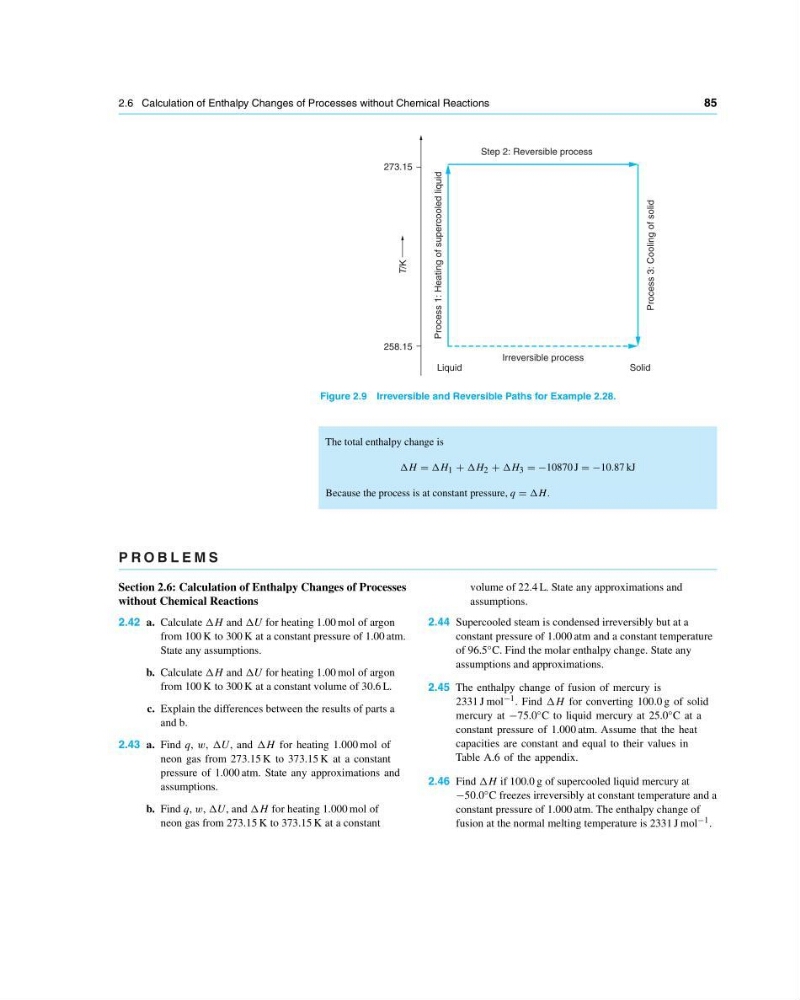
Figure 2.9 Irreversible and Reversible Paths for Example 2.28.
The total enthalpy change is
∆H ∆H 1 + ∆H 2 + ∆H 3 −10870 J −10.87 kJ
Because the process is at constant pressure, q ∆H.
P R O B L E M S
Section 2.6: Calculation of Enthalpy Changes of Processes
without Chemical Reactions
2.42 a. Calculate ∆H and ∆U for heating 1.00 mol of argon
from 100 K to 300 K at a constant pressure of 1.00 atm.
State any assumptions.
b. Calculate ∆H and ∆U for heating 1.00 mol of argon
from 100 K to 300 K at a constant volume of 30.6 L.
c. Explain the differences between the results of parts a
and b.
2.43 a. Find q, w, ∆U, and ∆H for heating 1.000 mol of
neon gas from 273.15 K to 373.15 K at a constant
pressure of 1.000 atm. State any approximations and
assumptions.
b. Find q, w, ∆U, and ∆H for heating 1.000 mol of
neon gas from 273.15 K to 373.15 K at a constant
volume of 22.4 L. State any approximations and
assumptions.
2.44 Supercooled steam is condensed irreversibly but at a
constant pressure of 1.000 atm and a constant temperature
of 96.5 ◦ C. Find the molar enthalpy change. State any
assumptions and approximations.
2.45 The enthalpy change of fusion of mercury is
2331 J mol −1 . Find ∆H for converting 100.0 g of solid
mercury at −75.0 ◦ C to liquid mercury at 25.0 ◦ C at a
constant pressure of 1.000 atm. Assume that the heat
capacities are constant and equal to their values in
Table A.6 of the appendix.
2.46 Find ∆H if 100.0 g of supercooled liquid mercury at
−50.0 ◦ C freezes irreversibly at constant temperature and a
constant pressure of 1.000 atm. The enthalpy change of
fusion at the normal melting temperature is 2331 J mol −1 .
85
273.15
Step 2: Reversible process
Irreversible process
Liquid
T/K
Solid
Process 1: Heating of supercooled liquid
Process 3: Cooling of solid
258.15
Figure 2.9 Irreversible and Reversible Paths for Example 2.28.
The total enthalpy change is
∆H ∆H 1 + ∆H 2 + ∆H 3 −10870 J −10.87 kJ
Because the process is at constant pressure, q ∆H.
P R O B L E M S
Section 2.6: Calculation of Enthalpy Changes of Processes
without Chemical Reactions
2.42 a. Calculate ∆H and ∆U for heating 1.00 mol of argon
from 100 K to 300 K at a constant pressure of 1.00 atm.
State any assumptions.
b. Calculate ∆H and ∆U for heating 1.00 mol of argon
from 100 K to 300 K at a constant volume of 30.6 L.
c. Explain the differences between the results of parts a
and b.
2.43 a. Find q, w, ∆U, and ∆H for heating 1.000 mol of
neon gas from 273.15 K to 373.15 K at a constant
pressure of 1.000 atm. State any approximations and
assumptions.
b. Find q, w, ∆U, and ∆H for heating 1.000 mol of
neon gas from 273.15 K to 373.15 K at a constant
volume of 22.4 L. State any approximations and
assumptions.
2.44 Supercooled steam is condensed irreversibly but at a
constant pressure of 1.000 atm and a constant temperature
of 96.5 ◦ C. Find the molar enthalpy change. State any
assumptions and approximations.
2.45 The enthalpy change of fusion of mercury is
2331 J mol −1 . Find ∆H for converting 100.0 g of solid
mercury at −75.0 ◦ C to liquid mercury at 25.0 ◦ C at a
constant pressure of 1.000 atm. Assume that the heat
capacities are constant and equal to their values in
Table A.6 of the appendix.
2.46 Find ∆H if 100.0 g of supercooled liquid mercury at
−50.0 ◦ C freezes irreversibly at constant temperature and a
constant pressure of 1.000 atm. The enthalpy change of
fusion at the normal melting temperature is 2331 J mol −1 .