

2.6 Calculation of Enthalpy Changes of Processes without Chemical Reactions
83
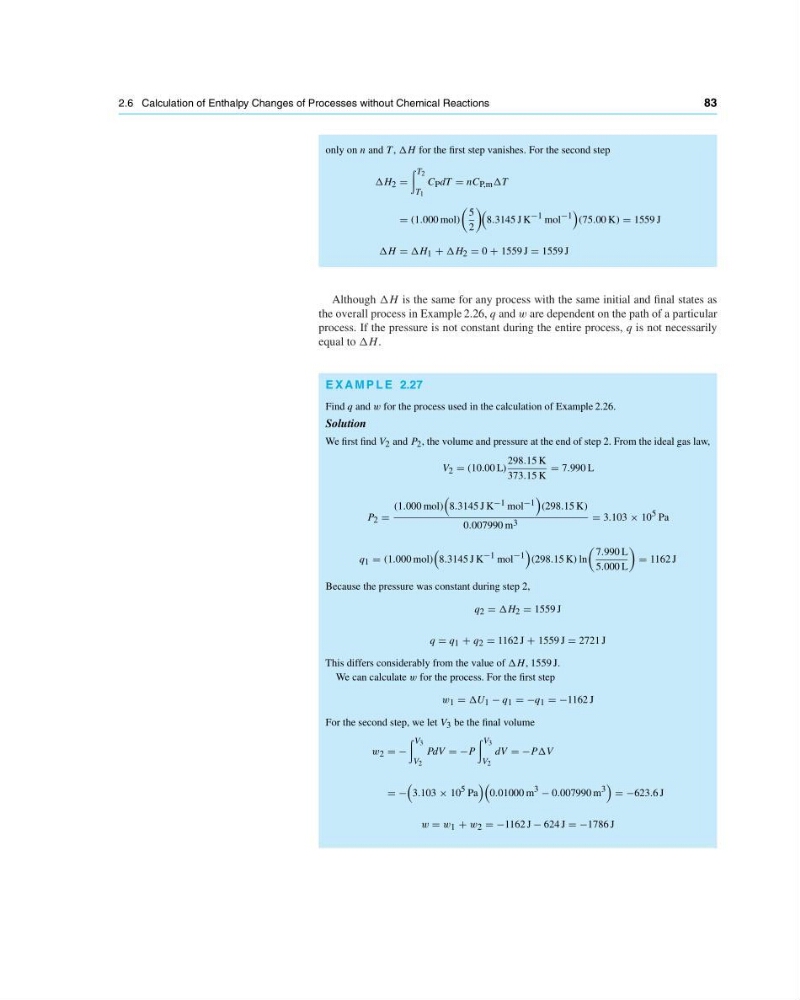
only on n and T , ∆H for the first step vanishes. For the second step
∆H 2
T 2
T 1
C P dT nC P,m ∆T
(1.000 mol)
5
2
8.3145 J K −1 mol −1
(75.00 K) 1559 J
∆H ∆H 1 + ∆H 2 0 + 1559 J 1559 J
Although ∆H is the same for any process with the same initial and final states as
the overall process in Example 2.26, q and w are dependent on the path of a particular
process. If the pressure is not constant during the entire process, q is not necessarily
equal to ∆H.
E X A M P L E 2.27
Find q and w for the process used in the calculation of Example 2.26.
Solution
We first find V 2 and P 2 , the volume and pressure at the end of step 2. From the ideal gas law,
V 2 (10.00 L)
298.15 K
373.15 K
7.990 L
P 2
(1.000 mol)
8.3145 J K −1 mol −1
(298.15 K)
0.007990 m 3
3.103 × 10 5 Pa
q 1 (1.000 mol)
8.3145 J K −1 mol −1
(298.15 K) ln
7.990 L
5.000 L
1162 J
Because the pressure was constant during step 2,
q 2 ∆H 2 1559 J
q q 1 + q 2 1162 J + 1559 J 2721 J
This differs considerably from the value of ∆H, 1559 J.
We can calculate w for the process. For the first step
w 1 ∆U 1 − q 1 −q 1 −1162 J
For the second step, we let V 3 be the final volume
w 2 −
V 3
V 2
PdV −P
V 3
V 2
dV −P∆V
−
3.103 × 10 5 Pa
0.01000 m 3 − 0.007990 m 3
−623.6 J
w w 1 + w 2 −1162 J − 624 J −1786 J
83
only on n and T , ∆H for the first step vanishes. For the second step
∆H 2
T 2
T 1
C P dT nC P,m ∆T
(1.000 mol)
5
2
8.3145 J K −1 mol −1
(75.00 K) 1559 J
∆H ∆H 1 + ∆H 2 0 + 1559 J 1559 J
Although ∆H is the same for any process with the same initial and final states as
the overall process in Example 2.26, q and w are dependent on the path of a particular
process. If the pressure is not constant during the entire process, q is not necessarily
equal to ∆H.
E X A M P L E 2.27
Find q and w for the process used in the calculation of Example 2.26.
Solution
We first find V 2 and P 2 , the volume and pressure at the end of step 2. From the ideal gas law,
V 2 (10.00 L)
298.15 K
373.15 K
7.990 L
P 2
(1.000 mol)
8.3145 J K −1 mol −1
(298.15 K)
0.007990 m 3
3.103 × 10 5 Pa
q 1 (1.000 mol)
8.3145 J K −1 mol −1
(298.15 K) ln
7.990 L
5.000 L
1162 J
Because the pressure was constant during step 2,
q 2 ∆H 2 1559 J
q q 1 + q 2 1162 J + 1559 J 2721 J
This differs considerably from the value of ∆H, 1559 J.
We can calculate w for the process. For the first step
w 1 ∆U 1 − q 1 −q 1 −1162 J
For the second step, we let V 3 be the final volume
w 2 −
V 3
V 2
PdV −P
V 3
V 2
dV −P∆V
−
3.103 × 10 5 Pa
0.01000 m 3 − 0.007990 m 3
−623.6 J
w w 1 + w 2 −1162 J − 624 J −1786 J