

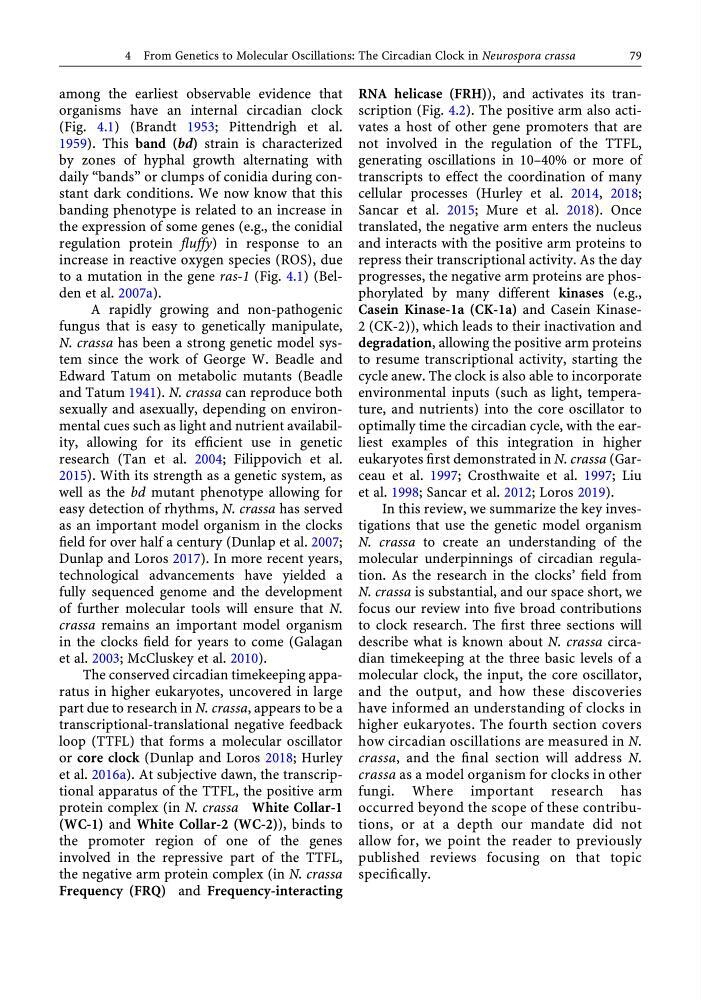
among the earliest observable evidence that
organisms have an internal circadian clock
(Fig. 4.1) (Brandt 1953; Pittendrigh et al.
1959). This band (bd) strain is characterized
by zones of hyphal growth alternating with
daily “bands” or clumps of conidia during constant dark conditions. We now know that this
banding phenotype is related to an increase in
the expression of some genes (e.g., the conidial
regulation protein fluffy) in response to an
increase in reactive oxygen species (ROS), due
to a mutation in the gene ras-1 (Fig. 4.1) (Belden et al. 2007a).
A rapidly growing and non-pathogenic
fungus that is easy to genetically manipulate,
N. crassa has been a strong genetic model system since the work of George W. Beadle and
Edward Tatum on metabolic mutants (Beadle
and Tatum 1941). N. crassa can reproduce both
sexually and asexually, depending on environmental cues such as light and nutrient availability, allowing for its efficient use in genetic
research (Tan et al. 2004; Filippovich et al.
2015). With its strength as a genetic system, as
well as the bd mutant phenotype allowing for
easy detection of rhythms, N. crassa has served
as an important model organism in the clocks
field for over half a century (Dunlap et al. 2007;
Dunlap and Loros 2017). In more recent years,
technological advancements have yielded a
fully sequenced genome and the development
of further molecular tools will ensure that N.
crassa remains an important model organism
in the clocks field for years to come (Galagan
et al. 2003; McCluskey et al. 2010).
The conserved circadian timekeeping apparatus in higher eukaryotes, uncovered in large
part due to research in N. crassa, appears to be a
transcriptional-translational negative feedback
loop (TTFL) that forms a molecular oscillator
or core clock (Dunlap and Loros 2018; Hurley
et al. 2016a). At subjective dawn, the transcriptional apparatus of the TTFL, the positive arm
protein complex (in N. crassa White Collar-1
(WC-1) and White Collar-2 (WC-2)), binds to
the promoter region of one of the genes
involved in the repressive part of the TTFL,
the negative arm protein complex (in N. crassa
Frequency (FRQ) and Frequency-interacting
RNA helicase (FRH)), and activates its transcription (Fig. 4.2). The positive arm also activates a host of other gene promoters that are
not involved in the regulation of the TTFL,
generating oscillations in 10–40% or more of
transcripts to effect the coordination of many
cellular processes (Hurley et al. 2014, 2018;
Sancar et al. 2015; Mure et al. 2018). Once
translated, the negative arm enters the nucleus
and interacts with the positive arm proteins to
repress their transcriptional activity. As the day
progresses, the negative arm proteins are phosphorylated by many different kinases (e.g.,
Casein Kinase-1a (CK-1a) and Casein Kinase2 (CK-2)), which leads to their inactivation and
degradation, allowing the positive arm proteins
to resume transcriptional activity, starting the
cycle anew. The clock is also able to incorporate
environmental inputs (such as light, temperature, and nutrients) into the core oscillator to
optimally time the circadian cycle, with the earliest examples of this integration in higher
eukaryotes first demonstrated in N. crassa (Garceau et al. 1997; Crosthwaite et al. 1997; Liu
et al. 1998; Sancar et al. 2012; Loros 2019).
In this review, we summarize the key investigations that use the genetic model organism
N. crassa to create an understanding of the
molecular underpinnings of circadian regulation. As the research in the clocks’ field from
N. crassa is substantial, and our space short, we
focus our review into five broad contributions
to clock research. The first three sections will
describe what is known about N. crassa circadian timekeeping at the three basic levels of a
molecular clock, the input, the core oscillator,
and the output, and how these discoveries
have informed an understanding of clocks in
higher eukaryotes. The fourth section covers
how circadian oscillations are measured in N.
crassa, and the final section will address N.
crassa as a model organism for clocks in other
fungi. Where important research has
occurred beyond the scope of these contributions, or at a depth our mandate did not
allow for, we point the reader to previously
published reviews focusing on that topic
specifically.
4 From Genetics to Molecular Oscillations: The Circadian Clock in Neurospora crassa
79
organisms have an internal circadian clock
(Fig. 4.1) (Brandt 1953; Pittendrigh et al.
1959). This band (bd) strain is characterized
by zones of hyphal growth alternating with
daily “bands” or clumps of conidia during constant dark conditions. We now know that this
banding phenotype is related to an increase in
the expression of some genes (e.g., the conidial
regulation protein fluffy) in response to an
increase in reactive oxygen species (ROS), due
to a mutation in the gene ras-1 (Fig. 4.1) (Belden et al. 2007a).
A rapidly growing and non-pathogenic
fungus that is easy to genetically manipulate,
N. crassa has been a strong genetic model system since the work of George W. Beadle and
Edward Tatum on metabolic mutants (Beadle
and Tatum 1941). N. crassa can reproduce both
sexually and asexually, depending on environmental cues such as light and nutrient availability, allowing for its efficient use in genetic
research (Tan et al. 2004; Filippovich et al.
2015). With its strength as a genetic system, as
well as the bd mutant phenotype allowing for
easy detection of rhythms, N. crassa has served
as an important model organism in the clocks
field for over half a century (Dunlap et al. 2007;
Dunlap and Loros 2017). In more recent years,
technological advancements have yielded a
fully sequenced genome and the development
of further molecular tools will ensure that N.
crassa remains an important model organism
in the clocks field for years to come (Galagan
et al. 2003; McCluskey et al. 2010).
The conserved circadian timekeeping apparatus in higher eukaryotes, uncovered in large
part due to research in N. crassa, appears to be a
transcriptional-translational negative feedback
loop (TTFL) that forms a molecular oscillator
or core clock (Dunlap and Loros 2018; Hurley
et al. 2016a). At subjective dawn, the transcriptional apparatus of the TTFL, the positive arm
protein complex (in N. crassa White Collar-1
(WC-1) and White Collar-2 (WC-2)), binds to
the promoter region of one of the genes
involved in the repressive part of the TTFL,
the negative arm protein complex (in N. crassa
Frequency (FRQ) and Frequency-interacting
RNA helicase (FRH)), and activates its transcription (Fig. 4.2). The positive arm also activates a host of other gene promoters that are
not involved in the regulation of the TTFL,
generating oscillations in 10–40% or more of
transcripts to effect the coordination of many
cellular processes (Hurley et al. 2014, 2018;
Sancar et al. 2015; Mure et al. 2018). Once
translated, the negative arm enters the nucleus
and interacts with the positive arm proteins to
repress their transcriptional activity. As the day
progresses, the negative arm proteins are phosphorylated by many different kinases (e.g.,
Casein Kinase-1a (CK-1a) and Casein Kinase2 (CK-2)), which leads to their inactivation and
degradation, allowing the positive arm proteins
to resume transcriptional activity, starting the
cycle anew. The clock is also able to incorporate
environmental inputs (such as light, temperature, and nutrients) into the core oscillator to
optimally time the circadian cycle, with the earliest examples of this integration in higher
eukaryotes first demonstrated in N. crassa (Garceau et al. 1997; Crosthwaite et al. 1997; Liu
et al. 1998; Sancar et al. 2012; Loros 2019).
In this review, we summarize the key investigations that use the genetic model organism
N. crassa to create an understanding of the
molecular underpinnings of circadian regulation. As the research in the clocks’ field from
N. crassa is substantial, and our space short, we
focus our review into five broad contributions
to clock research. The first three sections will
describe what is known about N. crassa circadian timekeeping at the three basic levels of a
molecular clock, the input, the core oscillator,
and the output, and how these discoveries
have informed an understanding of clocks in
higher eukaryotes. The fourth section covers
how circadian oscillations are measured in N.
crassa, and the final section will address N.
crassa as a model organism for clocks in other
fungi. Where important research has
occurred beyond the scope of these contributions, or at a depth our mandate did not
allow for, we point the reader to previously
published reviews focusing on that topic
specifically.
4 From Genetics to Molecular Oscillations: The Circadian Clock in Neurospora crassa
79