

phosphorylation is required for deoligomerisation during recovery from ER stress
(Chawla et al. 2011; Rubio et al. 2011).
2. Ire1-Mediated Unconventional Splicing
The overall domain structure and the functional requirement of Ire1 for ER stress resistance is conserved among eukaryotes. In most
fungi, and in contrast to higher eukaryotes (see
also B. 3), the sole and specific target of Ire1dependent endonucleolytic cleavage is the
HAC1 mRNA (Kimata et al. 2007; Korennykh
et al. 2009; Li et al. 2010; Oikawa et al. 2007;
Sidrauski and Walter 1997). The HAC1 mRNA
is constitutively expressed and exhibits a conserved secondary structure in which two hairpin stem-loops are recognized and cleaved by
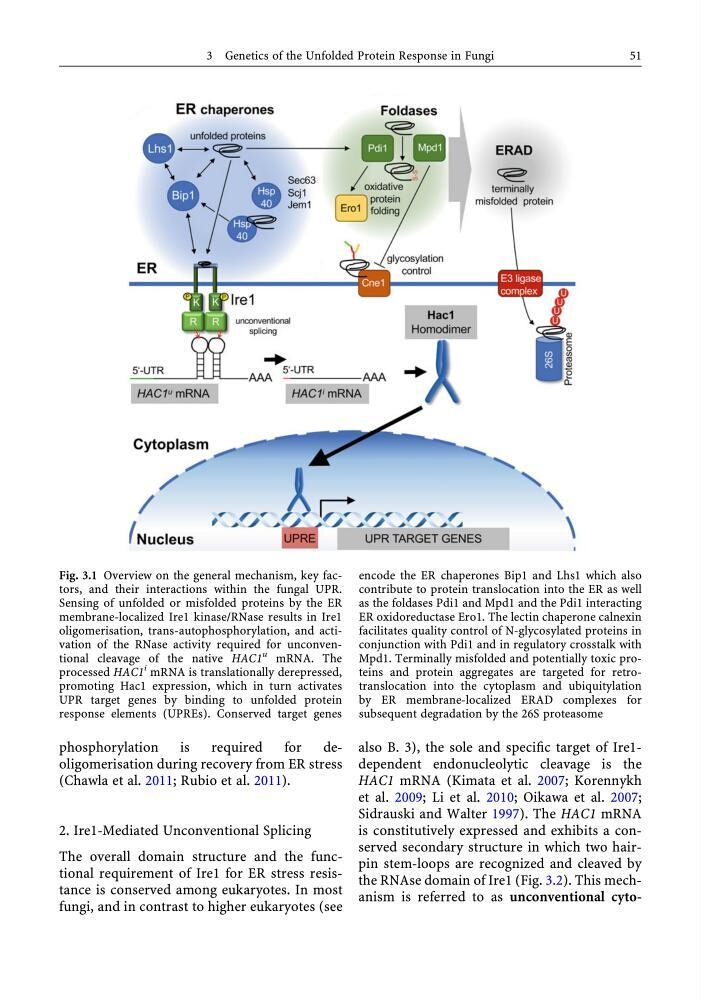
the RNAse domain of Ire1 (Fig. 3.2). This mechanism is referred to as unconventional cytoFig. 3.1 Overview on the general mechanism, key factors, and their interactions within the fungal UPR.
Sensing of unfolded or misfolded proteins by the ER
membrane-localized Ire1 kinase/RNase results in Ire1
oligomerisation, trans-autophosphorylation, and activation of the RNase activity required for unconventional cleavage of the native HAC1
u mRNA. The
processed HAC1
i mRNA is translationally derepressed,
promoting Hac1 expression, which in turn activates
UPR target genes by binding to unfolded protein
response elements (UPREs). Conserved target genes
encode the ER chaperones Bip1 and Lhs1 which also
contribute to protein translocation into the ER as well
as the foldases Pdi1 and Mpd1 and the Pdi1 interacting
ER oxidoreductase Ero1. The lectin chaperone calnexin
facilitates quality control of N-glycosylated proteins in
conjunction with Pdi1 and in regulatory crosstalk with
Mpd1. Terminally misfolded and potentially toxic proteins and protein aggregates are targeted for retrotranslocation into the cytoplasm and ubiquitylation
by ER membrane-localized ERAD complexes for
subsequent degradation by the 26S proteasome
3 Genetics of the Unfolded Protein Response in Fungi
51
(Chawla et al. 2011; Rubio et al. 2011).
2. Ire1-Mediated Unconventional Splicing
The overall domain structure and the functional requirement of Ire1 for ER stress resistance is conserved among eukaryotes. In most
fungi, and in contrast to higher eukaryotes (see
also B. 3), the sole and specific target of Ire1dependent endonucleolytic cleavage is the
HAC1 mRNA (Kimata et al. 2007; Korennykh
et al. 2009; Li et al. 2010; Oikawa et al. 2007;
Sidrauski and Walter 1997). The HAC1 mRNA
is constitutively expressed and exhibits a conserved secondary structure in which two hairpin stem-loops are recognized and cleaved by
the RNAse domain of Ire1 (Fig. 3.2). This mechanism is referred to as unconventional cytoFig. 3.1 Overview on the general mechanism, key factors, and their interactions within the fungal UPR.
Sensing of unfolded or misfolded proteins by the ER
membrane-localized Ire1 kinase/RNase results in Ire1
oligomerisation, trans-autophosphorylation, and activation of the RNase activity required for unconventional cleavage of the native HAC1
u mRNA. The
processed HAC1
i mRNA is translationally derepressed,
promoting Hac1 expression, which in turn activates
UPR target genes by binding to unfolded protein
response elements (UPREs). Conserved target genes
encode the ER chaperones Bip1 and Lhs1 which also
contribute to protein translocation into the ER as well
as the foldases Pdi1 and Mpd1 and the Pdi1 interacting
ER oxidoreductase Ero1. The lectin chaperone calnexin
facilitates quality control of N-glycosylated proteins in
conjunction with Pdi1 and in regulatory crosstalk with
Mpd1. Terminally misfolded and potentially toxic proteins and protein aggregates are targeted for retrotranslocation into the cytoplasm and ubiquitylation
by ER membrane-localized ERAD complexes for
subsequent degradation by the 26S proteasome
3 Genetics of the Unfolded Protein Response in Fungi
51