

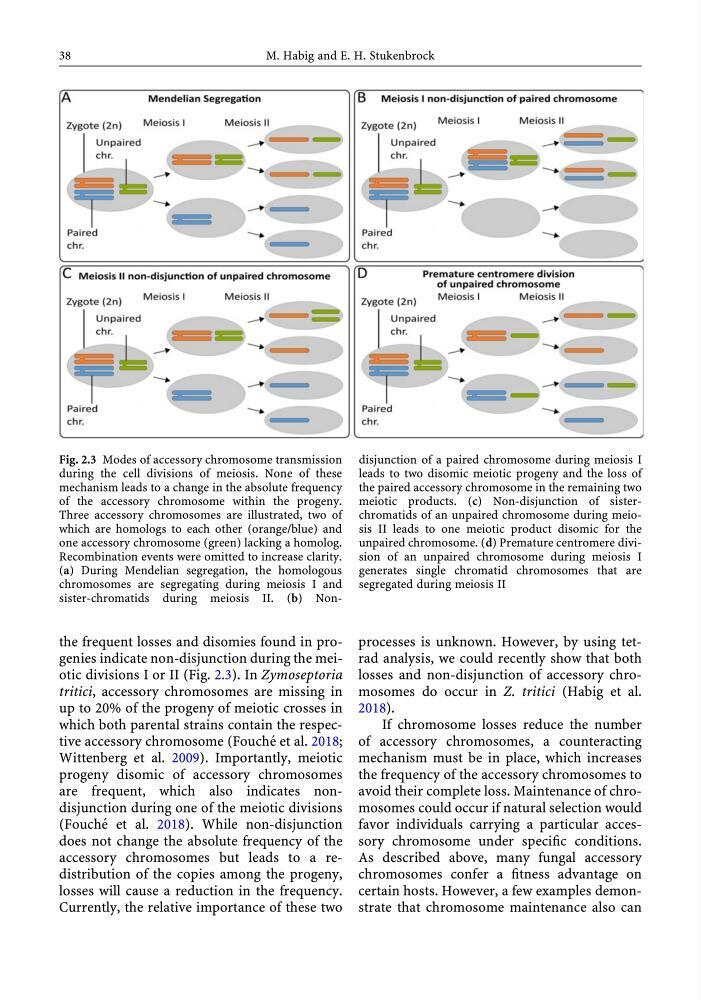
the frequent losses and disomies found in progenies indicate non-disjunction during the meiotic divisions I or II (Fig. 2.3). In Zymoseptoria
tritici, accessory chromosomes are missing in
up to 20% of the progeny of meiotic crosses in
which both parental strains contain the respective accessory chromosome (Fouche ´ et al. 2018;
Wittenberg et al. 2009). Importantly, meiotic
progeny disomic of accessory chromosomes
are frequent, which also indicates nondisjunction during one of the meiotic divisions
(Fouche ´ et al. 2018). While non-disjunction
does not change the absolute frequency of the
accessory chromosomes but leads to a redistribution of the copies among the progeny,
losses will cause a reduction in the frequency.
Currently, the relative importance of these two
processes is unknown. However, by using tetrad analysis, we could recently show that both
losses and non-disjunction of accessory chromosomes do occur in Z. tritici (Habig et al.
2018).
If chromosome losses reduce the number
of accessory chromosomes, a counteracting
mechanism must be in place, which increases
the frequency of the accessory chromosomes to
avoid their complete loss. Maintenance of chromosomes could occur if natural selection would
favor individuals carrying a particular accessory chromosome under specific conditions.
As described above, many fungal accessory
chromosomes confer a fitness advantage on
certain hosts. However, a few examples demonstrate that chromosome maintenance also can
Fig. 2.3 Modes of accessory chromosome transmission
during the cell divisions of meiosis. None of these
mechanism leads to a change in the absolute frequency
of the accessory chromosome within the progeny.
Three accessory chromosomes are illustrated, two of
which are homologs to each other (orange/blue) and
one accessory chromosome (green) lacking a homolog.
Recombination events were omitted to increase clarity.
(a) During Mendelian segregation, the homologous
chromosomes are segregating during meiosis I and
sister-chromatids during meiosis II. (b) Nondisjunction of a paired chromosome during meiosis I
leads to two disomic meiotic progeny and the loss of
the paired accessory chromosome in the remaining two
meiotic products. (c) Non-disjunction of sisterchromatids of an unpaired chromosome during meiosis II leads to one meiotic product disomic for the
unpaired chromosome. (d) Premature centromere division of an unpaired chromosome during meiosis I
generates single chromatid chromosomes that are
segregated during meiosis II
38
M. Habig and E. H. Stukenbrock
tritici, accessory chromosomes are missing in
up to 20% of the progeny of meiotic crosses in
which both parental strains contain the respective accessory chromosome (Fouche ´ et al. 2018;
Wittenberg et al. 2009). Importantly, meiotic
progeny disomic of accessory chromosomes
are frequent, which also indicates nondisjunction during one of the meiotic divisions
(Fouche ´ et al. 2018). While non-disjunction
does not change the absolute frequency of the
accessory chromosomes but leads to a redistribution of the copies among the progeny,
losses will cause a reduction in the frequency.
Currently, the relative importance of these two
processes is unknown. However, by using tetrad analysis, we could recently show that both
losses and non-disjunction of accessory chromosomes do occur in Z. tritici (Habig et al.
2018).
If chromosome losses reduce the number
of accessory chromosomes, a counteracting
mechanism must be in place, which increases
the frequency of the accessory chromosomes to
avoid their complete loss. Maintenance of chromosomes could occur if natural selection would
favor individuals carrying a particular accessory chromosome under specific conditions.
As described above, many fungal accessory
chromosomes confer a fitness advantage on
certain hosts. However, a few examples demonstrate that chromosome maintenance also can
Fig. 2.3 Modes of accessory chromosome transmission
during the cell divisions of meiosis. None of these
mechanism leads to a change in the absolute frequency
of the accessory chromosome within the progeny.
Three accessory chromosomes are illustrated, two of
which are homologs to each other (orange/blue) and
one accessory chromosome (green) lacking a homolog.
Recombination events were omitted to increase clarity.
(a) During Mendelian segregation, the homologous
chromosomes are segregating during meiosis I and
sister-chromatids during meiosis II. (b) Nondisjunction of a paired chromosome during meiosis I
leads to two disomic meiotic progeny and the loss of
the paired accessory chromosome in the remaining two
meiotic products. (c) Non-disjunction of sisterchromatids of an unpaired chromosome during meiosis II leads to one meiotic product disomic for the
unpaired chromosome. (d) Premature centromere division of an unpaired chromosome during meiosis I
generates single chromatid chromosomes that are
segregated during meiosis II
38
M. Habig and E. H. Stukenbrock