

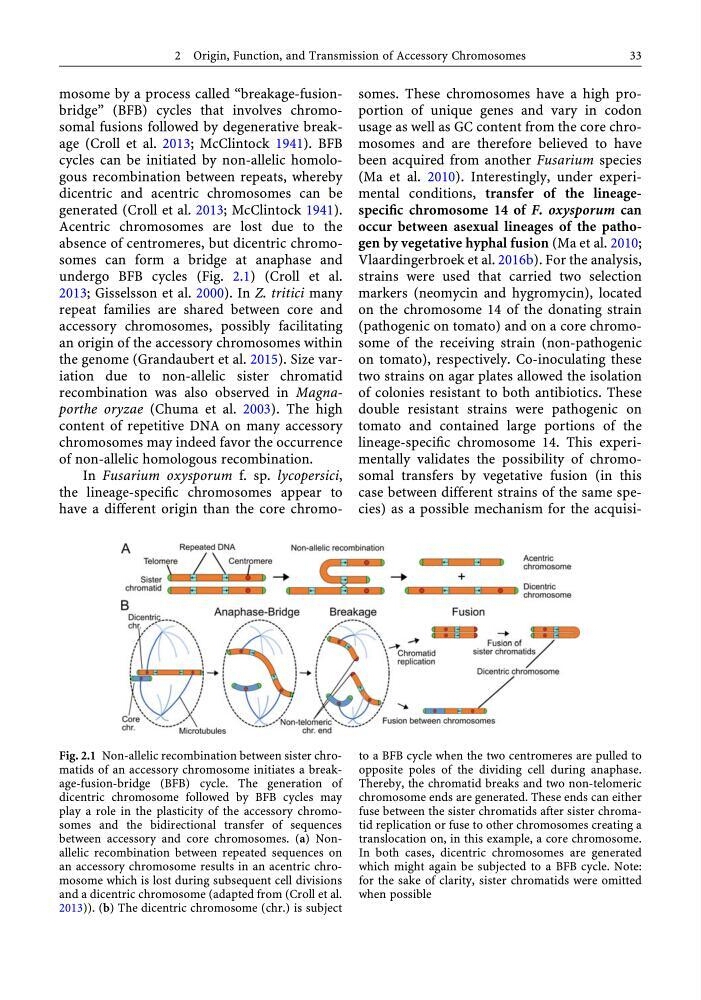
mosome by a process called “breakage-fusionbridge” (BFB) cycles that involves chromosomal fusions followed by degenerative breakage (Croll et al. 2013; McClintock 1941). BFB
cycles can be initiated by non-allelic homologous recombination between repeats, whereby
dicentric and acentric chromosomes can be
generated (Croll et al. 2013; McClintock 1941).
Acentric chromosomes are lost due to the
absence of centromeres, but dicentric chromosomes can form a bridge at anaphase and
undergo BFB cycles (Fig. 2.1) (Croll et al.
2013; Gisselsson et al. 2000). In Z. tritici many
repeat families are shared between core and
accessory chromosomes, possibly facilitating
an origin of the accessory chromosomes within
the genome (Grandaubert et al. 2015). Size variation due to non-allelic sister chromatid
recombination was also observed in Magnaporthe oryzae (Chuma et al. 2003). The high
content of repetitive DNA on many accessory
chromosomes may indeed favor the occurrence
of non-allelic homologous recombination.
In Fusarium oxysporum f. sp. lycopersici,
the lineage-specific chromosomes appear to
have a different origin than the core chromosomes. These chromosomes have a high proportion of unique genes and vary in codon
usage as well as GC content from the core chromosomes and are therefore believed to have
been acquired from another Fusarium species
(Ma et al. 2010). Interestingly, under experimental conditions, transfer of the lineagespecific chromosome 14 of F. oxysporum can
occur between asexual lineages of the pathogen by vegetative hyphal fusion (Ma et al. 2010;
Vlaardingerbroek et al. 2016b). For the analysis,
strains were used that carried two selection
markers (neomycin and hygromycin), located
on the chromosome 14 of the donating strain
(pathogenic on tomato) and on a core chromosome of the receiving strain (non-pathogenic
on tomato), respectively. Co-inoculating these
two strains on agar plates allowed the isolation
of colonies resistant to both antibiotics. These
double resistant strains were pathogenic on
tomato and contained large portions of the
lineage-specific chromosome 14. This experimentally validates the possibility of chromosomal transfers by vegetative fusion (in this
case between different strains of the same species) as a possible mechanism for the acquisiFig. 2.1 Non-allelic recombination between sister chromatids of an accessory chromosome initiates a breakage-fusion-bridge (BFB) cycle. The generation of
dicentric chromosome followed by BFB cycles may
play a role in the plasticity of the accessory chromosomes and the bidirectional transfer of sequences
between accessory and core chromosomes. (a) Nonallelic recombination between repeated sequences on
an accessory chromosome results in an acentric chromosome which is lost during subsequent cell divisions
and a dicentric chromosome (adapted from (Croll et al.
2013)). (b) The dicentric chromosome (chr.) is subject
to a BFB cycle when the two centromeres are pulled to
opposite poles of the dividing cell during anaphase.
Thereby, the chromatid breaks and two non-telomeric
chromosome ends are generated. These ends can either
fuse between the sister chromatids after sister chromatid replication or fuse to other chromosomes creating a
translocation on, in this example, a core chromosome.
In both cases, dicentric chromosomes are generated
which might again be subjected to a BFB cycle. Note:
for the sake of clarity, sister chromatids were omitted
when possible
2 Origin, Function, and Transmission of Accessory Chromosomes
33
cycles can be initiated by non-allelic homologous recombination between repeats, whereby
dicentric and acentric chromosomes can be
generated (Croll et al. 2013; McClintock 1941).
Acentric chromosomes are lost due to the
absence of centromeres, but dicentric chromosomes can form a bridge at anaphase and
undergo BFB cycles (Fig. 2.1) (Croll et al.
2013; Gisselsson et al. 2000). In Z. tritici many
repeat families are shared between core and
accessory chromosomes, possibly facilitating
an origin of the accessory chromosomes within
the genome (Grandaubert et al. 2015). Size variation due to non-allelic sister chromatid
recombination was also observed in Magnaporthe oryzae (Chuma et al. 2003). The high
content of repetitive DNA on many accessory
chromosomes may indeed favor the occurrence
of non-allelic homologous recombination.
In Fusarium oxysporum f. sp. lycopersici,
the lineage-specific chromosomes appear to
have a different origin than the core chromosomes. These chromosomes have a high proportion of unique genes and vary in codon
usage as well as GC content from the core chromosomes and are therefore believed to have
been acquired from another Fusarium species
(Ma et al. 2010). Interestingly, under experimental conditions, transfer of the lineagespecific chromosome 14 of F. oxysporum can
occur between asexual lineages of the pathogen by vegetative hyphal fusion (Ma et al. 2010;
Vlaardingerbroek et al. 2016b). For the analysis,
strains were used that carried two selection
markers (neomycin and hygromycin), located
on the chromosome 14 of the donating strain
(pathogenic on tomato) and on a core chromosome of the receiving strain (non-pathogenic
on tomato), respectively. Co-inoculating these
two strains on agar plates allowed the isolation
of colonies resistant to both antibiotics. These
double resistant strains were pathogenic on
tomato and contained large portions of the
lineage-specific chromosome 14. This experimentally validates the possibility of chromosomal transfers by vegetative fusion (in this
case between different strains of the same species) as a possible mechanism for the acquisiFig. 2.1 Non-allelic recombination between sister chromatids of an accessory chromosome initiates a breakage-fusion-bridge (BFB) cycle. The generation of
dicentric chromosome followed by BFB cycles may
play a role in the plasticity of the accessory chromosomes and the bidirectional transfer of sequences
between accessory and core chromosomes. (a) Nonallelic recombination between repeated sequences on
an accessory chromosome results in an acentric chromosome which is lost during subsequent cell divisions
and a dicentric chromosome (adapted from (Croll et al.
2013)). (b) The dicentric chromosome (chr.) is subject
to a BFB cycle when the two centromeres are pulled to
opposite poles of the dividing cell during anaphase.
Thereby, the chromatid breaks and two non-telomeric
chromosome ends are generated. These ends can either
fuse between the sister chromatids after sister chromatid replication or fuse to other chromosomes creating a
translocation on, in this example, a core chromosome.
In both cases, dicentric chromosomes are generated
which might again be subjected to a BFB cycle. Note:
for the sake of clarity, sister chromatids were omitted
when possible
2 Origin, Function, and Transmission of Accessory Chromosomes
33