

Another important concern regarding the
utilization of anaerobic fungi for biogas production is their short survival time in digesters
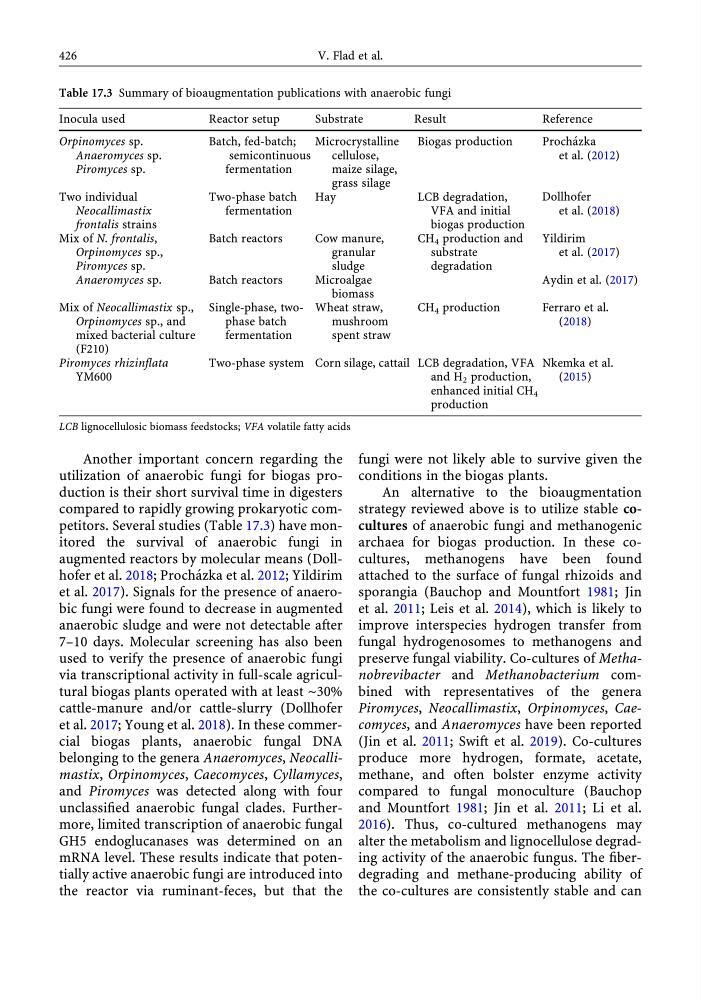
compared to rapidly growing prokaryotic competitors. Several studies (Table 17.3) have monitored the survival of anaerobic fungi in
augmented reactors by molecular means (Dollhofer et al. 2018; Procha ´zka et al. 2012; Yildirim
et al. 2017). Signals for the presence of anaerobic fungi were found to decrease in augmented
anaerobic sludge and were not detectable after
7–10 days. Molecular screening has also been
used to verify the presence of anaerobic fungi
via transcriptional activity in full-scale agricultural biogas plants operated with at least ~30%
cattle-manure and/or cattle-slurry (Dollhofer
et al. 2017; Young et al. 2018). In these commercial biogas plants, anaerobic fungal DNA
belonging to the genera Anaeromyces, Neocallimastix, Orpinomyces, Caecomyces, Cyllamyces,
and Piromyces was detected along with four
unclassified anaerobic fungal clades. Furthermore, limited transcription of anaerobic fungal
GH5 endoglucanases was determined on an
mRNA level. These results indicate that potentially active anaerobic fungi are introduced into
the reactor via ruminant-feces, but that the
fungi were not likely able to survive given the
conditions in the biogas plants.
An alternative to the bioaugmentation
strategy reviewed above is to utilize stable cocultures of anaerobic fungi and methanogenic
archaea for biogas production. In these cocultures, methanogens have been found
attached to the surface of fungal rhizoids and
sporangia (Bauchop and Mountfort 1981; Jin
et al. 2011; Leis et al. 2014), which is likely to
improve interspecies hydrogen transfer from
fungal hydrogenosomes to methanogens and
preserve fungal viability. Co-cultures of Methanobrevibacter and Methanobacterium combined with representatives of the genera
Piromyces, Neocallimastix, Orpinomyces, Caecomyces, and Anaeromyces have been reported
(Jin et al. 2011; Swift et al. 2019). Co-cultures
produce more hydrogen, formate, acetate,
methane, and often bolster enzyme activity
compared to fungal monoculture (Bauchop
and Mountfort 1981; Jin et al. 2011; Li et al.
2016). Thus, co-cultured methanogens may
alter the metabolism and lignocellulose degrading activity of the anaerobic fungus. The fiberdegrading and methane-producing ability of
the co-cultures are consistently stable and can
Table 17.3 Summary of bioaugmentation publications with anaerobic fungi
Inocula used
Reactor setup
Substrate
Result
Reference
Orpinomyces sp.
Anaeromyces sp.
Piromyces sp.
Batch, fed-batch;
semicontinuous
fermentation
Microcrystalline
cellulose,
maize silage,
grass silage
Biogas production
Procha ´zka
et al. (2012)
Two individual
Neocallimastix
frontalis strains
Two-phase batch
fermentation
Hay
LCB degradation,
VFA and initial
biogas production
Dollhofer
et al. (2018)
Mix of N. frontalis,
Orpinomyces sp.,
Piromyces sp.
Anaeromyces sp.
Batch reactors
Cow manure,
granular
sludge
CH 4 production and
substrate
degradation
Yildirim
et al. (2017)
Batch reactors
Microalgae
biomass
Aydin et al. (2017)
Mix of Neocallimastix sp.,
Orpinomyces sp., and
mixed bacterial culture
(F210)
Single-phase, twophase batch
fermentation
Wheat straw,
mushroom
spent straw
CH 4 production
Ferraro et al.
(2018)
Piromyces rhizinflata
YM600
Two-phase system Corn silage, cattail LCB degradation, VFA
and H 2 production,
enhanced initial CH 4
production
Nkemka et al.
(2015)
LCB lignocellulosic biomass feedstocks; VFA volatile fatty acids
426
V. Flad et al.
utilization of anaerobic fungi for biogas production is their short survival time in digesters
compared to rapidly growing prokaryotic competitors. Several studies (Table 17.3) have monitored the survival of anaerobic fungi in
augmented reactors by molecular means (Dollhofer et al. 2018; Procha ´zka et al. 2012; Yildirim
et al. 2017). Signals for the presence of anaerobic fungi were found to decrease in augmented
anaerobic sludge and were not detectable after
7–10 days. Molecular screening has also been
used to verify the presence of anaerobic fungi
via transcriptional activity in full-scale agricultural biogas plants operated with at least ~30%
cattle-manure and/or cattle-slurry (Dollhofer
et al. 2017; Young et al. 2018). In these commercial biogas plants, anaerobic fungal DNA
belonging to the genera Anaeromyces, Neocallimastix, Orpinomyces, Caecomyces, Cyllamyces,
and Piromyces was detected along with four
unclassified anaerobic fungal clades. Furthermore, limited transcription of anaerobic fungal
GH5 endoglucanases was determined on an
mRNA level. These results indicate that potentially active anaerobic fungi are introduced into
the reactor via ruminant-feces, but that the
fungi were not likely able to survive given the
conditions in the biogas plants.
An alternative to the bioaugmentation
strategy reviewed above is to utilize stable cocultures of anaerobic fungi and methanogenic
archaea for biogas production. In these cocultures, methanogens have been found
attached to the surface of fungal rhizoids and
sporangia (Bauchop and Mountfort 1981; Jin
et al. 2011; Leis et al. 2014), which is likely to
improve interspecies hydrogen transfer from
fungal hydrogenosomes to methanogens and
preserve fungal viability. Co-cultures of Methanobrevibacter and Methanobacterium combined with representatives of the genera
Piromyces, Neocallimastix, Orpinomyces, Caecomyces, and Anaeromyces have been reported
(Jin et al. 2011; Swift et al. 2019). Co-cultures
produce more hydrogen, formate, acetate,
methane, and often bolster enzyme activity
compared to fungal monoculture (Bauchop
and Mountfort 1981; Jin et al. 2011; Li et al.
2016). Thus, co-cultured methanogens may
alter the metabolism and lignocellulose degrading activity of the anaerobic fungus. The fiberdegrading and methane-producing ability of
the co-cultures are consistently stable and can
Table 17.3 Summary of bioaugmentation publications with anaerobic fungi
Inocula used
Reactor setup
Substrate
Result
Reference
Orpinomyces sp.
Anaeromyces sp.
Piromyces sp.
Batch, fed-batch;
semicontinuous
fermentation
Microcrystalline
cellulose,
maize silage,
grass silage
Biogas production
Procha ´zka
et al. (2012)
Two individual
Neocallimastix
frontalis strains
Two-phase batch
fermentation
Hay
LCB degradation,
VFA and initial
biogas production
Dollhofer
et al. (2018)
Mix of N. frontalis,
Orpinomyces sp.,
Piromyces sp.
Anaeromyces sp.
Batch reactors
Cow manure,
granular
sludge
CH 4 production and
substrate
degradation
Yildirim
et al. (2017)
Batch reactors
Microalgae
biomass
Aydin et al. (2017)
Mix of Neocallimastix sp.,
Orpinomyces sp., and
mixed bacterial culture
(F210)
Single-phase, twophase batch
fermentation
Wheat straw,
mushroom
spent straw
CH 4 production
Ferraro et al.
(2018)
Piromyces rhizinflata
YM600
Two-phase system Corn silage, cattail LCB degradation, VFA
and H 2 production,
enhanced initial CH 4
production
Nkemka et al.
(2015)
LCB lignocellulosic biomass feedstocks; VFA volatile fatty acids
426
V. Flad et al.