

gal taxa identified in molecular studies are
likely to be difficult to propagate in culture,
either because they are outcompeted by spores
of (terrestrial) fungi also contained in the environmental samples, or alternatively their life
cycle is dependent on a symbiotic interaction
(Del Campo et al. 2014).
B. Availability of Strain Collections
For the optimal and sustainable use of the
marine fungal sources, it is essential to store
the microbial cultures. Culture collections keep
strains available for further investigations and
production processes. Conservation of living
cells while reducing metabolism, e.g., by cryoconservation, is crucial in order to prevent
genetic and phenotypic changes induced by
repeated passaging of the cultures. Culture collections thus play a vital role in the conservation and sustainable use of microbial resources
including fungi (Daniel and Prasad 2010). They
also provide the authentic biological material
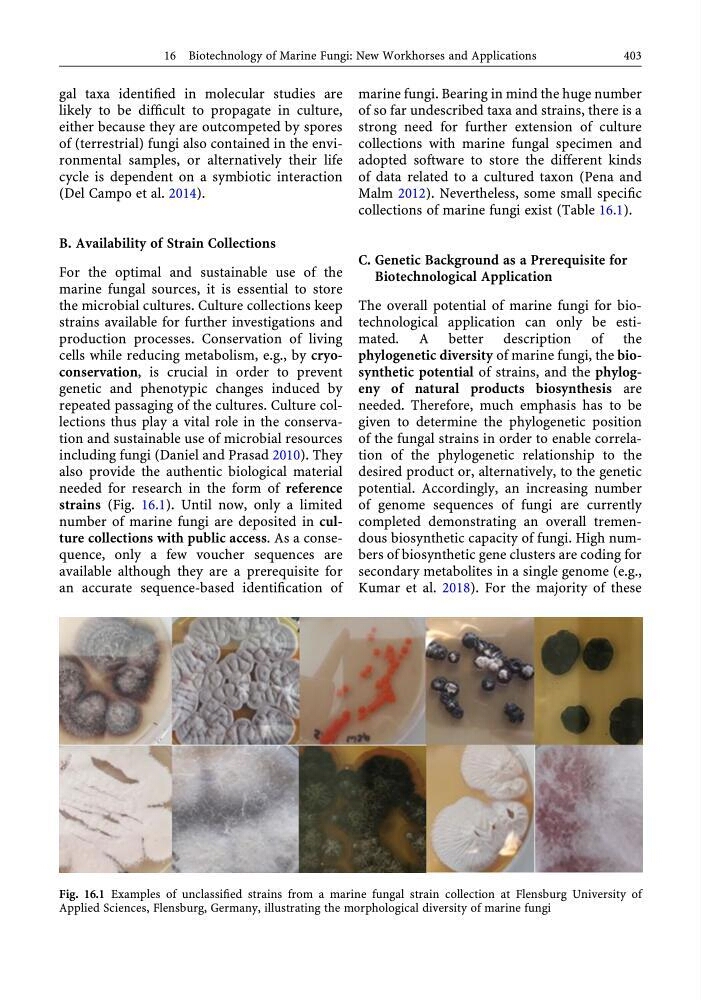
needed for research in the form of reference
strains (Fig. 16.1). Until now, only a limited
number of marine fungi are deposited in culture collections with public access. As a consequence, only a few voucher sequences are
available although they are a prerequisite for
an accurate sequence-based identification of
marine fungi. Bearing in mind the huge number
of so far undescribed taxa and strains, there is a
strong need for further extension of culture
collections with marine fungal specimen and
adopted software to store the different kinds
of data related to a cultured taxon (Pena and
Malm 2012). Nevertheless, some small specific
collections of marine fungi exist (Table 16.1).
C. Genetic Background as a Prerequisite for
Biotechnological Application
The overall potential of marine fungi for biotechnological application can only be estimated. A better description of the
phylogenetic diversity of marine fungi, the biosynthetic potential of strains, and the phylogeny of natural products biosynthesis are
needed. Therefore, much emphasis has to be
given to determine the phylogenetic position
of the fungal strains in order to enable correlation of the phylogenetic relationship to the
desired product or, alternatively, to the genetic
potential. Accordingly, an increasing number
of genome sequences of fungi are currently
completed demonstrating an overall tremendous biosynthetic capacity of fungi. High numbers of biosynthetic gene clusters are coding for
secondary metabolites in a single genome (e.g.,
Kumar et al. 2018). For the majority of these
Fig. 16.1 Examples of unclassified strains from a marine fungal strain collection at Flensburg University of
Applied Sciences, Flensburg, Germany, illustrating the morphological diversity of marine fungi
16 Biotechnology of Marine Fungi: New Workhorses and Applications
403
likely to be difficult to propagate in culture,
either because they are outcompeted by spores
of (terrestrial) fungi also contained in the environmental samples, or alternatively their life
cycle is dependent on a symbiotic interaction
(Del Campo et al. 2014).
B. Availability of Strain Collections
For the optimal and sustainable use of the
marine fungal sources, it is essential to store
the microbial cultures. Culture collections keep
strains available for further investigations and
production processes. Conservation of living
cells while reducing metabolism, e.g., by cryoconservation, is crucial in order to prevent
genetic and phenotypic changes induced by
repeated passaging of the cultures. Culture collections thus play a vital role in the conservation and sustainable use of microbial resources
including fungi (Daniel and Prasad 2010). They
also provide the authentic biological material
needed for research in the form of reference
strains (Fig. 16.1). Until now, only a limited
number of marine fungi are deposited in culture collections with public access. As a consequence, only a few voucher sequences are
available although they are a prerequisite for
an accurate sequence-based identification of
marine fungi. Bearing in mind the huge number
of so far undescribed taxa and strains, there is a
strong need for further extension of culture
collections with marine fungal specimen and
adopted software to store the different kinds
of data related to a cultured taxon (Pena and
Malm 2012). Nevertheless, some small specific
collections of marine fungi exist (Table 16.1).
C. Genetic Background as a Prerequisite for
Biotechnological Application
The overall potential of marine fungi for biotechnological application can only be estimated. A better description of the
phylogenetic diversity of marine fungi, the biosynthetic potential of strains, and the phylogeny of natural products biosynthesis are
needed. Therefore, much emphasis has to be
given to determine the phylogenetic position
of the fungal strains in order to enable correlation of the phylogenetic relationship to the
desired product or, alternatively, to the genetic
potential. Accordingly, an increasing number
of genome sequences of fungi are currently
completed demonstrating an overall tremendous biosynthetic capacity of fungi. High numbers of biosynthetic gene clusters are coding for
secondary metabolites in a single genome (e.g.,
Kumar et al. 2018). For the majority of these
Fig. 16.1 Examples of unclassified strains from a marine fungal strain collection at Flensburg University of
Applied Sciences, Flensburg, Germany, illustrating the morphological diversity of marine fungi
16 Biotechnology of Marine Fungi: New Workhorses and Applications
403