

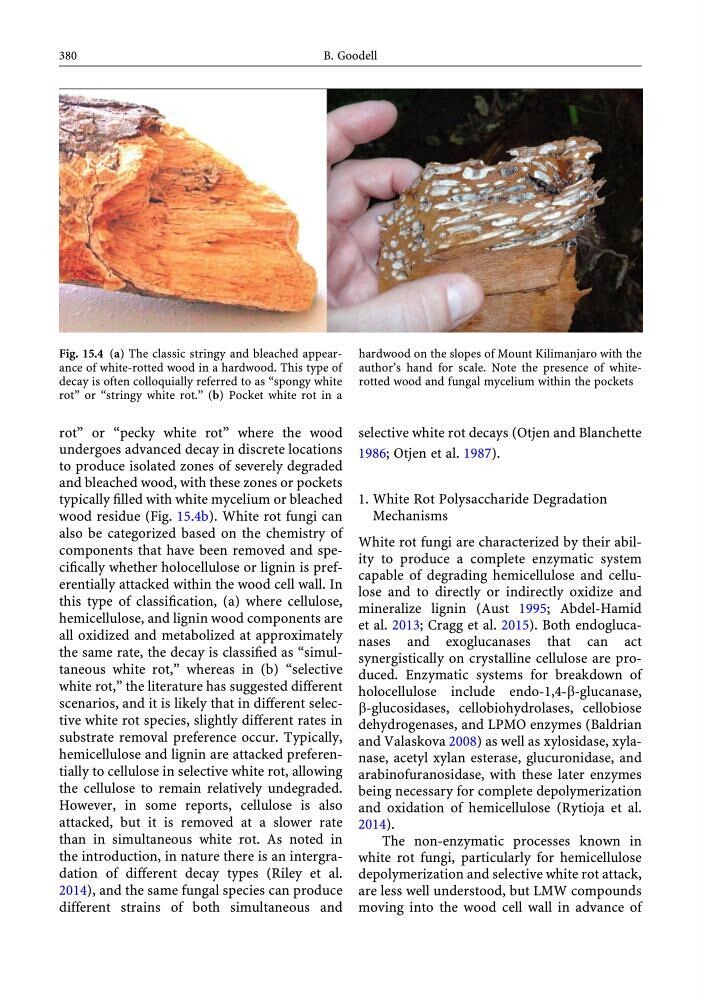
rot” or “pecky white rot” where the wood
undergoes advanced decay in discrete locations
to produce isolated zones of severely degraded
and bleached wood, with these zones or pockets
typically filled with white mycelium or bleached
wood residue (Fig. 15.4b). White rot fungi can
also be categorized based on the chemistry of
components that have been removed and specifically whether holocellulose or lignin is preferentially attacked within the wood cell wall. In
this type of classification, (a) where cellulose,
hemicellulose, and lignin wood components are
all oxidized and metabolized at approximately
the same rate, the decay is classified as “simultaneous white rot,” whereas in (b) “selective
white rot,” the literature has suggested different
scenarios, and it is likely that in different selective white rot species, slightly different rates in
substrate removal preference occur. Typically,
hemicellulose and lignin are attacked preferentially to cellulose in selective white rot, allowing
the cellulose to remain relatively undegraded.
However, in some reports, cellulose is also
attacked, but it is removed at a slower rate
than in simultaneous white rot. As noted in
the introduction, in nature there is an intergradation of different decay types (Riley et al.
2014), and the same fungal species can produce
different strains of both simultaneous and
selective white rot decays (Otjen and Blanchette
1986; Otjen et al. 1987).
1. White Rot Polysaccharide Degradation
Mechanisms
White rot fungi are characterized by their ability to produce a complete enzymatic system
capable of degrading hemicellulose and cellulose and to directly or indirectly oxidize and
mineralize lignin (Aust 1995; Abdel-Hamid
et al. 2013; Cragg et al. 2015). Both endoglucanases and exoglucanases that can act
synergistically on crystalline cellulose are produced. Enzymatic systems for breakdown of
holocellulose include endo-1,4-b-glucanase,
b-glucosidases, cellobiohydrolases, cellobiose
dehydrogenases, and LPMO enzymes (Baldrian
and Valaskova 2008) as well as xylosidase, xylanase, acetyl xylan esterase, glucuronidase, and
arabinofuranosidase, with these later enzymes
being necessary for complete depolymerization
and oxidation of hemicellulose (Rytioja et al.
2014).
The non-enzymatic processes known in
white rot fungi, particularly for hemicellulose
depolymerization and selective white rot attack,
are less well understood, but LMW compounds
moving into the wood cell wall in advance of
Fig. 15.4 (a) The classic stringy and bleached appearance of white-rotted wood in a hardwood. This type of
decay is often colloquially referred to as “spongy white
rot” or “stringy white rot.” (b) Pocket white rot in a
hardwood on the slopes of Mount Kilimanjaro with the
author’s hand for scale. Note the presence of whiterotted wood and fungal mycelium within the pockets
380
B. Goodell
undergoes advanced decay in discrete locations
to produce isolated zones of severely degraded
and bleached wood, with these zones or pockets
typically filled with white mycelium or bleached
wood residue (Fig. 15.4b). White rot fungi can
also be categorized based on the chemistry of
components that have been removed and specifically whether holocellulose or lignin is preferentially attacked within the wood cell wall. In
this type of classification, (a) where cellulose,
hemicellulose, and lignin wood components are
all oxidized and metabolized at approximately
the same rate, the decay is classified as “simultaneous white rot,” whereas in (b) “selective
white rot,” the literature has suggested different
scenarios, and it is likely that in different selective white rot species, slightly different rates in
substrate removal preference occur. Typically,
hemicellulose and lignin are attacked preferentially to cellulose in selective white rot, allowing
the cellulose to remain relatively undegraded.
However, in some reports, cellulose is also
attacked, but it is removed at a slower rate
than in simultaneous white rot. As noted in
the introduction, in nature there is an intergradation of different decay types (Riley et al.
2014), and the same fungal species can produce
different strains of both simultaneous and
selective white rot decays (Otjen and Blanchette
1986; Otjen et al. 1987).
1. White Rot Polysaccharide Degradation
Mechanisms
White rot fungi are characterized by their ability to produce a complete enzymatic system
capable of degrading hemicellulose and cellulose and to directly or indirectly oxidize and
mineralize lignin (Aust 1995; Abdel-Hamid
et al. 2013; Cragg et al. 2015). Both endoglucanases and exoglucanases that can act
synergistically on crystalline cellulose are produced. Enzymatic systems for breakdown of
holocellulose include endo-1,4-b-glucanase,
b-glucosidases, cellobiohydrolases, cellobiose
dehydrogenases, and LPMO enzymes (Baldrian
and Valaskova 2008) as well as xylosidase, xylanase, acetyl xylan esterase, glucuronidase, and
arabinofuranosidase, with these later enzymes
being necessary for complete depolymerization
and oxidation of hemicellulose (Rytioja et al.
2014).
The non-enzymatic processes known in
white rot fungi, particularly for hemicellulose
depolymerization and selective white rot attack,
are less well understood, but LMW compounds
moving into the wood cell wall in advance of
Fig. 15.4 (a) The classic stringy and bleached appearance of white-rotted wood in a hardwood. This type of
decay is often colloquially referred to as “spongy white
rot” or “stringy white rot.” (b) Pocket white rot in a
hardwood on the slopes of Mount Kilimanjaro with the
author’s hand for scale. Note the presence of whiterotted wood and fungal mycelium within the pockets
380
B. Goodell