

on lignocellulose (see below) in CMF brown rot
degradation. Modification of the chemistry of
the lignin phenolic units would also not be
possible without depolymerization. Further,
the modified lignin residue that is described in
older literature as “slightly modified lignin” is
actually quite extensively modified in that aliphatic side-chain cleavage and demethoxylation have occurred, and then the majority of
the modified aromatic subunits have repolymerized to produce the brown, crumbly polymerized mass that is observed in heavily
brown-rotted wood. These wood residues
should therefore be described as containing
extensively modified lignin, even though—
chemically—there are similarities between the
original lignin and brown-rotted lignin.
Genome sequencing of many brown rot
decay fungi has occurred only within the past
decade, and prior to that, brown rot fungi were
generally considered to be primitive species
which had not evolved a complete suite of
enzymes to deconstruct holocellulose or lignin.
The reason why brown rot fungi evolved
from the white rot progenitors, discarding
many of their extracellular enzyme systems in
the process and evolving the LMW catalytic
mechanism, is unknown. However, several
researchers have postulated that this shift
from reliance solely on extracellular enzymes
to reliance primarily on a system like the CMF
system is more favorable from the perspective
of obtaining energy from a recalcitrant substrate like wood (Martinez et al. 2009; Eastwood
2014; Arantes and Goodell 2014). This more
recent evolution of brown rot genera is the
reason that these fungi currently represent
only a small percentage of all Basidiomycota
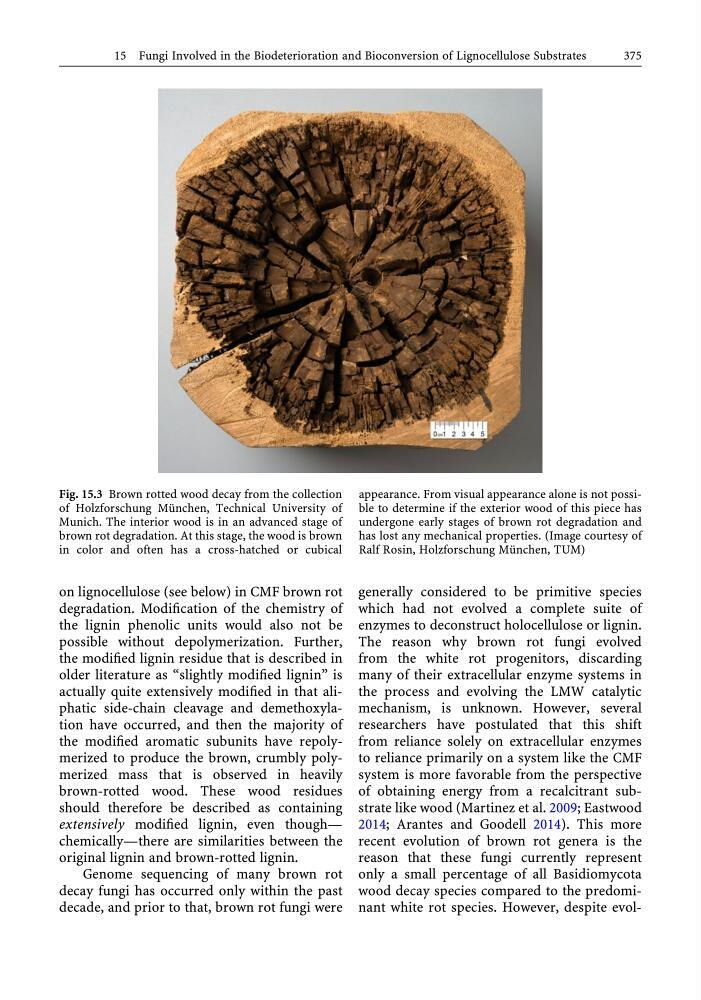
wood decay species compared to the predominant white rot species. However, despite evolFig. 15.3 Brown rotted wood decay from the collection
of Holzforschung Mu ¨nchen, Technical University of
Munich. The interior wood is in an advanced stage of
brown rot degradation. At this stage, the wood is brown
in color and often has a cross-hatched or cubical
appearance. From visual appearance alone is not possible to determine if the exterior wood of this piece has
undergone early stages of brown rot degradation and
has lost any mechanical properties. (Image courtesy of
Ralf Rosin, Holzforschung Mu ¨nchen, TUM)
15 Fungi Involved in the Biodeterioration and Bioconversion of Lignocellulose Substrates
375
degradation. Modification of the chemistry of
the lignin phenolic units would also not be
possible without depolymerization. Further,
the modified lignin residue that is described in
older literature as “slightly modified lignin” is
actually quite extensively modified in that aliphatic side-chain cleavage and demethoxylation have occurred, and then the majority of
the modified aromatic subunits have repolymerized to produce the brown, crumbly polymerized mass that is observed in heavily
brown-rotted wood. These wood residues
should therefore be described as containing
extensively modified lignin, even though—
chemically—there are similarities between the
original lignin and brown-rotted lignin.
Genome sequencing of many brown rot
decay fungi has occurred only within the past
decade, and prior to that, brown rot fungi were
generally considered to be primitive species
which had not evolved a complete suite of
enzymes to deconstruct holocellulose or lignin.
The reason why brown rot fungi evolved
from the white rot progenitors, discarding
many of their extracellular enzyme systems in
the process and evolving the LMW catalytic
mechanism, is unknown. However, several
researchers have postulated that this shift
from reliance solely on extracellular enzymes
to reliance primarily on a system like the CMF
system is more favorable from the perspective
of obtaining energy from a recalcitrant substrate like wood (Martinez et al. 2009; Eastwood
2014; Arantes and Goodell 2014). This more
recent evolution of brown rot genera is the
reason that these fungi currently represent
only a small percentage of all Basidiomycota
wood decay species compared to the predominant white rot species. However, despite evolFig. 15.3 Brown rotted wood decay from the collection
of Holzforschung Mu ¨nchen, Technical University of
Munich. The interior wood is in an advanced stage of
brown rot degradation. At this stage, the wood is brown
in color and often has a cross-hatched or cubical
appearance. From visual appearance alone is not possible to determine if the exterior wood of this piece has
undergone early stages of brown rot degradation and
has lost any mechanical properties. (Image courtesy of
Ralf Rosin, Holzforschung Mu ¨nchen, TUM)
15 Fungi Involved in the Biodeterioration and Bioconversion of Lignocellulose Substrates
375