

Decay and Depolymerization of Lignocellulose
Cell Walls
Wood decay fungi including brown rots, white
rots, and soft rot fungi generally have the
capacity to attack both holocellulose and lignin
components. The type of attack will vary as
outlined for the specific decay types below,
but as decay progresses, the fungi not only
depolymerize all or portions of the lignocellulose, but they metabolize particularly the oligosaccharide and sugar fractions of the substrate
once adequate depolymerization has occurred
to allow depolymerized fractions to be small
enough to allow passage through the fungal
cell wall and membrane. As depolymerization
of holocellulose and lignin occurs, mechanical
property loss occurs in the wood (Highley
1988). In some cases, depolymerization is
paced to match metabolism by the fungus,
and in such cases, mass loss of the wood will
parallel mechanical property loss (Goodell
2014). More often however, as in the initial
stages of decay by brown rot fungi, rapid depolymerization of the wood cell wall occurs with
little metabolism of the cell wall components, so
mechanical property loss can advance significantly before large mass loss has occurred
(Highley and Illman 1991). Concurrent with
mass loss as decay progresses, shrinkage of
wood occurs. In some decay types, the wood
cell wall itself develops a porous structure so
that bulk shrinkage may be less noticeable as
mass loss increases. However, in brown rot of
softwoods, it has been noted that the wood cell
wall collapses upon itself (Daniel 2014) with
rearrangement of modified lignin (Goodell
et al. 2017). This ultimately results in the cubical, friable appearance of brown rotted wood as
this type of decay advances. Shrinkage is also
observed in other types of decay but is often
masked because of micro-porosity development within the cell walls or when cells delaminate at the middle lamellae uniformly to allow a
more uniform appearance of the wood.
Hyphal Progression During Decay
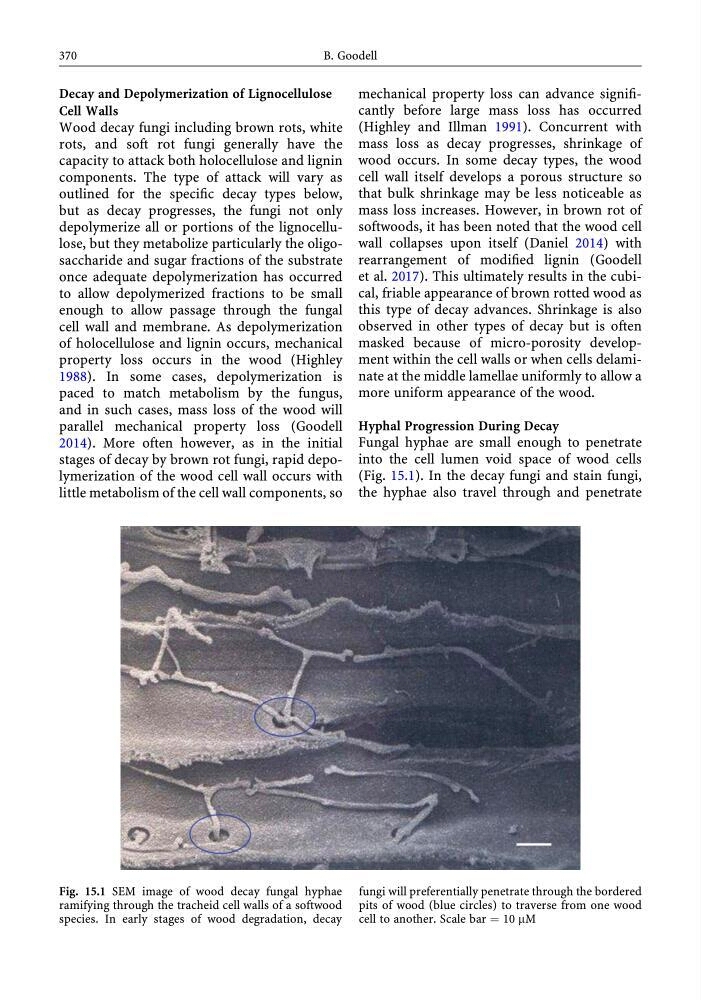
Fungal hyphae are small enough to penetrate
into the cell lumen void space of wood cells
(Fig. 15.1). In the decay fungi and stain fungi,
the hyphae also travel through and penetrate
Fig. 15.1 SEM image of wood decay fungal hyphae
ramifying through the tracheid cell walls of a softwood
species. In early stages of wood degradation, decay
fungi will preferentially penetrate through the bordered
pits of wood (blue circles) to traverse from one wood
cell to another. Scale bar ¼ 10 mM
370
B. Goodell
Cell Walls
Wood decay fungi including brown rots, white
rots, and soft rot fungi generally have the
capacity to attack both holocellulose and lignin
components. The type of attack will vary as
outlined for the specific decay types below,
but as decay progresses, the fungi not only
depolymerize all or portions of the lignocellulose, but they metabolize particularly the oligosaccharide and sugar fractions of the substrate
once adequate depolymerization has occurred
to allow depolymerized fractions to be small
enough to allow passage through the fungal
cell wall and membrane. As depolymerization
of holocellulose and lignin occurs, mechanical
property loss occurs in the wood (Highley
1988). In some cases, depolymerization is
paced to match metabolism by the fungus,
and in such cases, mass loss of the wood will
parallel mechanical property loss (Goodell
2014). More often however, as in the initial
stages of decay by brown rot fungi, rapid depolymerization of the wood cell wall occurs with
little metabolism of the cell wall components, so
mechanical property loss can advance significantly before large mass loss has occurred
(Highley and Illman 1991). Concurrent with
mass loss as decay progresses, shrinkage of
wood occurs. In some decay types, the wood
cell wall itself develops a porous structure so
that bulk shrinkage may be less noticeable as
mass loss increases. However, in brown rot of
softwoods, it has been noted that the wood cell
wall collapses upon itself (Daniel 2014) with
rearrangement of modified lignin (Goodell
et al. 2017). This ultimately results in the cubical, friable appearance of brown rotted wood as
this type of decay advances. Shrinkage is also
observed in other types of decay but is often
masked because of micro-porosity development within the cell walls or when cells delaminate at the middle lamellae uniformly to allow a
more uniform appearance of the wood.
Hyphal Progression During Decay
Fungal hyphae are small enough to penetrate
into the cell lumen void space of wood cells
(Fig. 15.1). In the decay fungi and stain fungi,
the hyphae also travel through and penetrate
Fig. 15.1 SEM image of wood decay fungal hyphae
ramifying through the tracheid cell walls of a softwood
species. In early stages of wood degradation, decay
fungi will preferentially penetrate through the bordered
pits of wood (blue circles) to traverse from one wood
cell to another. Scale bar ¼ 10 mM
370
B. Goodell