

Regarding gfp transcript levels, they were ~50fold induced after 1 h of light, staying as high as
80-fold throughout the 48 h of the time course
(Hurley et al. 2012). Importantly, rapid and
strong increase in vvd expression has been
reported by the use of destabilized luc as gene
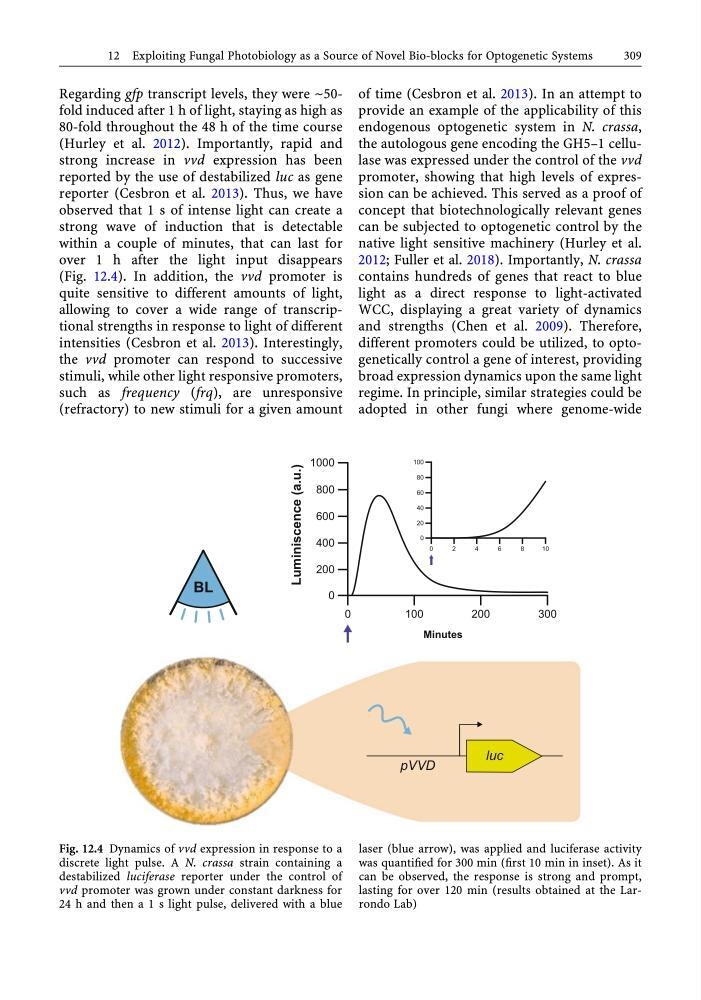
reporter (Cesbron et al. 2013). Thus, we have
observed that 1 s of intense light can create a
strong wave of induction that is detectable
within a couple of minutes, that can last for
over 1 h after the light input disappears
(Fig. 12.4). In addition, the vvd promoter is
quite sensitive to different amounts of light,
allowing to cover a wide range of transcriptional strengths in response to light of different
intensities (Cesbron et al. 2013). Interestingly,
the vvd promoter can respond to successive
stimuli, while other light responsive promoters,
such as frequency (frq), are unresponsive
(refractory) to new stimuli for a given amount
of time (Cesbron et al. 2013). In an attempt to
provide an example of the applicability of this
endogenous optogenetic system in N. crassa,
the autologous gene encoding the GH5–1 cellulase was expressed under the control of the vvd
promoter, showing that high levels of expression can be achieved. This served as a proof of
concept that biotechnologically relevant genes
can be subjected to optogenetic control by the
native light sensitive machinery (Hurley et al.
2012; Fuller et al. 2018). Importantly, N. crassa
contains hundreds of genes that react to blue
light as a direct response to light-activated
WCC, displaying a great variety of dynamics
and strengths (Chen et al. 2009). Therefore,
different promoters could be utilized, to optogenetically control a gene of interest, providing
broad expression dynamics upon the same light
regime. In principle, similar strategies could be
adopted in other fungi where genome-wide
pVVD
luc
Luminiscence (a.u.)
1000
800
600
400
200
0
0
100
200
300
Minutes
100
80
60
40
20
0
0
2
4
6
8
1 0
BL
Fig. 12.4 Dynamics of vvd expression in response to a
discrete light pulse. A N. crassa strain containing a
destabilized luciferase reporter under the control of
vvd promoter was grown under constant darkness for
24 h and then a 1 s light pulse, delivered with a blue
laser (blue arrow), was applied and luciferase activity
was quantified for 300 min (first 10 min in inset). As it
can be observed, the response is strong and prompt,
lasting for over 120 min (results obtained at the Larrondo Lab)
12 Exploiting Fungal Photobiology as a Source of Novel Bio-blocks for Optogenetic Systems
309
80-fold throughout the 48 h of the time course
(Hurley et al. 2012). Importantly, rapid and
strong increase in vvd expression has been
reported by the use of destabilized luc as gene
reporter (Cesbron et al. 2013). Thus, we have
observed that 1 s of intense light can create a
strong wave of induction that is detectable
within a couple of minutes, that can last for
over 1 h after the light input disappears
(Fig. 12.4). In addition, the vvd promoter is
quite sensitive to different amounts of light,
allowing to cover a wide range of transcriptional strengths in response to light of different
intensities (Cesbron et al. 2013). Interestingly,
the vvd promoter can respond to successive
stimuli, while other light responsive promoters,
such as frequency (frq), are unresponsive
(refractory) to new stimuli for a given amount
of time (Cesbron et al. 2013). In an attempt to
provide an example of the applicability of this
endogenous optogenetic system in N. crassa,
the autologous gene encoding the GH5–1 cellulase was expressed under the control of the vvd
promoter, showing that high levels of expression can be achieved. This served as a proof of
concept that biotechnologically relevant genes
can be subjected to optogenetic control by the
native light sensitive machinery (Hurley et al.
2012; Fuller et al. 2018). Importantly, N. crassa
contains hundreds of genes that react to blue
light as a direct response to light-activated
WCC, displaying a great variety of dynamics
and strengths (Chen et al. 2009). Therefore,
different promoters could be utilized, to optogenetically control a gene of interest, providing
broad expression dynamics upon the same light
regime. In principle, similar strategies could be
adopted in other fungi where genome-wide
pVVD
luc
Luminiscence (a.u.)
1000
800
600
400
200
0
0
100
200
300
Minutes
100
80
60
40
20
0
0
2
4
6
8
1 0
BL
Fig. 12.4 Dynamics of vvd expression in response to a
discrete light pulse. A N. crassa strain containing a
destabilized luciferase reporter under the control of
vvd promoter was grown under constant darkness for
24 h and then a 1 s light pulse, delivered with a blue
laser (blue arrow), was applied and luciferase activity
was quantified for 300 min (first 10 min in inset). As it
can be observed, the response is strong and prompt,
lasting for over 120 min (results obtained at the Larrondo Lab)
12 Exploiting Fungal Photobiology as a Source of Novel Bio-blocks for Optogenetic Systems
309