

Obviously, the abovementioned examples
do not encompass all optogenetic systems
described to date. However, they constitute representative illustrations of synthetic devices
responding to light of different wavelengths.
Altogether, these diverse optogenetic systems
have the capacity to control gene expression,
subcellular protein localization, protein activity, cell morphology, cell signaling, and protein
degradation in multiple biological platforms.
However, a major challenge still to be
addressed is the combination of multiple optogenetic systems for the control of several
processes by simultaneously responding to
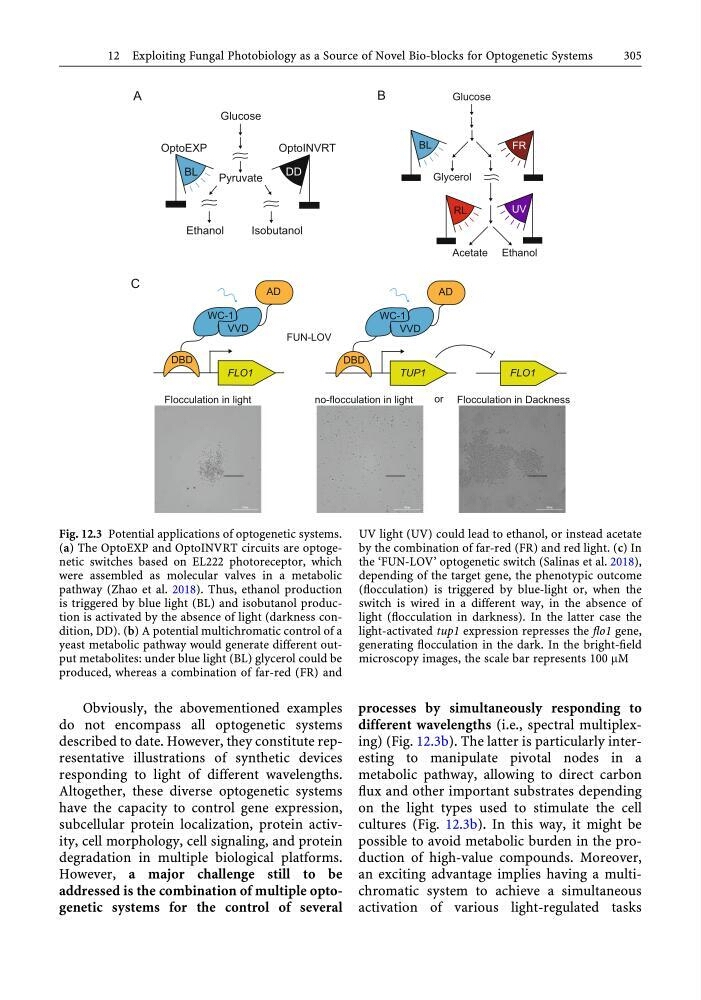
different wavelengths (i.e., spectral multiplexing) (Fig. 12.3b). The latter is particularly interesting to manipulate pivotal nodes in a
metabolic pathway, allowing to direct carbon
flux and other important substrates depending
on the light types used to stimulate the cell
cultures (Fig. 12.3b). In this way, it might be
possible to avoid metabolic burden in the production of high-value compounds. Moreover,
an exciting advantage implies having a multichromatic system to achieve a simultaneous
activation of various light-regulated tasks
C
DBD
AD
WC-1
VVD
FLO1
DBD
AD
WC-1
VVD
TUP1
FLO1
FUN-LOV
s
s
e
n
k
c
a
D
n
i
n
o
i
t
a
l
u
c
c
o
l
F
t
h
g
i
l
n
i
n
o
i
t
a
l
u
c
c
o
l
F
no-flocculation in light
or
A
Glucose
Pyruvate
OptoEXP
OptoINVRT
Ethanol
Isobutanol
BL
DD
B
Glucose
Glycerol
Acetate Ethanol
BL
FR
UV
RL
Fig. 12.3 Potential applications of optogenetic systems.
(a) The OptoEXP and OptoINVRT circuits are optogenetic switches based on EL222 photoreceptor, which
were assembled as molecular valves in a metabolic
pathway (Zhao et al. 2018). Thus, ethanol production
is triggered by blue light (BL) and isobutanol production is activated by the absence of light (darkness condition, DD). (b) A potential multichromatic control of a
yeast metabolic pathway would generate different output metabolites: under blue light (BL) glycerol could be
produced, whereas a combination of far-red (FR) and
UV light (UV) could lead to ethanol, or instead acetate
by the combination of far-red (FR) and red light. (c) In
the ‘FUN-LOV’ optogenetic switch (Salinas et al. 2018),
depending of the target gene, the phenotypic outcome
(flocculation) is triggered by blue-light or, when the
switch is wired in a different way, in the absence of
light (flocculation in darkness). In the latter case the
light-activated tup1 expression represses the flo1 gene,
generating flocculation in the dark. In the bright-field
microscopy images, the scale bar represents 100 mM
12 Exploiting Fungal Photobiology as a Source of Novel Bio-blocks for Optogenetic Systems
305
do not encompass all optogenetic systems
described to date. However, they constitute representative illustrations of synthetic devices
responding to light of different wavelengths.
Altogether, these diverse optogenetic systems
have the capacity to control gene expression,
subcellular protein localization, protein activity, cell morphology, cell signaling, and protein
degradation in multiple biological platforms.
However, a major challenge still to be
addressed is the combination of multiple optogenetic systems for the control of several
processes by simultaneously responding to
different wavelengths (i.e., spectral multiplexing) (Fig. 12.3b). The latter is particularly interesting to manipulate pivotal nodes in a
metabolic pathway, allowing to direct carbon
flux and other important substrates depending
on the light types used to stimulate the cell
cultures (Fig. 12.3b). In this way, it might be
possible to avoid metabolic burden in the production of high-value compounds. Moreover,
an exciting advantage implies having a multichromatic system to achieve a simultaneous
activation of various light-regulated tasks
C
DBD
AD
WC-1
VVD
FLO1
DBD
AD
WC-1
VVD
TUP1
FLO1
FUN-LOV
s
s
e
n
k
c
a
D
n
i
n
o
i
t
a
l
u
c
c
o
l
F
t
h
g
i
l
n
i
n
o
i
t
a
l
u
c
c
o
l
F
no-flocculation in light
or
A
Glucose
Pyruvate
OptoEXP
OptoINVRT
Ethanol
Isobutanol
BL
DD
B
Glucose
Glycerol
Acetate Ethanol
BL
FR
UV
RL
Fig. 12.3 Potential applications of optogenetic systems.
(a) The OptoEXP and OptoINVRT circuits are optogenetic switches based on EL222 photoreceptor, which
were assembled as molecular valves in a metabolic
pathway (Zhao et al. 2018). Thus, ethanol production
is triggered by blue light (BL) and isobutanol production is activated by the absence of light (darkness condition, DD). (b) A potential multichromatic control of a
yeast metabolic pathway would generate different output metabolites: under blue light (BL) glycerol could be
produced, whereas a combination of far-red (FR) and
UV light (UV) could lead to ethanol, or instead acetate
by the combination of far-red (FR) and red light. (c) In
the ‘FUN-LOV’ optogenetic switch (Salinas et al. 2018),
depending of the target gene, the phenotypic outcome
(flocculation) is triggered by blue-light or, when the
switch is wired in a different way, in the absence of
light (flocculation in darkness). In the latter case the
light-activated tup1 expression represses the flo1 gene,
generating flocculation in the dark. In the bright-field
microscopy images, the scale bar represents 100 mM
12 Exploiting Fungal Photobiology as a Source of Novel Bio-blocks for Optogenetic Systems
305