

it can be metabolized, etc. On the other hand,
light presents itself as a prominent tool to
assess complex and dynamic biological phenomena, and thus, different synthetic
approaches have used proteins containing
light-sensitive domains as genetically encoded
building blocks to manipulate cellular processes by luminous stimuli (Mo ¨glich and Moffat 2010; Schmidt and Cho 2015). Indeed, light
is an ideal modulator of specific biological phenomena because it possesses various advantages compared to traditional induction
strategies based on chemical inducers. First,
light can be easily controlled by manageable
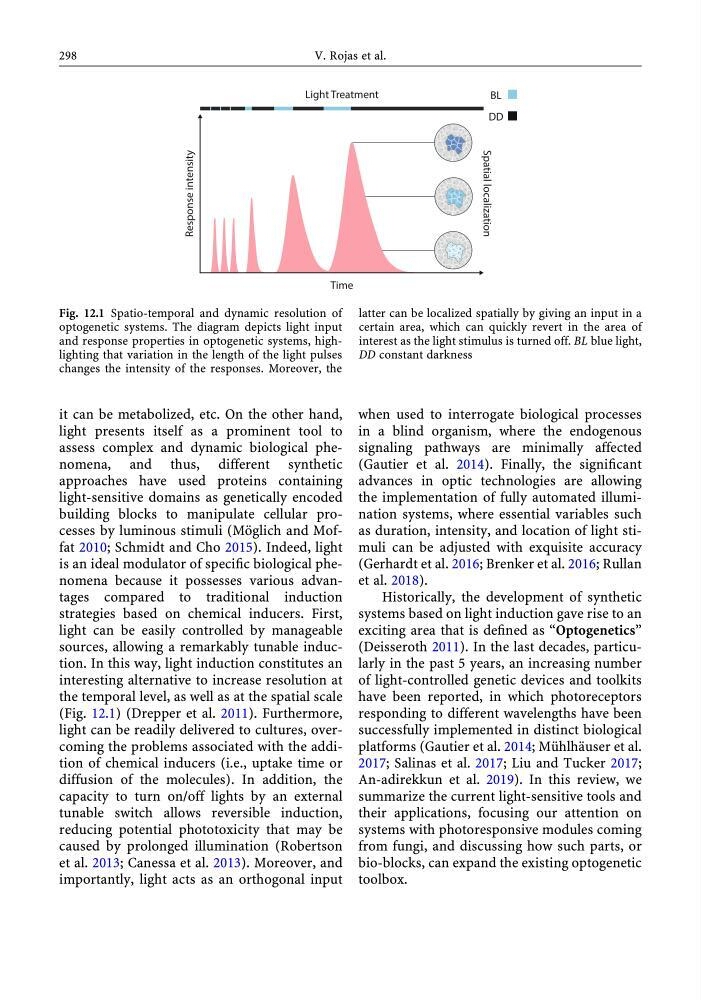
sources, allowing a remarkably tunable induction. In this way, light induction constitutes an
interesting alternative to increase resolution at
the temporal level, as well as at the spatial scale
(Fig. 12.1) (Drepper et al. 2011). Furthermore,
light can be readily delivered to cultures, overcoming the problems associated with the addition of chemical inducers (i.e., uptake time or
diffusion of the molecules). In addition, the
capacity to turn on/off lights by an external
tunable switch allows reversible induction,
reducing potential phototoxicity that may be
caused by prolonged illumination (Robertson
et al. 2013; Canessa et al. 2013). Moreover, and
importantly, light acts as an orthogonal input
when used to interrogate biological processes
in a blind organism, where the endogenous
signaling pathways are minimally affected
(Gautier et al. 2014). Finally, the significant
advances in optic technologies are allowing
the implementation of fully automated illumination systems, where essential variables such
as duration, intensity, and location of light stimuli can be adjusted with exquisite accuracy
(Gerhardt et al. 2016; Brenker et al. 2016; Rullan
et al. 2018).
Historically, the development of synthetic
systems based on light induction gave rise to an
exciting area that is defined as “Optogenetics”
(Deisseroth 2011). In the last decades, particularly in the past 5 years, an increasing number
of light-controlled genetic devices and toolkits
have been reported, in which photoreceptors
responding to different wavelengths have been
successfully implemented in distinct biological
platforms (Gautier et al. 2014; Mu ¨hlha ¨user et al.
2017; Salinas et al. 2017; Liu and Tucker 2017;
An-adirekkun et al. 2019). In this review, we
summarize the current light-sensitive tools and
their applications, focusing our attention on
systems with photoresponsive modules coming
from fungi, and discussing how such parts, or
bio-blocks, can expand the existing optogenetic
toolbox.
Light Treatment
BL
DD
Response intensity
Spatial localization
Time
Fig. 12.1 Spatio-temporal and dynamic resolution of
optogenetic systems. The diagram depicts light input
and response properties in optogenetic systems, highlighting that variation in the length of the light pulses
changes the intensity of the responses. Moreover, the
latter can be localized spatially by giving an input in a
certain area, which can quickly revert in the area of
interest as the light stimulus is turned off. BL blue light,
DD constant darkness
298
V. Rojas et al.
light presents itself as a prominent tool to
assess complex and dynamic biological phenomena, and thus, different synthetic
approaches have used proteins containing
light-sensitive domains as genetically encoded
building blocks to manipulate cellular processes by luminous stimuli (Mo ¨glich and Moffat 2010; Schmidt and Cho 2015). Indeed, light
is an ideal modulator of specific biological phenomena because it possesses various advantages compared to traditional induction
strategies based on chemical inducers. First,
light can be easily controlled by manageable
sources, allowing a remarkably tunable induction. In this way, light induction constitutes an
interesting alternative to increase resolution at
the temporal level, as well as at the spatial scale
(Fig. 12.1) (Drepper et al. 2011). Furthermore,
light can be readily delivered to cultures, overcoming the problems associated with the addition of chemical inducers (i.e., uptake time or
diffusion of the molecules). In addition, the
capacity to turn on/off lights by an external
tunable switch allows reversible induction,
reducing potential phototoxicity that may be
caused by prolonged illumination (Robertson
et al. 2013; Canessa et al. 2013). Moreover, and
importantly, light acts as an orthogonal input
when used to interrogate biological processes
in a blind organism, where the endogenous
signaling pathways are minimally affected
(Gautier et al. 2014). Finally, the significant
advances in optic technologies are allowing
the implementation of fully automated illumination systems, where essential variables such
as duration, intensity, and location of light stimuli can be adjusted with exquisite accuracy
(Gerhardt et al. 2016; Brenker et al. 2016; Rullan
et al. 2018).
Historically, the development of synthetic
systems based on light induction gave rise to an
exciting area that is defined as “Optogenetics”
(Deisseroth 2011). In the last decades, particularly in the past 5 years, an increasing number
of light-controlled genetic devices and toolkits
have been reported, in which photoreceptors
responding to different wavelengths have been
successfully implemented in distinct biological
platforms (Gautier et al. 2014; Mu ¨hlha ¨user et al.
2017; Salinas et al. 2017; Liu and Tucker 2017;
An-adirekkun et al. 2019). In this review, we
summarize the current light-sensitive tools and
their applications, focusing our attention on
systems with photoresponsive modules coming
from fungi, and discussing how such parts, or
bio-blocks, can expand the existing optogenetic
toolbox.
Light Treatment
BL
DD
Response intensity
Spatial localization
Time
Fig. 12.1 Spatio-temporal and dynamic resolution of
optogenetic systems. The diagram depicts light input
and response properties in optogenetic systems, highlighting that variation in the length of the light pulses
changes the intensity of the responses. Moreover, the
latter can be localized spatially by giving an input in a
certain area, which can quickly revert in the area of
interest as the light stimulus is turned off. BL blue light,
DD constant darkness
298
V. Rojas et al.