

RIP’d DNA regions (Lewis et al. 2010a), whereas DIM-9,
DDB1, and CUL4 are required for DIM-5 catalytic activity in vitro (Lewis et al. 2010a). However, the latter three
complex members, which also function in DNA repair,
appear to have a structural role for DCDC assembly, as
the C-terminal domain of CUL4, which contains the
critical lysine required for the posttranslational addition of a NEDD peptide for DNA repair, is dispensable
for heterochromatin formation (Adhvaryu et al. 2015).
Further, the Neurospora protein DIM-3 (NCU01249),
whose homologs in yeast (importin a) and humans
(karyopherin a) transport proteins into the nucleus,
may be required for DCDC localization to heterochromatin following nuclear shuttling (Klocko et al. 2015).
Interestingly, DIM-5 does not require these accessory
factors to methylate the H3 K9 residue in vitro (Zhang
et al. 2002, 2003; Tamaru et al. 2003; Collins et al. 2005;
Adhvaryu et al. 2011). In addition to regulation by
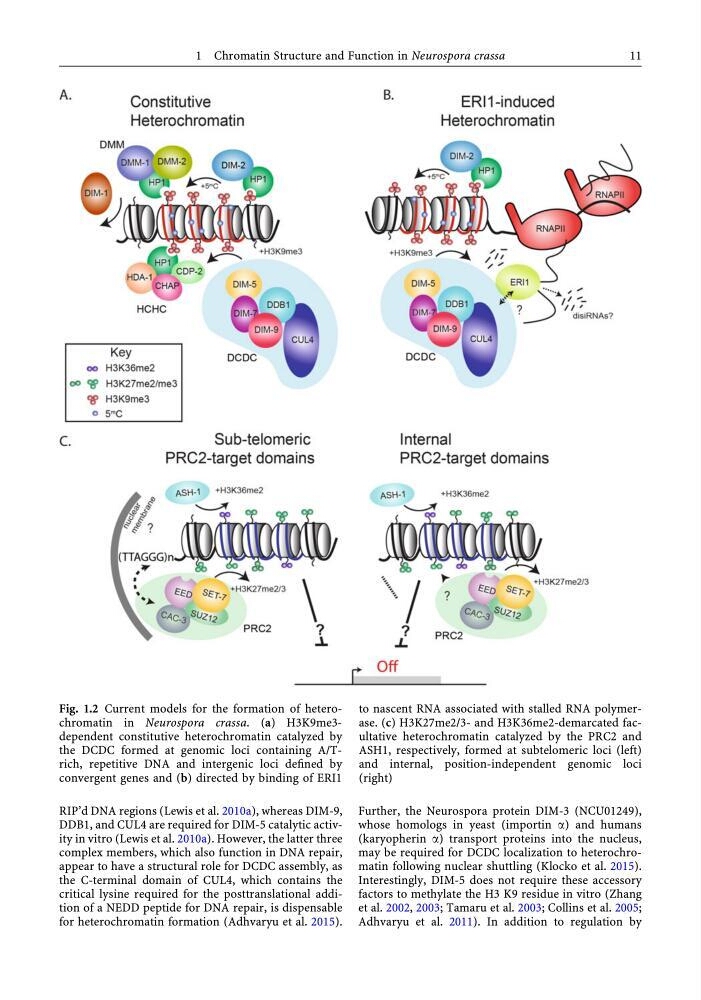
Fig. 1.2 Current models for the formation of heterochromatin in Neurospora crassa. (a) H3K9me3dependent constitutive heterochromatin catalyzed by
the DCDC formed at genomic loci containing A/Trich, repetitive DNA and intergenic loci defined by
convergent genes and (b) directed by binding of ERI1
to nascent RNA associated with stalled RNA polymerase. (c) H3K27me2/3- and H3K36me2-demarcated facultative heterochromatin catalyzed by the PRC2 and
ASH1, respectively, formed at subtelomeric loci (left)
and internal, position-independent genomic loci
(right)
1 Chromatin Structure and Function in Neurospora crassa
11
DDB1, and CUL4 are required for DIM-5 catalytic activity in vitro (Lewis et al. 2010a). However, the latter three
complex members, which also function in DNA repair,
appear to have a structural role for DCDC assembly, as
the C-terminal domain of CUL4, which contains the
critical lysine required for the posttranslational addition of a NEDD peptide for DNA repair, is dispensable
for heterochromatin formation (Adhvaryu et al. 2015).
Further, the Neurospora protein DIM-3 (NCU01249),
whose homologs in yeast (importin a) and humans
(karyopherin a) transport proteins into the nucleus,
may be required for DCDC localization to heterochromatin following nuclear shuttling (Klocko et al. 2015).
Interestingly, DIM-5 does not require these accessory
factors to methylate the H3 K9 residue in vitro (Zhang
et al. 2002, 2003; Tamaru et al. 2003; Collins et al. 2005;
Adhvaryu et al. 2011). In addition to regulation by
Fig. 1.2 Current models for the formation of heterochromatin in Neurospora crassa. (a) H3K9me3dependent constitutive heterochromatin catalyzed by
the DCDC formed at genomic loci containing A/Trich, repetitive DNA and intergenic loci defined by
convergent genes and (b) directed by binding of ERI1
to nascent RNA associated with stalled RNA polymerase. (c) H3K27me2/3- and H3K36me2-demarcated facultative heterochromatin catalyzed by the PRC2 and
ASH1, respectively, formed at subtelomeric loci (left)
and internal, position-independent genomic loci
(right)
1 Chromatin Structure and Function in Neurospora crassa
11