

Fortunately, however, the biosynthetic
potential of these organisms is still greatly
unexplored, even underestimated. Mining the
increasing number of published fungal genomes revealed that the vast majority of fungal
SMs still await discovery. Most fungal genomes
contain more biosynthetic gene clusters
(BGCs) than the number of NPs known to be
produced by the respective fungus (e.g., de
Vries et al. 2017; Rutledge and Challis 2015;
Sanchez et al. 2012; Bergmann et al. 2007).
Two main reasons hinder a comprehensive
mining of BGCs: (1) the overwhelming majority
of microorganisms, including fungi, cannot be
cultivated independently as axenic cultures in
the laboratory, and (2) most SM gene clusters
are silent under standard laboratory growth
conditions. In the previous decade, a number
of strategies have been developed to overcome
these drawbacks (reviewed extensively in
(Brakhage and Schroeckh 2011; Brakhage
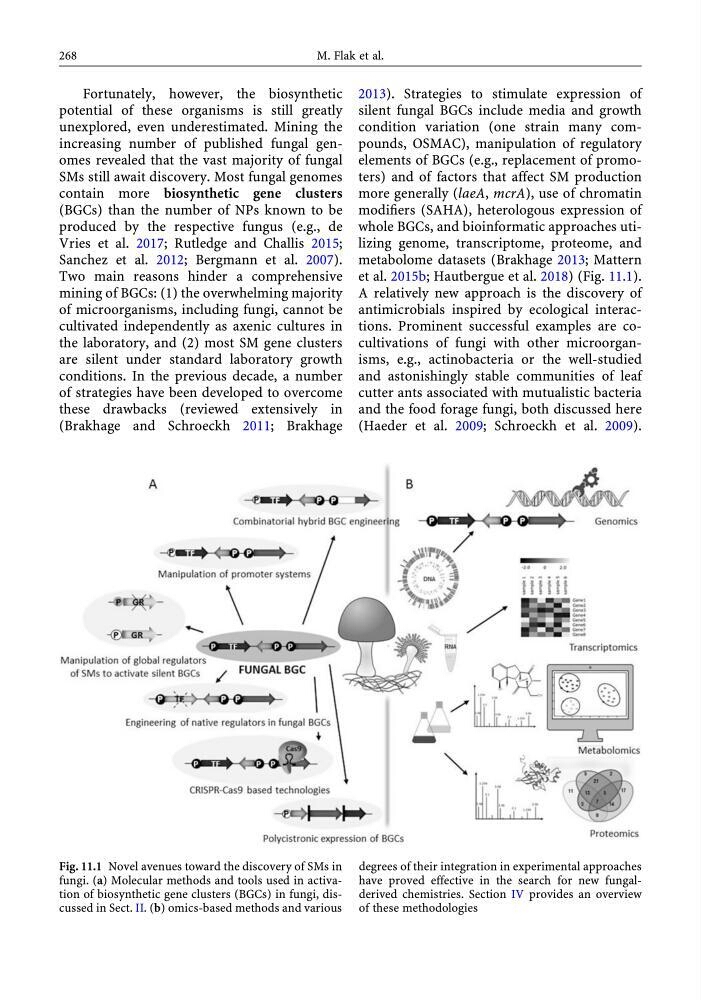
2013). Strategies to stimulate expression of
silent fungal BGCs include media and growth
condition variation (one strain many compounds, OSMAC), manipulation of regulatory
elements of BGCs (e.g., replacement of promoters) and of factors that affect SM production
more generally (laeA, mcrA), use of chromatin
modifiers (SAHA), heterologous expression of
whole BGCs, and bioinformatic approaches utilizing genome, transcriptome, proteome, and
metabolome datasets (Brakhage 2013; Mattern
et al. 2015b; Hautbergue et al. 2018) (Fig. 11.1).
A relatively new approach is the discovery of
antimicrobials inspired by ecological interactions. Prominent successful examples are cocultivations of fungi with other microorganisms, e.g., actinobacteria or the well-studied
and astonishingly stable communities of leaf
cutter ants associated with mutualistic bacteria
and the food forage fungi, both discussed here
(Haeder et al. 2009; Schroeckh et al. 2009).
Fig. 11.1 Novel avenues toward the discovery of SMs in
fungi. (a) Molecular methods and tools used in activation of biosynthetic gene clusters (BGCs) in fungi, discussed in Sect. II. (b) omics-based methods and various
degrees of their integration in experimental approaches
have proved effective in the search for new fungalderived chemistries. Section IV provides an overview
of these methodologies
268
M. Flak et al.
potential of these organisms is still greatly
unexplored, even underestimated. Mining the
increasing number of published fungal genomes revealed that the vast majority of fungal
SMs still await discovery. Most fungal genomes
contain more biosynthetic gene clusters
(BGCs) than the number of NPs known to be
produced by the respective fungus (e.g., de
Vries et al. 2017; Rutledge and Challis 2015;
Sanchez et al. 2012; Bergmann et al. 2007).
Two main reasons hinder a comprehensive
mining of BGCs: (1) the overwhelming majority
of microorganisms, including fungi, cannot be
cultivated independently as axenic cultures in
the laboratory, and (2) most SM gene clusters
are silent under standard laboratory growth
conditions. In the previous decade, a number
of strategies have been developed to overcome
these drawbacks (reviewed extensively in
(Brakhage and Schroeckh 2011; Brakhage
2013). Strategies to stimulate expression of
silent fungal BGCs include media and growth
condition variation (one strain many compounds, OSMAC), manipulation of regulatory
elements of BGCs (e.g., replacement of promoters) and of factors that affect SM production
more generally (laeA, mcrA), use of chromatin
modifiers (SAHA), heterologous expression of
whole BGCs, and bioinformatic approaches utilizing genome, transcriptome, proteome, and
metabolome datasets (Brakhage 2013; Mattern
et al. 2015b; Hautbergue et al. 2018) (Fig. 11.1).
A relatively new approach is the discovery of
antimicrobials inspired by ecological interactions. Prominent successful examples are cocultivations of fungi with other microorganisms, e.g., actinobacteria or the well-studied
and astonishingly stable communities of leaf
cutter ants associated with mutualistic bacteria
and the food forage fungi, both discussed here
(Haeder et al. 2009; Schroeckh et al. 2009).
Fig. 11.1 Novel avenues toward the discovery of SMs in
fungi. (a) Molecular methods and tools used in activation of biosynthetic gene clusters (BGCs) in fungi, discussed in Sect. II. (b) omics-based methods and various
degrees of their integration in experimental approaches
have proved effective in the search for new fungalderived chemistries. Section IV provides an overview
of these methodologies
268
M. Flak et al.