

needs to be recycled during iterative genetic
engineering.
The many uses of selectable markers in
strain development are reflected in the fact
that several different types of markers have
been developed, which can be divided into
four main categories: resistance, visual, auxotrophic/nutritional, and counter-selectable
markers. Importantly, the choice of selectable
marker depends on the strain that needs to be
engineered and on the purpose of the experiment. Below, we will briefly review the different
categories of selectable markers and discuss in
which situations a given marker can be advantageous.
1. Resistance Markers
Resistance markers encode proteins that neutralize the toxic effect of antimicrobials and
thereby convey resistance as a dominant trait.
Since the functionality of these markers (like
some visual markers, see below) typically do
not require any modifications of the host
genome, they can be used with wild-type
model fungi or with fungi where no or few
genetic
tools
are
available.
Several
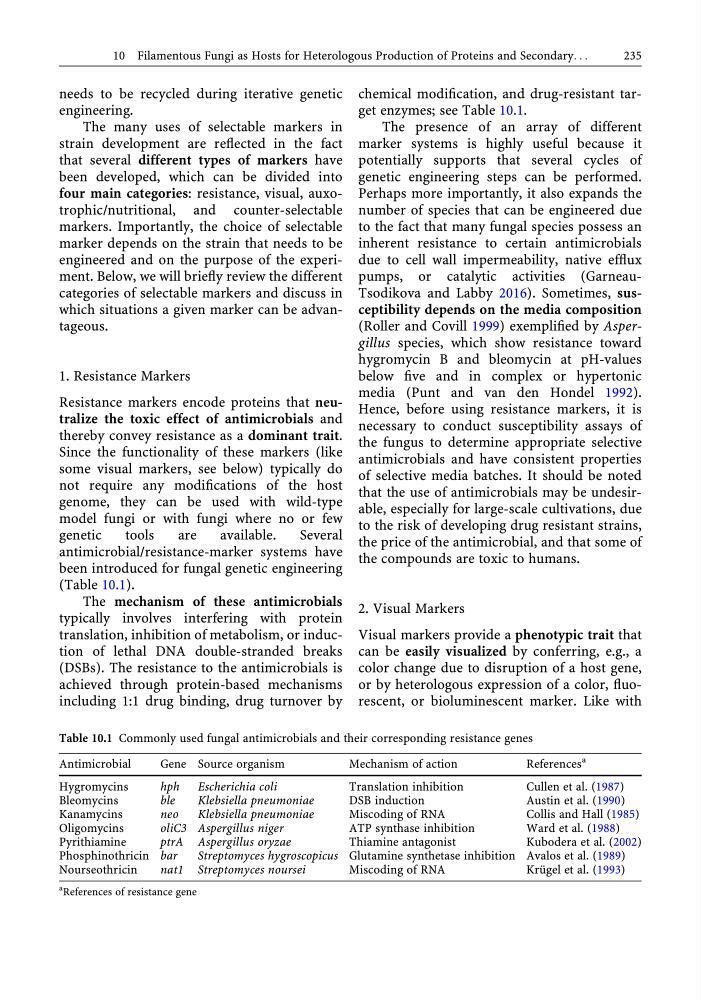
antimicrobial/resistance-marker systems have
been introduced for fungal genetic engineering
(Table 10.1).
The mechanism of these antimicrobials
typically involves interfering with protein
translation, inhibition of metabolism, or induction of lethal DNA double-stranded breaks
(DSBs). The resistance to the antimicrobials is
achieved through protein-based mechanisms
including 1:1 drug binding, drug turnover by
chemical modification, and drug-resistant target enzymes; see Table 10.1.
The presence of an array of different
marker systems is highly useful because it
potentially supports that several cycles of
genetic engineering steps can be performed.
Perhaps more importantly, it also expands the
number of species that can be engineered due
to the fact that many fungal species possess an
inherent resistance to certain antimicrobials
due to cell wall impermeability, native efflux
pumps, or catalytic activities (GarneauTsodikova and Labby 2016). Sometimes, susceptibility depends on the media composition
(Roller and Covill 1999) exemplified by Aspergillus species, which show resistance toward
hygromycin B and bleomycin at pH-values
below five and in complex or hypertonic
media (Punt and van den Hondel 1992).
Hence, before using resistance markers, it is
necessary to conduct susceptibility assays of
the fungus to determine appropriate selective
antimicrobials and have consistent properties
of selective media batches. It should be noted
that the use of antimicrobials may be undesirable, especially for large-scale cultivations, due
to the risk of developing drug resistant strains,
the price of the antimicrobial, and that some of
the compounds are toxic to humans.
2. Visual Markers
Visual markers provide a phenotypic trait that
can be easily visualized by conferring, e.g., a
color change due to disruption of a host gene,
or by heterologous expression of a color, fluorescent, or bioluminescent marker. Like with
Table 10.1 Commonly used fungal antimicrobials and their corresponding resistance genes
Antimicrobial
Gene Source organism
Mechanism of action
References
a
Hygromycins
hph Escherichia coli
Translation inhibition
Cullen et al. (1987)
Bleomycins
ble
Klebsiella pneumoniae
DSB induction
Austin et al. (1990)
Kanamycins
neo
Klebsiella pneumoniae
Miscoding of RNA
Collis and Hall (1985)
Oligomycins
oliC3 Aspergillus niger
ATP synthase inhibition
Ward et al. (1988)
Pyrithiamine
ptrA Aspergillus oryzae
Thiamine antagonist
Kubodera et al. (2002)
Phosphinothricin bar
Streptomyces hygroscopicus Glutamine synthetase inhibition Avalos et al. (1989)
Nourseothricin
nat1 Streptomyces noursei
Miscoding of RNA
Kru ¨gel et al. (1993)
a
References of resistance gene
10 Filamentous Fungi as Hosts for Heterologous Production of Proteins and Secondary. . .
235
engineering.
The many uses of selectable markers in
strain development are reflected in the fact
that several different types of markers have
been developed, which can be divided into
four main categories: resistance, visual, auxotrophic/nutritional, and counter-selectable
markers. Importantly, the choice of selectable
marker depends on the strain that needs to be
engineered and on the purpose of the experiment. Below, we will briefly review the different
categories of selectable markers and discuss in
which situations a given marker can be advantageous.
1. Resistance Markers
Resistance markers encode proteins that neutralize the toxic effect of antimicrobials and
thereby convey resistance as a dominant trait.
Since the functionality of these markers (like
some visual markers, see below) typically do
not require any modifications of the host
genome, they can be used with wild-type
model fungi or with fungi where no or few
genetic
tools
are
available.
Several
antimicrobial/resistance-marker systems have
been introduced for fungal genetic engineering
(Table 10.1).
The mechanism of these antimicrobials
typically involves interfering with protein
translation, inhibition of metabolism, or induction of lethal DNA double-stranded breaks
(DSBs). The resistance to the antimicrobials is
achieved through protein-based mechanisms
including 1:1 drug binding, drug turnover by
chemical modification, and drug-resistant target enzymes; see Table 10.1.
The presence of an array of different
marker systems is highly useful because it
potentially supports that several cycles of
genetic engineering steps can be performed.
Perhaps more importantly, it also expands the
number of species that can be engineered due
to the fact that many fungal species possess an
inherent resistance to certain antimicrobials
due to cell wall impermeability, native efflux
pumps, or catalytic activities (GarneauTsodikova and Labby 2016). Sometimes, susceptibility depends on the media composition
(Roller and Covill 1999) exemplified by Aspergillus species, which show resistance toward
hygromycin B and bleomycin at pH-values
below five and in complex or hypertonic
media (Punt and van den Hondel 1992).
Hence, before using resistance markers, it is
necessary to conduct susceptibility assays of
the fungus to determine appropriate selective
antimicrobials and have consistent properties
of selective media batches. It should be noted
that the use of antimicrobials may be undesirable, especially for large-scale cultivations, due
to the risk of developing drug resistant strains,
the price of the antimicrobial, and that some of
the compounds are toxic to humans.
2. Visual Markers
Visual markers provide a phenotypic trait that
can be easily visualized by conferring, e.g., a
color change due to disruption of a host gene,
or by heterologous expression of a color, fluorescent, or bioluminescent marker. Like with
Table 10.1 Commonly used fungal antimicrobials and their corresponding resistance genes
Antimicrobial
Gene Source organism
Mechanism of action
References
a
Hygromycins
hph Escherichia coli
Translation inhibition
Cullen et al. (1987)
Bleomycins
ble
Klebsiella pneumoniae
DSB induction
Austin et al. (1990)
Kanamycins
neo
Klebsiella pneumoniae
Miscoding of RNA
Collis and Hall (1985)
Oligomycins
oliC3 Aspergillus niger
ATP synthase inhibition
Ward et al. (1988)
Pyrithiamine
ptrA Aspergillus oryzae
Thiamine antagonist
Kubodera et al. (2002)
Phosphinothricin bar
Streptomyces hygroscopicus Glutamine synthetase inhibition Avalos et al. (1989)
Nourseothricin
nat1 Streptomyces noursei
Miscoding of RNA
Kru ¨gel et al. (1993)
a
References of resistance gene
10 Filamentous Fungi as Hosts for Heterologous Production of Proteins and Secondary. . .
235