

inserted by iterative gene targeting using a
recyclable marker (see Sect. III.B.5). Strain construction with these methods is cumbersome
and restricts the method to biosynthetic pathways composed of a small number of genes.
However, these limitations can be dramatically
reduced by constructing the strains via
CRISPR-based multiplexed marker-free gene
insertions.
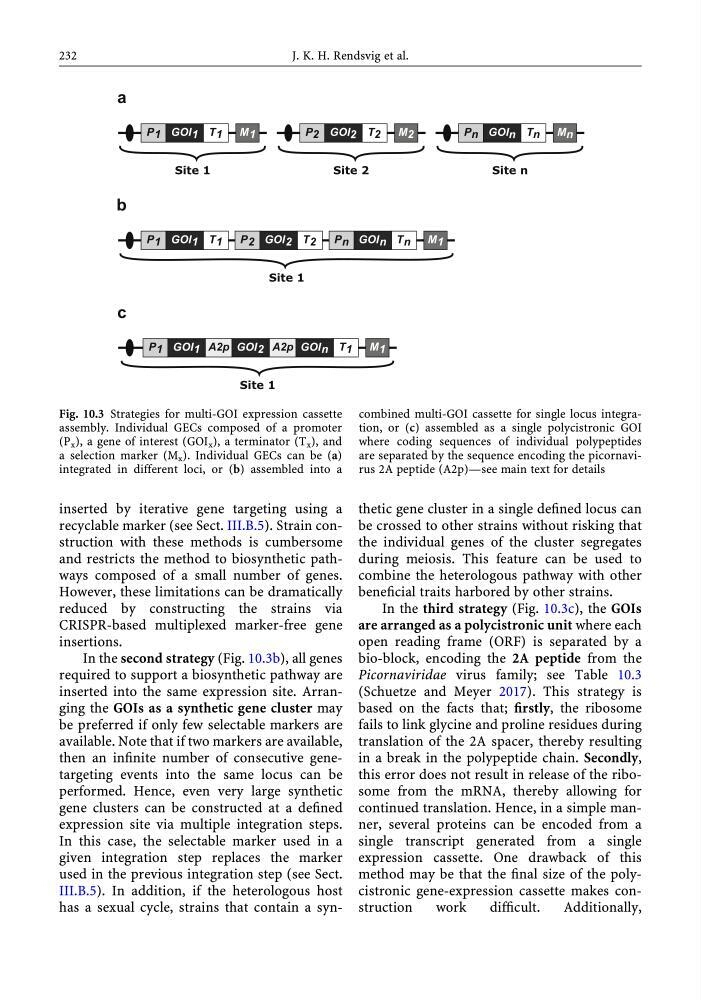
In the second strategy (Fig. 10.3b), all genes
required to support a biosynthetic pathway are
inserted into the same expression site. Arranging the GOIs as a synthetic gene cluster may
be preferred if only few selectable markers are
available. Note that if two markers are available,
then an infinite number of consecutive genetargeting events into the same locus can be
performed. Hence, even very large synthetic
gene clusters can be constructed at a defined
expression site via multiple integration steps.
In this case, the selectable marker used in a
given integration step replaces the marker
used in the previous integration step (see Sect.
III.B.5). In addition, if the heterologous host
has a sexual cycle, strains that contain a synthetic gene cluster in a single defined locus can
be crossed to other strains without risking that
the individual genes of the cluster segregates
during meiosis. This feature can be used to
combine the heterologous pathway with other
beneficial traits harbored by other strains.
In the third strategy (Fig. 10.3c), the GOIs
are arranged as a polycistronic unit where each
open reading frame (ORF) is separated by a
bio-block, encoding the 2A peptide from the
Picornaviridae virus family; see Table 10.3
(Schuetze and Meyer 2017). This strategy is
based on the facts that; firstly, the ribosome
fails to link glycine and proline residues during
translation of the 2A spacer, thereby resulting
in a break in the polypeptide chain. Secondly,
this error does not result in release of the ribosome from the mRNA, thereby allowing for
continued translation. Hence, in a simple manner, several proteins can be encoded from a
single transcript generated from a single
expression cassette. One drawback of this
method may be that the final size of the polycistronic gene-expression cassette makes construction
work
difficult.
Additionally,
c
a
b
Site 1
T n
GOI n
P 1 GOI 1 T 1
M 1
P 2 GOI 2 T 2
P n
Site 1
T 1
GOI n
P 1 GOI 1
M 1
GOI 2 A2p
A2p
Site n
Site 2
P n GOI n T n
M n
P 2 GOI 2 T 2
M 2
Site 1
P 1 GOI 1 T 1
M 1
Fig. 10.3 Strategies for multi-GOI expression cassette
assembly. Individual GECs composed of a promoter
(P x ), a gene of interest (GOI x ), a terminator (T x ), and
a selection marker (M x ). Individual GECs can be (a)
integrated in different loci, or (b) assembled into a
combined multi-GOI cassette for single locus integration, or (c) assembled as a single polycistronic GOI
where coding sequences of individual polypeptides
are separated by the sequence encoding the picornavirus 2A peptide (A2p)—see main text for details
232
J. K. H. Rendsvig et al.
recyclable marker (see Sect. III.B.5). Strain construction with these methods is cumbersome
and restricts the method to biosynthetic pathways composed of a small number of genes.
However, these limitations can be dramatically
reduced by constructing the strains via
CRISPR-based multiplexed marker-free gene
insertions.
In the second strategy (Fig. 10.3b), all genes
required to support a biosynthetic pathway are
inserted into the same expression site. Arranging the GOIs as a synthetic gene cluster may
be preferred if only few selectable markers are
available. Note that if two markers are available,
then an infinite number of consecutive genetargeting events into the same locus can be
performed. Hence, even very large synthetic
gene clusters can be constructed at a defined
expression site via multiple integration steps.
In this case, the selectable marker used in a
given integration step replaces the marker
used in the previous integration step (see Sect.
III.B.5). In addition, if the heterologous host
has a sexual cycle, strains that contain a synthetic gene cluster in a single defined locus can
be crossed to other strains without risking that
the individual genes of the cluster segregates
during meiosis. This feature can be used to
combine the heterologous pathway with other
beneficial traits harbored by other strains.
In the third strategy (Fig. 10.3c), the GOIs
are arranged as a polycistronic unit where each
open reading frame (ORF) is separated by a
bio-block, encoding the 2A peptide from the
Picornaviridae virus family; see Table 10.3
(Schuetze and Meyer 2017). This strategy is
based on the facts that; firstly, the ribosome
fails to link glycine and proline residues during
translation of the 2A spacer, thereby resulting
in a break in the polypeptide chain. Secondly,
this error does not result in release of the ribosome from the mRNA, thereby allowing for
continued translation. Hence, in a simple manner, several proteins can be encoded from a
single transcript generated from a single
expression cassette. One drawback of this
method may be that the final size of the polycistronic gene-expression cassette makes construction
work
difficult.
Additionally,
c
a
b
Site 1
T n
GOI n
P 1 GOI 1 T 1
M 1
P 2 GOI 2 T 2
P n
Site 1
T 1
GOI n
P 1 GOI 1
M 1
GOI 2 A2p
A2p
Site n
Site 2
P n GOI n T n
M n
P 2 GOI 2 T 2
M 2
Site 1
P 1 GOI 1 T 1
M 1
Fig. 10.3 Strategies for multi-GOI expression cassette
assembly. Individual GECs composed of a promoter
(P x ), a gene of interest (GOI x ), a terminator (T x ), and
a selection marker (M x ). Individual GECs can be (a)
integrated in different loci, or (b) assembled into a
combined multi-GOI cassette for single locus integration, or (c) assembled as a single polycistronic GOI
where coding sequences of individual polypeptides
are separated by the sequence encoding the picornavirus 2A peptide (A2p)—see main text for details
232
J. K. H. Rendsvig et al.