

lans, the veA homolog of N. crassa ve-1 regulates asexual sporulation (Bayram et al. 2008c).
Rewiring of transcriptional regulation is presumably, together with gene mutations and
gene transfer, an important driving force to
evolve fungal divergences and to adapt to different lifestyles (Nocedal et al. 2017).
III. Epigenetics and Fungal Secondary
Metabolism and Development
Secondary metabolite gene clusters evolved
either from gene relocations with sometimes
prior gene duplication or, in rarer cases, by
horizontal gene cluster transfer from bacteria
to fungal ancestors (Rokas et al. 2018). Clustering offers the economic advantage that these
genes can be transcriptionally co-regulated by
changes in the chromatin structure through
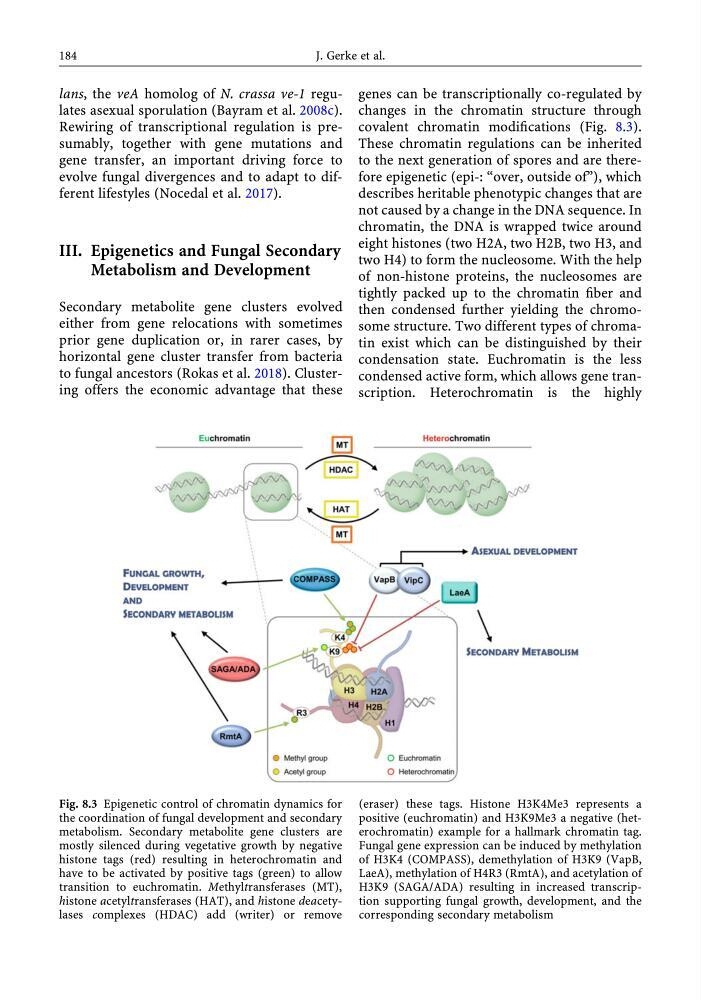
covalent chromatin modifications (Fig. 8.3).
These chromatin regulations can be inherited
to the next generation of spores and are therefore epigenetic (epi-: “over, outside of”), which
describes heritable phenotypic changes that are
not caused by a change in the DNA sequence. In
chromatin, the DNA is wrapped twice around
eight histones (two H2A, two H2B, two H3, and
two H4) to form the nucleosome. With the help
of non-histone proteins, the nucleosomes are
tightly packed up to the chromatin fiber and
then condensed further yielding the chromosome structure. Two different types of chromatin exist which can be distinguished by their
condensation state. Euchromatin is the less
condensed active form, which allows gene transcription. Heterochromatin is the highly
Fig. 8.3 Epigenetic control of chromatin dynamics for
the coordination of fungal development and secondary
metabolism. Secondary metabolite gene clusters are
mostly silenced during vegetative growth by negative
histone tags (red) resulting in heterochromatin and
have to be activated by positive tags (green) to allow
transition to euchromatin. Methyltransferases (MT),
histone acetyltransferases (HAT), and histone deacetylases complexes (HDAC) add (writer) or remove
(eraser) these tags. Histone H3K4Me3 represents a
positive (euchromatin) and H3K9Me3 a negative (heterochromatin) example for a hallmark chromatin tag.
Fungal gene expression can be induced by methylation
of H3K4 (COMPASS), demethylation of H3K9 (VapB,
LaeA), methylation of H4R3 (RmtA), and acetylation of
H3K9 (SAGA/ADA) resulting in increased transcription supporting fungal growth, development, and the
corresponding secondary metabolism
184
J. Gerke et al.
Rewiring of transcriptional regulation is presumably, together with gene mutations and
gene transfer, an important driving force to
evolve fungal divergences and to adapt to different lifestyles (Nocedal et al. 2017).
III. Epigenetics and Fungal Secondary
Metabolism and Development
Secondary metabolite gene clusters evolved
either from gene relocations with sometimes
prior gene duplication or, in rarer cases, by
horizontal gene cluster transfer from bacteria
to fungal ancestors (Rokas et al. 2018). Clustering offers the economic advantage that these
genes can be transcriptionally co-regulated by
changes in the chromatin structure through
covalent chromatin modifications (Fig. 8.3).
These chromatin regulations can be inherited
to the next generation of spores and are therefore epigenetic (epi-: “over, outside of”), which
describes heritable phenotypic changes that are
not caused by a change in the DNA sequence. In
chromatin, the DNA is wrapped twice around
eight histones (two H2A, two H2B, two H3, and
two H4) to form the nucleosome. With the help
of non-histone proteins, the nucleosomes are
tightly packed up to the chromatin fiber and
then condensed further yielding the chromosome structure. Two different types of chromatin exist which can be distinguished by their
condensation state. Euchromatin is the less
condensed active form, which allows gene transcription. Heterochromatin is the highly
Fig. 8.3 Epigenetic control of chromatin dynamics for
the coordination of fungal development and secondary
metabolism. Secondary metabolite gene clusters are
mostly silenced during vegetative growth by negative
histone tags (red) resulting in heterochromatin and
have to be activated by positive tags (green) to allow
transition to euchromatin. Methyltransferases (MT),
histone acetyltransferases (HAT), and histone deacetylases complexes (HDAC) add (writer) or remove
(eraser) these tags. Histone H3K4Me3 represents a
positive (euchromatin) and H3K9Me3 a negative (heterochromatin) example for a hallmark chromatin tag.
Fungal gene expression can be induced by methylation
of H3K4 (COMPASS), demethylation of H3K9 (VapB,
LaeA), methylation of H4R3 (RmtA), and acetylation of
H3K9 (SAGA/ADA) resulting in increased transcription supporting fungal growth, development, and the
corresponding secondary metabolism
184
J. Gerke et al.