

2. Light Response: The Fungal Vision
Almost all fungi are able to perceive changes in
light or temperature conditions. Light is perceived as a signal and also as a stressor and
induces a wide range of responses by inducing
different genetic networks resulting in changes
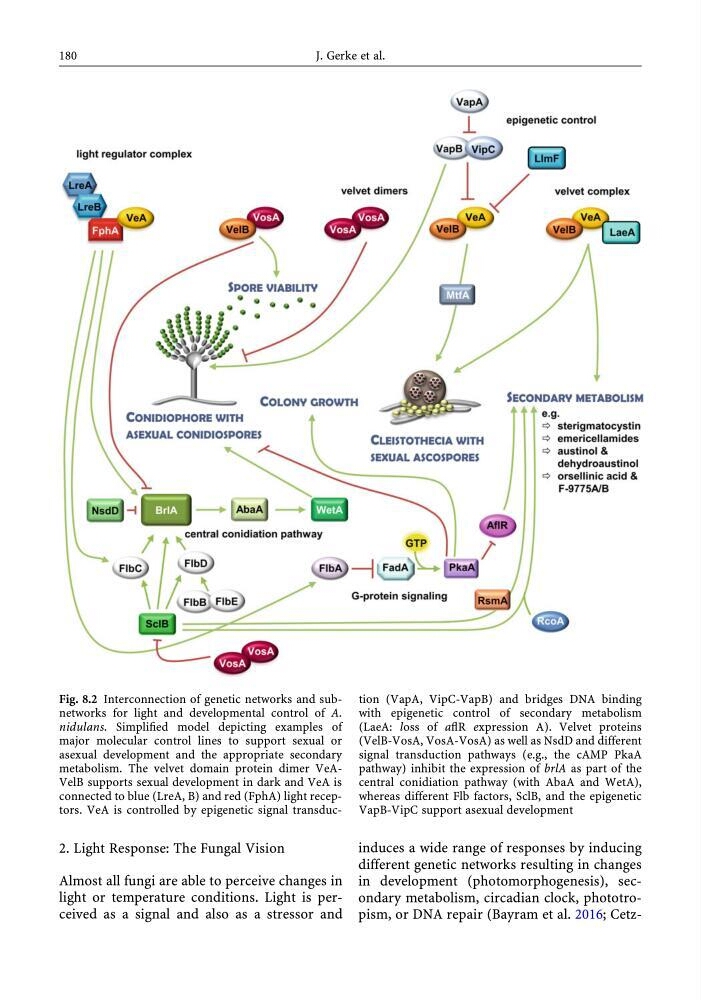
in development (photomorphogenesis), secondary metabolism, circadian clock, phototropism, or DNA repair (Bayram et al. 2016; CetzFig. 8.2 Interconnection of genetic networks and subnetworks for light and developmental control of A.
nidulans. Simplified model depicting examples of
major molecular control lines to support sexual or
asexual development and the appropriate secondary
metabolism. The velvet domain protein dimer VeAVelB supports sexual development in dark and VeA is
connected to blue (LreA, B) and red (FphA) light receptors. VeA is controlled by epigenetic signal transduction (VapA, VipC-VapB) and bridges DNA binding
with epigenetic control of secondary metabolism
(LaeA: loss of aflR expression A). Velvet proteins
(VelB-VosA, VosA-VosA) as well as NsdD and different
signal transduction pathways (e.g., the cAMP PkaA
pathway) inhibit the expression of brlA as part of the
central conidiation pathway (with AbaA and WetA),
whereas different Flb factors, SclB, and the epigenetic
VapB-VipC support asexual development
180
J. Gerke et al.
Almost all fungi are able to perceive changes in
light or temperature conditions. Light is perceived as a signal and also as a stressor and
induces a wide range of responses by inducing
different genetic networks resulting in changes
in development (photomorphogenesis), secondary metabolism, circadian clock, phototropism, or DNA repair (Bayram et al. 2016; CetzFig. 8.2 Interconnection of genetic networks and subnetworks for light and developmental control of A.
nidulans. Simplified model depicting examples of
major molecular control lines to support sexual or
asexual development and the appropriate secondary
metabolism. The velvet domain protein dimer VeAVelB supports sexual development in dark and VeA is
connected to blue (LreA, B) and red (FphA) light receptors. VeA is controlled by epigenetic signal transduction (VapA, VipC-VapB) and bridges DNA binding
with epigenetic control of secondary metabolism
(LaeA: loss of aflR expression A). Velvet proteins
(VelB-VosA, VosA-VosA) as well as NsdD and different
signal transduction pathways (e.g., the cAMP PkaA
pathway) inhibit the expression of brlA as part of the
central conidiation pathway (with AbaA and WetA),
whereas different Flb factors, SclB, and the epigenetic
VapB-VipC support asexual development
180
J. Gerke et al.