

the nature of their genome organization: the
discovery of homokaryotic and dikaryotic
strains of R. irregularis (Ropars et al. 2016;
Corradi and Brachmann 2017) and the finding
that distinct nuclear genotypes can undergo
recombination events (possibly through a meiotic process) in dikaryotic mycelia (Chen et al.
2018b) highlight the potential of AM fungi for
sexual reproduction and offer perspectives for
genetic strain improvement. Together with
functional analyses, this knowledge will be fundamental to allow a selection of AM fungi with
specific impact on plant performance.
On the plant side, susceptibility to AM
fungi, evaluated by the measurement of colonized root length, depends on several environmental factors, among which soil nutrient
availability, in particular that of P, is a crucial
parameter, with high fertilization having generally a negative effect (Sawers et al. 2010; Chu
et al. 2013). In addition, not only susceptibility
to AM fungi but also the mycorrhizal growth
response depends on the plant genotype. It is
worth to note that current literature data, however, could not highlight a clear correlation
between the amount of colonization and plant
performance (Koch et al. 2017; Sawers et al.
2017; Lekberg and Koide 2005).
There is increasing interest in exploring the
variations in AM susceptibility and responsiveness in cultivated accessions and, through
genome-wide association analyses, in identifying the genetic determinants associated to those
traits. One of the first large-scale studies considering genetic variation in AM fungi susceptibility was carried out on 94 wheat (Triticum
aestivum) genotypes inoculated by a mixed
inoculum of 3 AM species (Lehnert et al.
2017). Interestingly, six quantitative trait loci
(QTLs) associated with colonization level
could be identified: they contained genes
related to cell wall metabolism and defense,
suggesting that they may be involved in
controlling root colonization.
A recent work analyzed a large collection of
wild, domesticated, and cultivated lines of Triticum turgidum ssp. durum colonized by two
AM fungi (Funneliformis mosseae and Rhizoglomus irregulare). Seven QTLs were linked to
mycorrhizal susceptibility, and candidate proteins with roles in host-parasite interactions,
degradation of cellular proteins, homeostasis
regulation, plant growth, and disease/defense
were identified (De Vita et al. 2018).
Concerning the responsiveness to AM
fungi, Sawers et al. (2017) analyzed the growth
response of 30 maize lines upon colonization by
F. mosseae; variations in shoot dry weight and
shoot Pi content were observed, and, interestingly, these correlated with the amount of
extraradical mycelium, suggesting a plantfungus reciprocal effect on growth performances. The molecular bases for this effect are
completely unknown and may rely on differential regulation of genes involved in nutrient
transport in both partners. In addition, the
concentration of 19 elements was also determined in roots and leaves of the same maize
lines (Ramirez-Flores et al. 2017): a number of
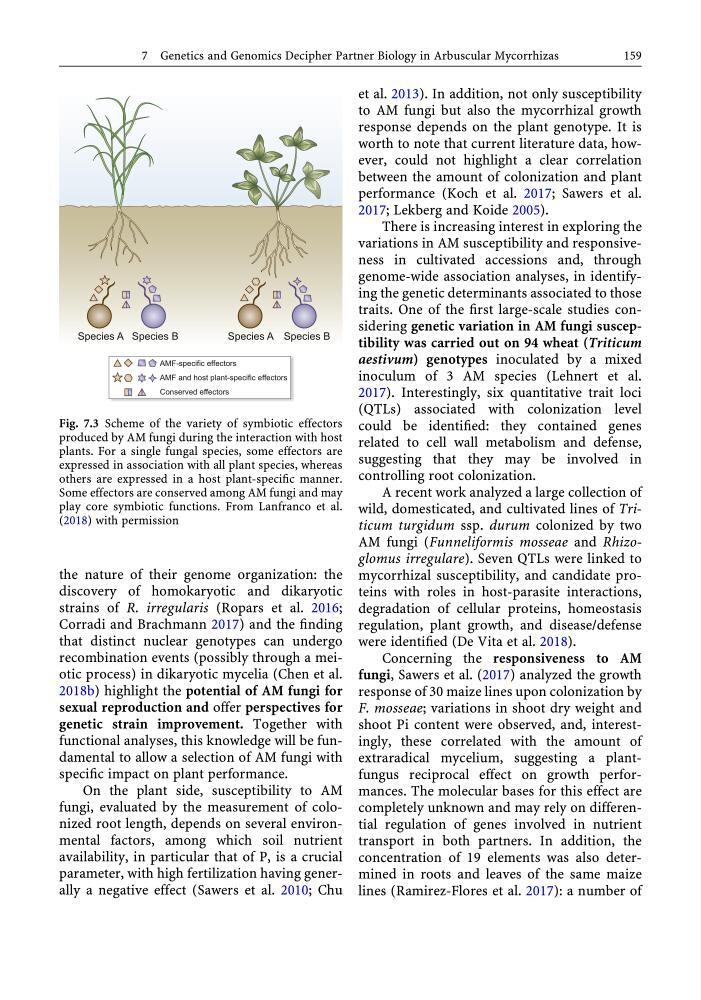
AMF-specific effectors
AMF and host plant-specific effectors
Conserved effectors
Species A Species B
Species A Species B
Fig. 7.3 Scheme of the variety of symbiotic effectors
produced by AM fungi during the interaction with host
plants. For a single fungal species, some effectors are
expressed in association with all plant species, whereas
others are expressed in a host plant-specific manner.
Some effectors are conserved among AM fungi and may
play core symbiotic functions. From Lanfranco et al.
(2018) with permission
7 Genetics and Genomics Decipher Partner Biology in Arbuscular Mycorrhizas
159
discovery of homokaryotic and dikaryotic
strains of R. irregularis (Ropars et al. 2016;
Corradi and Brachmann 2017) and the finding
that distinct nuclear genotypes can undergo
recombination events (possibly through a meiotic process) in dikaryotic mycelia (Chen et al.
2018b) highlight the potential of AM fungi for
sexual reproduction and offer perspectives for
genetic strain improvement. Together with
functional analyses, this knowledge will be fundamental to allow a selection of AM fungi with
specific impact on plant performance.
On the plant side, susceptibility to AM
fungi, evaluated by the measurement of colonized root length, depends on several environmental factors, among which soil nutrient
availability, in particular that of P, is a crucial
parameter, with high fertilization having generally a negative effect (Sawers et al. 2010; Chu
et al. 2013). In addition, not only susceptibility
to AM fungi but also the mycorrhizal growth
response depends on the plant genotype. It is
worth to note that current literature data, however, could not highlight a clear correlation
between the amount of colonization and plant
performance (Koch et al. 2017; Sawers et al.
2017; Lekberg and Koide 2005).
There is increasing interest in exploring the
variations in AM susceptibility and responsiveness in cultivated accessions and, through
genome-wide association analyses, in identifying the genetic determinants associated to those
traits. One of the first large-scale studies considering genetic variation in AM fungi susceptibility was carried out on 94 wheat (Triticum
aestivum) genotypes inoculated by a mixed
inoculum of 3 AM species (Lehnert et al.
2017). Interestingly, six quantitative trait loci
(QTLs) associated with colonization level
could be identified: they contained genes
related to cell wall metabolism and defense,
suggesting that they may be involved in
controlling root colonization.
A recent work analyzed a large collection of
wild, domesticated, and cultivated lines of Triticum turgidum ssp. durum colonized by two
AM fungi (Funneliformis mosseae and Rhizoglomus irregulare). Seven QTLs were linked to
mycorrhizal susceptibility, and candidate proteins with roles in host-parasite interactions,
degradation of cellular proteins, homeostasis
regulation, plant growth, and disease/defense
were identified (De Vita et al. 2018).
Concerning the responsiveness to AM
fungi, Sawers et al. (2017) analyzed the growth
response of 30 maize lines upon colonization by
F. mosseae; variations in shoot dry weight and
shoot Pi content were observed, and, interestingly, these correlated with the amount of
extraradical mycelium, suggesting a plantfungus reciprocal effect on growth performances. The molecular bases for this effect are
completely unknown and may rely on differential regulation of genes involved in nutrient
transport in both partners. In addition, the
concentration of 19 elements was also determined in roots and leaves of the same maize
lines (Ramirez-Flores et al. 2017): a number of
AMF-specific effectors
AMF and host plant-specific effectors
Conserved effectors
Species A Species B
Species A Species B
Fig. 7.3 Scheme of the variety of symbiotic effectors
produced by AM fungi during the interaction with host
plants. For a single fungal species, some effectors are
expressed in association with all plant species, whereas
others are expressed in a host plant-specific manner.
Some effectors are conserved among AM fungi and may
play core symbiotic functions. From Lanfranco et al.
(2018) with permission
7 Genetics and Genomics Decipher Partner Biology in Arbuscular Mycorrhizas
159