

ANK coding region at the 3
0 end of the coding sequence.
Together these observations suggest that there is an
evolutionary necessity associated with the generation
of variability in these fungal NLR-encoding genes.
In the brown algae Ectocarpus siliculosus, NB-ARC
TPR-encoding genes were also found to display an
unusual gene organization with exons encoding one
single TPR-repeat and exon shuffling taking place
(Zambounis et al. 2012). Apparently, different evolutionary mechanisms ensure high functional variations
in superstructure-forming repeat domains in NLR-type
proteins.
Quite in line with what is known from the
evolution of NLR repertoires in plant models,
genes encoding proteins of this family in fungi
apparently undergo death-and-birth evolution
with common, lineage-, species-, or even strainspecific expansions (Dyrka et al. 2014; Fedorova et al. 2008; Iotti et al. 2012; Kubicek et al.
2011; Martin et al. 2008; Van der Nest et al.
2014; Zuccaro et al. 2011). For example, this
phenomenon is apparent when the NLR repertoires are compared in species for which genomics data for several strains are available. A
significant fraction of the NLRs are restricted
to one strain, and NLR genes are more variable
than the rest of the genome (Dyrka et al. 2014).
Importantly, this gene family appears plastic in
the sense that phylogenetic analyses suggest
that domain architecture re-inventions frequently occur. Different effector/signaling
domains are re-shuffled with distinct NOD
and repeat domains. NLR domain modularity
is illustrated by the fact that of the 60 possible
domain architectures that can theoretically be
achieved by free combinatorial association of
the 10 most common N-terminal domain types
with 2 classes of NBDs and 3 classes of repeat
domains, 39 are actually found in our current
dataset.
Considering the specific mechanisms of
repeat domain diversification, the death-andbirth evolution with lineage-specific expansion,
and the common domain architecture reinvention events, the NLR family in fungi
stands out as highly dynamic and variable. A
variety of comparative genomic approaches
have pointed to the fact that NLR-encoding
genes show expansions in specific lineages.
Significant NLR gene expansion was reported
in mycoparasitic, lichen-forming, mycorrhizal,
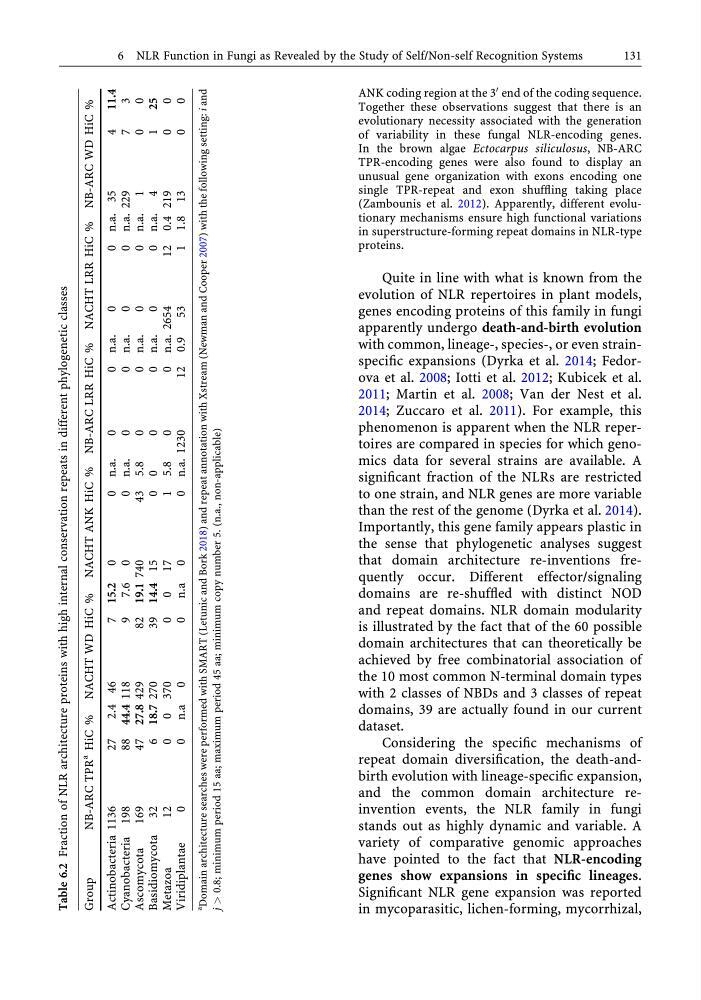
Table 6.2 Fraction of NLR architecture proteins with high internal conservation repeats in different phylogenetic classes
Group
NB-ARC TPR
a
HiC % NACHT WD HiC % NACHT ANK HiC % NB-ARC LRR HiC % NACHT LRR HiC % NB-ARC WD HiC %
Actinobacteria 1136
27
2.4 46
7
15.2 0
0 n.a.
0
0 n.a.
0
0 n.a. 35
4
11.4
Cyanobacteria 198
88
44.4 118
9
7.6 0
0 n.a.
0
0 n.a.
0
0 n.a. 229
7
3
Ascomycota
169
47
27.8 429
82
19.1 740
43 5.8
0
0 n.a.
0
0 n.a. 1
0
0
Basidiomycota 32
6
18.7 270
39
14.4 15
0 0
0
0 n.a.
0
0 n.a. 4
1
25
Metazoa
12
0
0 370
0
0
17
1 5.8
0
0 n.a. 2654
12 0.4 219
0
0
Viridiplantae
0
0 n.a 0
0 n.a 0
0 n.a. 1230
12 0.9
53
1 1.8 13
0
0
a
Domain architecture searches were performed with SMART (Letunic and Bork 2018) and repeat annotation with Xstream (Newman and Cooper 2007) with the following setting: i and
j
> 0.8; minimum period 15 aa; maximum period 45 aa; minimum copy number 5. (n.a., non-applicable)
6 NLR Function in Fungi as Revealed by the Study of Self/Non-self Recognition Systems
131
0 end of the coding sequence.
Together these observations suggest that there is an
evolutionary necessity associated with the generation
of variability in these fungal NLR-encoding genes.
In the brown algae Ectocarpus siliculosus, NB-ARC
TPR-encoding genes were also found to display an
unusual gene organization with exons encoding one
single TPR-repeat and exon shuffling taking place
(Zambounis et al. 2012). Apparently, different evolutionary mechanisms ensure high functional variations
in superstructure-forming repeat domains in NLR-type
proteins.
Quite in line with what is known from the
evolution of NLR repertoires in plant models,
genes encoding proteins of this family in fungi
apparently undergo death-and-birth evolution
with common, lineage-, species-, or even strainspecific expansions (Dyrka et al. 2014; Fedorova et al. 2008; Iotti et al. 2012; Kubicek et al.
2011; Martin et al. 2008; Van der Nest et al.
2014; Zuccaro et al. 2011). For example, this
phenomenon is apparent when the NLR repertoires are compared in species for which genomics data for several strains are available. A
significant fraction of the NLRs are restricted
to one strain, and NLR genes are more variable
than the rest of the genome (Dyrka et al. 2014).
Importantly, this gene family appears plastic in
the sense that phylogenetic analyses suggest
that domain architecture re-inventions frequently occur. Different effector/signaling
domains are re-shuffled with distinct NOD
and repeat domains. NLR domain modularity
is illustrated by the fact that of the 60 possible
domain architectures that can theoretically be
achieved by free combinatorial association of
the 10 most common N-terminal domain types
with 2 classes of NBDs and 3 classes of repeat
domains, 39 are actually found in our current
dataset.
Considering the specific mechanisms of
repeat domain diversification, the death-andbirth evolution with lineage-specific expansion,
and the common domain architecture reinvention events, the NLR family in fungi
stands out as highly dynamic and variable. A
variety of comparative genomic approaches
have pointed to the fact that NLR-encoding
genes show expansions in specific lineages.
Significant NLR gene expansion was reported
in mycoparasitic, lichen-forming, mycorrhizal,
Table 6.2 Fraction of NLR architecture proteins with high internal conservation repeats in different phylogenetic classes
Group
NB-ARC TPR
a
HiC % NACHT WD HiC % NACHT ANK HiC % NB-ARC LRR HiC % NACHT LRR HiC % NB-ARC WD HiC %
Actinobacteria 1136
27
2.4 46
7
15.2 0
0 n.a.
0
0 n.a.
0
0 n.a. 35
4
11.4
Cyanobacteria 198
88
44.4 118
9
7.6 0
0 n.a.
0
0 n.a.
0
0 n.a. 229
7
3
Ascomycota
169
47
27.8 429
82
19.1 740
43 5.8
0
0 n.a.
0
0 n.a. 1
0
0
Basidiomycota 32
6
18.7 270
39
14.4 15
0 0
0
0 n.a.
0
0 n.a. 4
1
25
Metazoa
12
0
0 370
0
0
17
1 5.8
0
0 n.a. 2654
12 0.4 219
0
0
Viridiplantae
0
0 n.a 0
0 n.a 0
0 n.a. 1230
12 0.9
53
1 1.8 13
0
0
a
Domain architecture searches were performed with SMART (Letunic and Bork 2018) and repeat annotation with Xstream (Newman and Cooper 2007) with the following setting: i and
j
> 0.8; minimum period 15 aa; maximum period 45 aa; minimum copy number 5. (n.a., non-applicable)
6 NLR Function in Fungi as Revealed by the Study of Self/Non-self Recognition Systems
131