

unlike strains differing at one or more het
loci (Saupe 2000). Although incompatibility
appears to be ubiquitous in filamentous fungi,
the species Neurospora crassa, Cryphonectria
parasitica, and Podospora anserina stand out
so far as the only species in which heterokaryon
incompatibility genes have been characterized
at the molecular level. In each of these species,
at least one of the known het systems involves
an NLR protein. het-d, het-e, het-r, and nwd2 in
Podospora (Chevanne et al. 2009; Daskalov et al.
2015b; Espagne et al. 2002; Saupe et al. 1995a),
plp-1 in Neurospora (Heller et al. 2018), and
vic2 and vic4 in Cryphonectria (Choi et al.
2012; Zhang et al. 2014) all correspond to
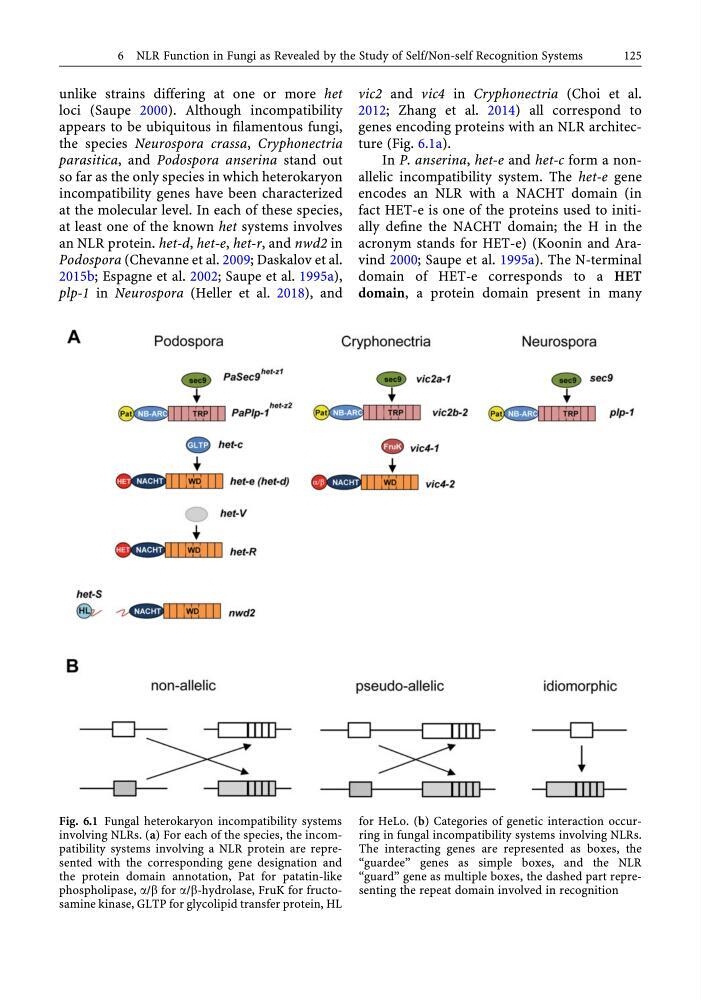
genes encoding proteins with an NLR architecture (Fig. 6.1a).
In P. anserina, het-e and het-c form a nonallelic incompatibility system. The het-e gene
encodes an NLR with a NACHT domain (in
fact HET-e is one of the proteins used to initially define the NACHT domain; the H in the
acronym stands for HET-e) (Koonin and Aravind 2000; Saupe et al. 1995a). The N-terminal
domain of HET-e corresponds to a HET
domain, a protein domain present in many
Fig. 6.1 Fungal heterokaryon incompatibility systems
involving NLRs. (a) For each of the species, the incompatibility systems involving a NLR protein are represented with the corresponding gene designation and
the protein domain annotation, Pat for patatin-like
phospholipase, a/b for a/b-hydrolase, FruK for fructosamine kinase, GLTP for glycolipid transfer protein, HL
for HeLo. (b) Categories of genetic interaction occurring in fungal incompatibility systems involving NLRs.
The interacting genes are represented as boxes, the
“guardee” genes as simple boxes, and the NLR
“guard” gene as multiple boxes, the dashed part representing the repeat domain involved in recognition
6 NLR Function in Fungi as Revealed by the Study of Self/Non-self Recognition Systems
125
loci (Saupe 2000). Although incompatibility
appears to be ubiquitous in filamentous fungi,
the species Neurospora crassa, Cryphonectria
parasitica, and Podospora anserina stand out
so far as the only species in which heterokaryon
incompatibility genes have been characterized
at the molecular level. In each of these species,
at least one of the known het systems involves
an NLR protein. het-d, het-e, het-r, and nwd2 in
Podospora (Chevanne et al. 2009; Daskalov et al.
2015b; Espagne et al. 2002; Saupe et al. 1995a),
plp-1 in Neurospora (Heller et al. 2018), and
vic2 and vic4 in Cryphonectria (Choi et al.
2012; Zhang et al. 2014) all correspond to
genes encoding proteins with an NLR architecture (Fig. 6.1a).
In P. anserina, het-e and het-c form a nonallelic incompatibility system. The het-e gene
encodes an NLR with a NACHT domain (in
fact HET-e is one of the proteins used to initially define the NACHT domain; the H in the
acronym stands for HET-e) (Koonin and Aravind 2000; Saupe et al. 1995a). The N-terminal
domain of HET-e corresponds to a HET
domain, a protein domain present in many
Fig. 6.1 Fungal heterokaryon incompatibility systems
involving NLRs. (a) For each of the species, the incompatibility systems involving a NLR protein are represented with the corresponding gene designation and
the protein domain annotation, Pat for patatin-like
phospholipase, a/b for a/b-hydrolase, FruK for fructosamine kinase, GLTP for glycolipid transfer protein, HL
for HeLo. (b) Categories of genetic interaction occurring in fungal incompatibility systems involving NLRs.
The interacting genes are represented as boxes, the
“guardee” genes as simple boxes, and the NLR
“guard” gene as multiple boxes, the dashed part representing the repeat domain involved in recognition
6 NLR Function in Fungi as Revealed by the Study of Self/Non-self Recognition Systems
125