

C. Circadian Output Interfaces with Many
Cellular Systems
The output generated from the circadian oscillator regulates many vital processes within the
cell, the foremost of which is cellular metabolism. There are connections between the clock
and metabolism that result in changes in clock
output depending on the type of growth media,
as discussed in Sect. IV.A.1, as well as some ion
cycles that may in fact be circadianly-regulated
(Hurley et al. 2014, 2016b; Feeney et al. 2016;
Dunlap and Loros 2016). Overall, gene ontologies related to metabolic functions are highly
enriched for ccgs at both the transcript and
protein levels (Hurley et al. 2014, 2018; Sancar
et al. 2015). These include, at the transcriptional level, the division between anabolic and
catabolic pathways between subjective night
and subjective day, while at the protein level,
there is an overall peak in enzymes in many
energy pathways near circadian dusk (Hurley
et al. 2014, 2018; Sancar et al. 2015). Other
studies have looked at oscillations within the
cell that may occur outside the circadian feedback loop involving the WCC and the FFC,
though many of these oscillations are not in
fact compensated and so cannot be considered
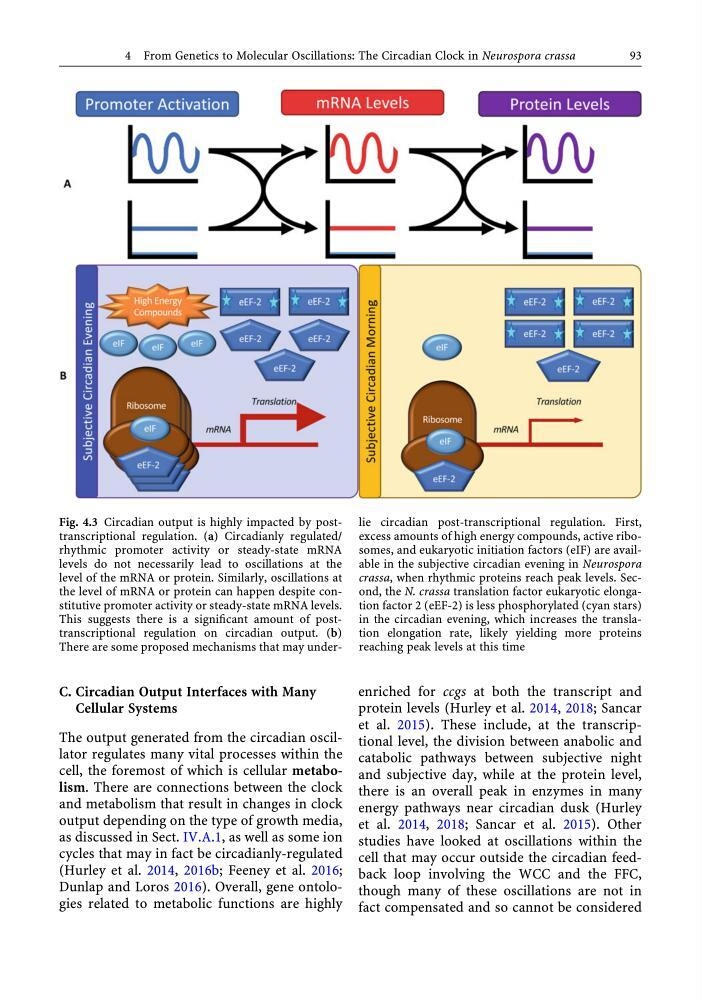
Fig. 4.3 Circadian output is highly impacted by posttranscriptional regulation. (a) Circadianly regulated/
rhythmic promoter activity or steady-state mRNA
levels do not necessarily lead to oscillations at the
level of the mRNA or protein. Similarly, oscillations at
the level of mRNA or protein can happen despite constitutive promoter activity or steady-state mRNA levels.
This suggests there is a significant amount of posttranscriptional regulation on circadian output. (b)
There are some proposed mechanisms that may underlie circadian post-transcriptional regulation. First,
excess amounts of high energy compounds, active ribosomes, and eukaryotic initiation factors (eIF) are available in the subjective circadian evening in Neurospora
crassa, when rhythmic proteins reach peak levels. Second, the N. crassa translation factor eukaryotic elongation factor 2 (eEF-2) is less phosphorylated (cyan stars)
in the circadian evening, which increases the translation elongation rate, likely yielding more proteins
reaching peak levels at this time
4 From Genetics to Molecular Oscillations: The Circadian Clock in Neurospora crassa
93
Cellular Systems
The output generated from the circadian oscillator regulates many vital processes within the
cell, the foremost of which is cellular metabolism. There are connections between the clock
and metabolism that result in changes in clock
output depending on the type of growth media,
as discussed in Sect. IV.A.1, as well as some ion
cycles that may in fact be circadianly-regulated
(Hurley et al. 2014, 2016b; Feeney et al. 2016;
Dunlap and Loros 2016). Overall, gene ontologies related to metabolic functions are highly
enriched for ccgs at both the transcript and
protein levels (Hurley et al. 2014, 2018; Sancar
et al. 2015). These include, at the transcriptional level, the division between anabolic and
catabolic pathways between subjective night
and subjective day, while at the protein level,
there is an overall peak in enzymes in many
energy pathways near circadian dusk (Hurley
et al. 2014, 2018; Sancar et al. 2015). Other
studies have looked at oscillations within the
cell that may occur outside the circadian feedback loop involving the WCC and the FFC,
though many of these oscillations are not in
fact compensated and so cannot be considered
Fig. 4.3 Circadian output is highly impacted by posttranscriptional regulation. (a) Circadianly regulated/
rhythmic promoter activity or steady-state mRNA
levels do not necessarily lead to oscillations at the
level of the mRNA or protein. Similarly, oscillations at
the level of mRNA or protein can happen despite constitutive promoter activity or steady-state mRNA levels.
This suggests there is a significant amount of posttranscriptional regulation on circadian output. (b)
There are some proposed mechanisms that may underlie circadian post-transcriptional regulation. First,
excess amounts of high energy compounds, active ribosomes, and eukaryotic initiation factors (eIF) are available in the subjective circadian evening in Neurospora
crassa, when rhythmic proteins reach peak levels. Second, the N. crassa translation factor eukaryotic elongation factor 2 (eEF-2) is less phosphorylated (cyan stars)
in the circadian evening, which increases the translation elongation rate, likely yielding more proteins
reaching peak levels at this time
4 From Genetics to Molecular Oscillations: The Circadian Clock in Neurospora crassa
93