

35
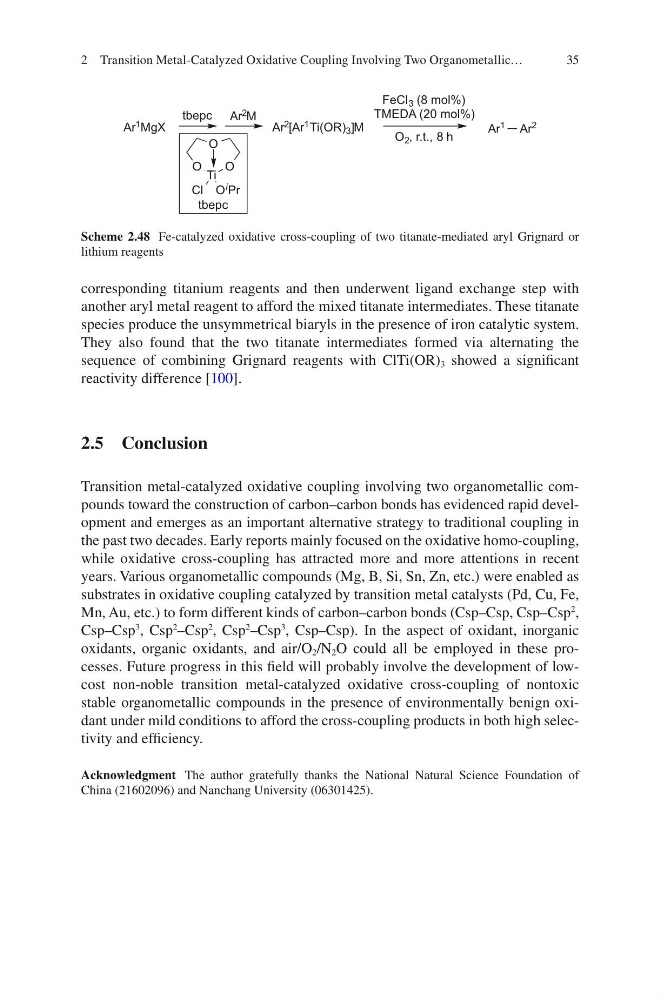
corresponding titanium reagents and then underwent ligand exchange step with
another aryl metal reagent to afford the mixed titanate intermediates. These titanate
species produce the unsymmetrical biaryls in the presence of iron catalytic system.
They also found that the two titanate intermediates formed via alternating the
sequence of combining Grignard reagents with ClTi(OR) 3 showed a significant
reactivity difference [100].
2.5 Conclusion
Transition metal-catalyzed oxidative coupling involving two organometallic compounds toward the construction of carbon–carbon bonds has evidenced rapid development and emerges as an important alternative strategy to traditional coupling in
the past two decades. Early reports mainly focused on the oxidative homo-coupling,
while oxidative cross-coupling has attracted more and more attentions in recent
years. Various organometallic compounds (Mg, B, Si, Sn, Zn, etc.) were enabled as
substrates in oxidative coupling catalyzed by transition metal catalysts (Pd, Cu, Fe,
Mn, Au, etc.) to form different kinds of carbon–carbon bonds (Csp–Csp, Csp–Csp
2
,
Csp–Csp
3
, Csp
2
–Csp
2
, Csp
2
–Csp
3
, Csp–Csp). In the aspect of oxidant, inorganic
oxidants, organic oxidants, and air/O 2 /N 2 O could all be employed in these processes. Future progress in this field will probably involve the development of lowcost non-noble transition metal-catalyzed oxidative cross-coupling of nontoxic
stable organometallic compounds in the presence of environmentally benign oxidant under mild conditions to afford the cross-coupling products in both high selectivity and efficiency.
Acknowledgment The author gratefully thanks the National Natural Science Foundation of
China (21602096) and Nanchang University (06301425).
Ar 1 MgX
tbepc Ar 2 M Ar 2 [Ar 1 Ti(OR) 3 ]M
FeCl 3 (8 mol%)
TMEDA (20 mol%)
O 2 , r.t., 8 h
Ar
1
Ar
2
O
O
O Ti
Cl O i Pr
tbepc
Scheme 2.48 Fe-catalyzed oxidative cross-coupling of two titanate-mediated aryl Grignard or
lithium reagents
2 Transition Metal-Catalyzed Oxidative Coupling Involving Two Organometallic…
corresponding titanium reagents and then underwent ligand exchange step with
another aryl metal reagent to afford the mixed titanate intermediates. These titanate
species produce the unsymmetrical biaryls in the presence of iron catalytic system.
They also found that the two titanate intermediates formed via alternating the
sequence of combining Grignard reagents with ClTi(OR) 3 showed a significant
reactivity difference [100].
2.5 Conclusion
Transition metal-catalyzed oxidative coupling involving two organometallic compounds toward the construction of carbon–carbon bonds has evidenced rapid development and emerges as an important alternative strategy to traditional coupling in
the past two decades. Early reports mainly focused on the oxidative homo-coupling,
while oxidative cross-coupling has attracted more and more attentions in recent
years. Various organometallic compounds (Mg, B, Si, Sn, Zn, etc.) were enabled as
substrates in oxidative coupling catalyzed by transition metal catalysts (Pd, Cu, Fe,
Mn, Au, etc.) to form different kinds of carbon–carbon bonds (Csp–Csp, Csp–Csp
2
,
Csp–Csp
3
, Csp
2
–Csp
2
, Csp
2
–Csp
3
, Csp–Csp). In the aspect of oxidant, inorganic
oxidants, organic oxidants, and air/O 2 /N 2 O could all be employed in these processes. Future progress in this field will probably involve the development of lowcost non-noble transition metal-catalyzed oxidative cross-coupling of nontoxic
stable organometallic compounds in the presence of environmentally benign oxidant under mild conditions to afford the cross-coupling products in both high selectivity and efficiency.
Acknowledgment The author gratefully thanks the National Natural Science Foundation of
China (21602096) and Nanchang University (06301425).
Ar 1 MgX
tbepc Ar 2 M Ar 2 [Ar 1 Ti(OR) 3 ]M
FeCl 3 (8 mol%)
TMEDA (20 mol%)
O 2 , r.t., 8 h
Ar
1
Ar
2
O
O
O Ti
Cl O i Pr
tbepc
Scheme 2.48 Fe-catalyzed oxidative cross-coupling of two titanate-mediated aryl Grignard or
lithium reagents
2 Transition Metal-Catalyzed Oxidative Coupling Involving Two Organometallic…