

27
palladium- catalyzed aerobic oxidative homo-coupling of organostannanes in 1997,
numerous palladium-catalyzed oxidative homo-couplings of organometals using air
or O 2 as oxidant have been developed (Scheme 2.35) [62, 64, 66–77]. The mechanism of palladium- catalyzed homo-coupling of arylboronic acids in the presence of
O 2 was fully elucidated by Amatore and Jutand (Scheme 2.36) [78]. The peroxo
complex (η
2
- O 2 )PdL 2 generated from the oxidation of Pd(0) catalyst by O 2 reacts
with arylboronic acid to generate an adduct. The adduct reacts with a second arylboronic acid to afford trans-ArPd(OH)L 2 complexes, which undergoes transmetalation with arylboronic acid to give trans-ArPdArL 2 complex. The following reductive
elimination releases the biaryl product and regenerates the Pd(0) catalyst.
Various gold catalytic systems were also applied to catalyze the oxidative
homo- coupling of potassium aryltrifluoroborates and arylboronic acids in the presence of air or O 2 as oxidant to afford the desired symmetrical biaryls (Scheme 2.37)
[79–84]. In the presence of different copper catalysts, organoboron and organomagnesium reagents could be homo-coupled as well using air or O 2 as oxidant
(Scheme 2.38) [85–88].
Cahiez and co-workers developed the manganese- and iron-catalyzed oxidative
homo-coupling of aryl, alkenyl, and alkynyl Grignard reagents using atmospheric
oxygen as oxidant (Scheme 2.39) [89]. These reactions are efficient, cheap and
ecofriendly, and applicable to the large-scale synthesis of symmetrical conjugated
R
SnBu 3
R
R
[PdCl(η
3
-C 3 H 5 )] 2
(2.5 mol%)
IP, DMF, 40 o C, 1-4 h
OAc
PPh 2
N
Ph
ArB(OH) 2
PdCl 2 (3 mol%)
p-TsCl, Na 2 CO 3
H 2 O/C 2 H 5 OH
r.t., 12 h
Ar Ar
RZnI
PdCl 2 (PPh 3 ) 3 or
Pd(PPh 3 ) 4 (2 mol%)
NCS, TMU or THF
35-45 o C, 2-16 h
R R
Me
S Cl
O
O
p-TsCl
IP
N
O
O
Cl
NCS
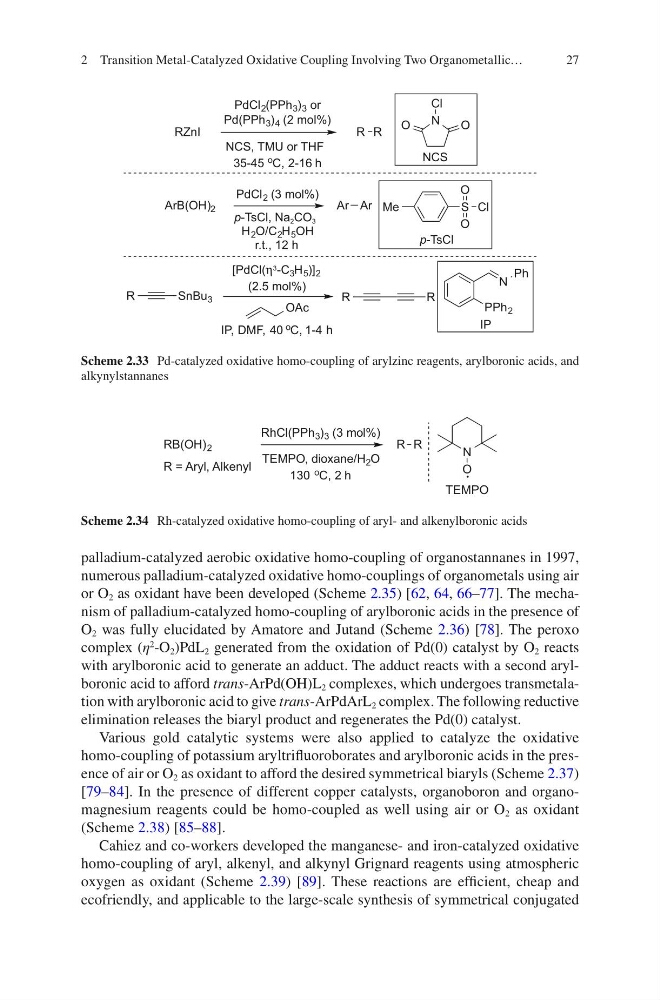
Scheme 2.33 Pd-catalyzed oxidative homo-coupling of arylzinc reagents, arylboronic acids, and
alkynylstannanes
RB(OH) 2
RhCl(PPh 3 ) 3 (3 mol%)
TEMPO, dioxane/H 2 O
130 o C, 2 h
R R
R = Aryl, Alkenyl
N
O
TEMPO
Scheme 2.34 Rh-catalyzed oxidative homo-coupling of aryl- and alkenylboronic acids
2 Transition Metal-Catalyzed Oxidative Coupling Involving Two Organometallic…
palladium- catalyzed aerobic oxidative homo-coupling of organostannanes in 1997,
numerous palladium-catalyzed oxidative homo-couplings of organometals using air
or O 2 as oxidant have been developed (Scheme 2.35) [62, 64, 66–77]. The mechanism of palladium- catalyzed homo-coupling of arylboronic acids in the presence of
O 2 was fully elucidated by Amatore and Jutand (Scheme 2.36) [78]. The peroxo
complex (η
2
- O 2 )PdL 2 generated from the oxidation of Pd(0) catalyst by O 2 reacts
with arylboronic acid to generate an adduct. The adduct reacts with a second arylboronic acid to afford trans-ArPd(OH)L 2 complexes, which undergoes transmetalation with arylboronic acid to give trans-ArPdArL 2 complex. The following reductive
elimination releases the biaryl product and regenerates the Pd(0) catalyst.
Various gold catalytic systems were also applied to catalyze the oxidative
homo- coupling of potassium aryltrifluoroborates and arylboronic acids in the presence of air or O 2 as oxidant to afford the desired symmetrical biaryls (Scheme 2.37)
[79–84]. In the presence of different copper catalysts, organoboron and organomagnesium reagents could be homo-coupled as well using air or O 2 as oxidant
(Scheme 2.38) [85–88].
Cahiez and co-workers developed the manganese- and iron-catalyzed oxidative
homo-coupling of aryl, alkenyl, and alkynyl Grignard reagents using atmospheric
oxygen as oxidant (Scheme 2.39) [89]. These reactions are efficient, cheap and
ecofriendly, and applicable to the large-scale synthesis of symmetrical conjugated
R
SnBu 3
R
R
[PdCl(η
3
-C 3 H 5 )] 2
(2.5 mol%)
IP, DMF, 40 o C, 1-4 h
OAc
PPh 2
N
Ph
ArB(OH) 2
PdCl 2 (3 mol%)
p-TsCl, Na 2 CO 3
H 2 O/C 2 H 5 OH
r.t., 12 h
Ar Ar
RZnI
PdCl 2 (PPh 3 ) 3 or
Pd(PPh 3 ) 4 (2 mol%)
NCS, TMU or THF
35-45 o C, 2-16 h
R R
Me
S Cl
O
O
p-TsCl
IP
N
O
O
Cl
NCS
Scheme 2.33 Pd-catalyzed oxidative homo-coupling of arylzinc reagents, arylboronic acids, and
alkynylstannanes
RB(OH) 2
RhCl(PPh 3 ) 3 (3 mol%)
TEMPO, dioxane/H 2 O
130 o C, 2 h
R R
R = Aryl, Alkenyl
N
O
TEMPO
Scheme 2.34 Rh-catalyzed oxidative homo-coupling of aryl- and alkenylboronic acids
2 Transition Metal-Catalyzed Oxidative Coupling Involving Two Organometallic…