

178
system showed superior performance over the oxidant-containing system for this
transformation. We believe that this methodology could be used for the amination of
sensitive substrates that cannot tolerate oxidative conditions (Scheme 5.33) [21].
Along similar lines, Wu and Tung’s groups reported the direct cross-coupling
between a benzene C-H bond and alcohol O-H bond in the presence of QuCN
+
/
Co(dmgBF 2 ) 2 (CH 3 CN) 2 as catalysts [22] (Scheme 5.34). Both intermolecular and
intramolecular etherification reactions were investigated to construct aryl ether and
chromane compounds in high yield.
Furthermore, Lei’s group developed an anti-Markovnikov oxidation of alkenes
to ketones and aldehydes using water as the terminal oxidant (Scheme 5.35) [23]. In
this transformation, an alkene substrate was oxidized by the excited photosensitizer
to form radical cation intermediate 90. Subsequently, the nucleophilic attack of this
radical cation species by water gave a distonic radical cation 91, which could generate the anti-Markovnikov radical intermediate 92 instead of Markovnikov intermediate 93 because of the high stability of the benzylic radical. The target product was
generated from 92 through sequential electron transfer, deprotonation, and tautomerization processes.
More recently, Lei’s group extended this methodology to synthesize a range of
enol ethers and N-vinylazoles using an alcohol or azole as the nucleophile instead
of water under very similar reaction conditions [24] (Scheme 5.36).
+
7 mol % Acr
+
-Mes ClO 4
-
8 mol % Co(dmgH) 2 Cl 2
CH 3 CN, blue LEDs
N 2 , r.t.
+ H 2
79
80
81
H
N
H
N
R
R
N
N
N
N
N
N
tBu
N
N
N
N
N
N
N
N
Ph
N
N
70 %
97 %
1:13 C A : C B
A
B
71 %
95 %
19:1 C A : C B
A
B
81 %
1:11.5 C A : C B
A
B
A
B
98 %
1:7.6 C A : C B
64 %
95 %
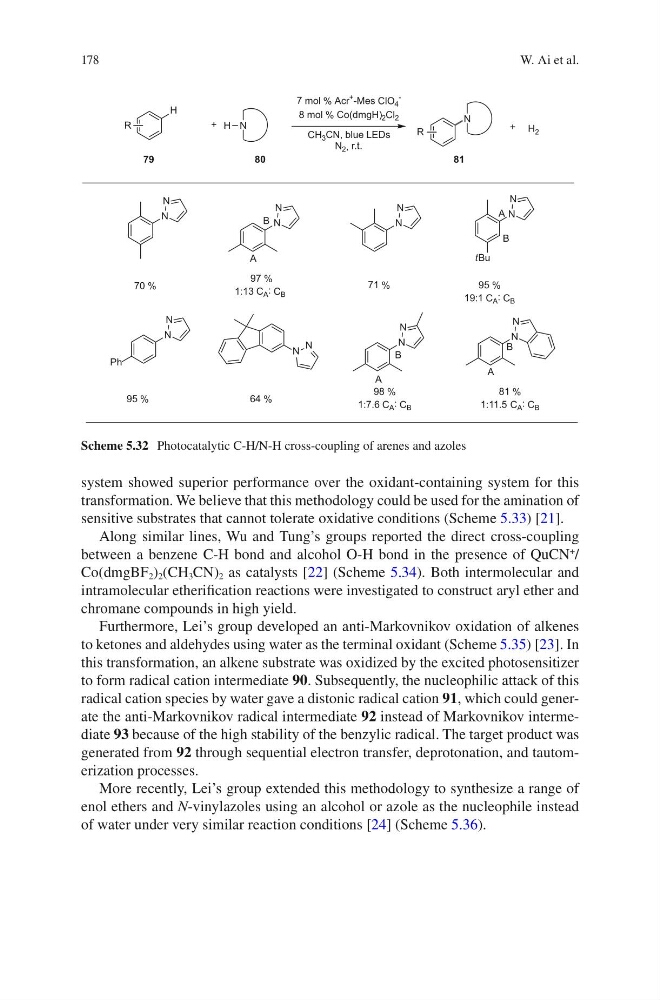
Scheme 5.32 Photocatalytic C-H/N-H cross-coupling of arenes and azoles
W. Ai et al.
system showed superior performance over the oxidant-containing system for this
transformation. We believe that this methodology could be used for the amination of
sensitive substrates that cannot tolerate oxidative conditions (Scheme 5.33) [21].
Along similar lines, Wu and Tung’s groups reported the direct cross-coupling
between a benzene C-H bond and alcohol O-H bond in the presence of QuCN
+
/
Co(dmgBF 2 ) 2 (CH 3 CN) 2 as catalysts [22] (Scheme 5.34). Both intermolecular and
intramolecular etherification reactions were investigated to construct aryl ether and
chromane compounds in high yield.
Furthermore, Lei’s group developed an anti-Markovnikov oxidation of alkenes
to ketones and aldehydes using water as the terminal oxidant (Scheme 5.35) [23]. In
this transformation, an alkene substrate was oxidized by the excited photosensitizer
to form radical cation intermediate 90. Subsequently, the nucleophilic attack of this
radical cation species by water gave a distonic radical cation 91, which could generate the anti-Markovnikov radical intermediate 92 instead of Markovnikov intermediate 93 because of the high stability of the benzylic radical. The target product was
generated from 92 through sequential electron transfer, deprotonation, and tautomerization processes.
More recently, Lei’s group extended this methodology to synthesize a range of
enol ethers and N-vinylazoles using an alcohol or azole as the nucleophile instead
of water under very similar reaction conditions [24] (Scheme 5.36).
+
7 mol % Acr
+
-Mes ClO 4
-
8 mol % Co(dmgH) 2 Cl 2
CH 3 CN, blue LEDs
N 2 , r.t.
+ H 2
79
80
81
H
N
H
N
R
R
N
N
N
N
N
N
tBu
N
N
N
N
N
N
N
N
Ph
N
N
70 %
97 %
1:13 C A : C B
A
B
71 %
95 %
19:1 C A : C B
A
B
81 %
1:11.5 C A : C B
A
B
A
B
98 %
1:7.6 C A : C B
64 %
95 %
Scheme 5.32 Photocatalytic C-H/N-H cross-coupling of arenes and azoles
W. Ai et al.