

176
5.2.2.2 C-N and C-O Cross-Coupling Reactions
Anilines and phenols are very useful raw materials for the production of dyes, agrochemicals, and polymers. However, industrial preparation methods suffer from
harsh conditions, e.g., high temperature, high pressure, and strong acids. Moreover,
multiple steps are required, generating a large amount of toxic waste [17–19].
Therefore, mild, one-step, and toxic waste-free methods to synthesize anilines and
phenols are needed. In 2016, Wu’s group reported an unprecedented direct hydroxylation and amination of the inert C-H bonds of benzene produce to aniline and
phenol using ammonia (NH 3 ) and water under visible-light irradiation [20]
(Scheme 5.30). This sustainable methodology generated H 2 gas as the sole by-product without the need for a sacrificial oxidant [20].
In this reaction cycle, visible-light irradiation of the onium photocatalyst (QuH
+
or QuCN
+
) generated its photoexcited state, which oxidized benzene to benzene
radical cation 75 and generated the reduced form of the photocatalyst. Subsequently,
the latter species delivered an electron to the Co(III) catalyst, regenerating the
ground-state photosensitizer. The benzene radical cation intermediate reacted with
an anionic nucleophile (X
−
) to produce an aromatic radical intermediate 76, which
underwent electron transfer to reduce Co(II) to Co(I) and generate dienyl cation 77.
The cation then quickly lost a proton to afford the desired product 78. Finally, the
Co(I) species reduced two protons, releasing H 2 gas as the sole by-product
(Scheme 5.31).
Very recently, Lei’s group reported another example of C-H/N-H cross-coupling
via CCHE reaction under visible-light irradiation. As shown in Scheme 5.32, a
series of N-arylazoles was readily synthesized using a catalytic system of
Co(dmgH) 2 Cl 2 /Acr
+
-Mes ClO 4
−
.
+ H 2
N
N
Co
N
N
O
O
H
O H
O H
Cl
N
Co(dmgH) 2 pyCl
-e - , -H
+
Co(III)
68
69
67
65
S OH
O
+
S
O
O
66
S
O
O
S
O
O
-e - , -H
+
PS
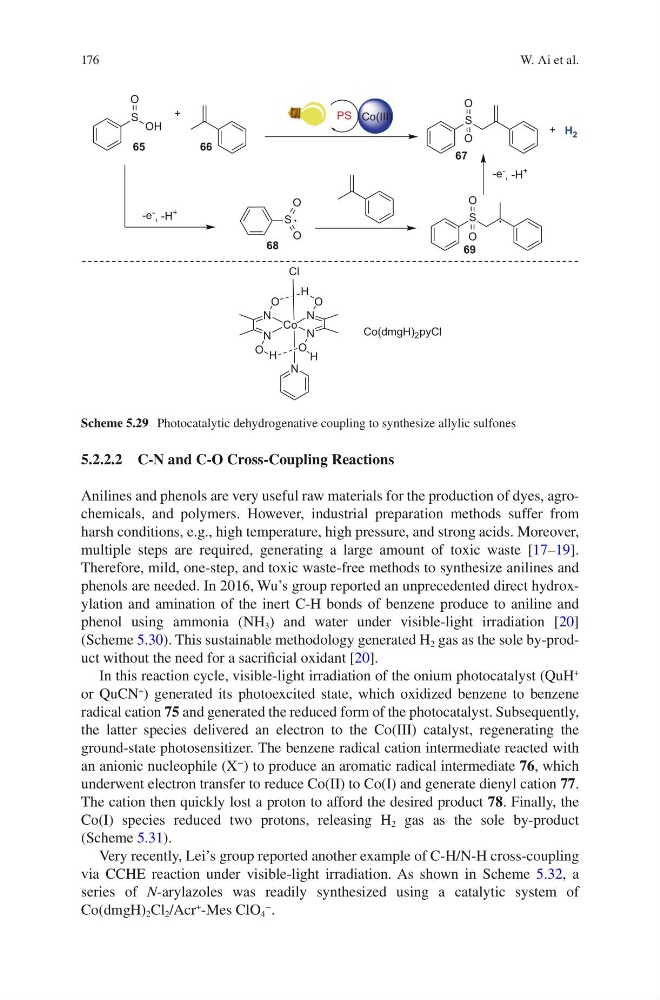
Scheme 5.29 Photocatalytic dehydrogenative coupling to synthesize allylic sulfones
W. Ai et al.
5.2.2.2 C-N and C-O Cross-Coupling Reactions
Anilines and phenols are very useful raw materials for the production of dyes, agrochemicals, and polymers. However, industrial preparation methods suffer from
harsh conditions, e.g., high temperature, high pressure, and strong acids. Moreover,
multiple steps are required, generating a large amount of toxic waste [17–19].
Therefore, mild, one-step, and toxic waste-free methods to synthesize anilines and
phenols are needed. In 2016, Wu’s group reported an unprecedented direct hydroxylation and amination of the inert C-H bonds of benzene produce to aniline and
phenol using ammonia (NH 3 ) and water under visible-light irradiation [20]
(Scheme 5.30). This sustainable methodology generated H 2 gas as the sole by-product without the need for a sacrificial oxidant [20].
In this reaction cycle, visible-light irradiation of the onium photocatalyst (QuH
+
or QuCN
+
) generated its photoexcited state, which oxidized benzene to benzene
radical cation 75 and generated the reduced form of the photocatalyst. Subsequently,
the latter species delivered an electron to the Co(III) catalyst, regenerating the
ground-state photosensitizer. The benzene radical cation intermediate reacted with
an anionic nucleophile (X
−
) to produce an aromatic radical intermediate 76, which
underwent electron transfer to reduce Co(II) to Co(I) and generate dienyl cation 77.
The cation then quickly lost a proton to afford the desired product 78. Finally, the
Co(I) species reduced two protons, releasing H 2 gas as the sole by-product
(Scheme 5.31).
Very recently, Lei’s group reported another example of C-H/N-H cross-coupling
via CCHE reaction under visible-light irradiation. As shown in Scheme 5.32, a
series of N-arylazoles was readily synthesized using a catalytic system of
Co(dmgH) 2 Cl 2 /Acr
+
-Mes ClO 4
−
.
+ H 2
N
N
Co
N
N
O
O
H
O H
O H
Cl
N
Co(dmgH) 2 pyCl
-e - , -H
+
Co(III)
68
69
67
65
S OH
O
+
S
O
O
66
S
O
O
S
O
O
-e - , -H
+
PS
Scheme 5.29 Photocatalytic dehydrogenative coupling to synthesize allylic sulfones
W. Ai et al.