

174
under visible-light irradiation. The selection of a suitable base is an important issue
for the success of this transformation. The base needs to meet three requirements:
(1) its pK b value must be low enough to capture a proton from the substrates; (2) it
should act as a hydrogen atom donor to promote H 2 evolution; and (3) it should be
redox inert. When Na-Gly was used as the base in this reaction system, a range of
desired benzothiazoles was efficiently afforded [15].
The transformation was also performed under oxidative conditions for comparison. The yields of oxidation by-products increased in the presence of oxidants. In
contrast, the amide by-product was avoided completely under CCHE reaction conditions (Scheme 5.28).
Subsequently, Lei, Wu, and co-workers developed an intermolecular dehydrogenative C-H bond thiolation reaction. Allylic sulfones were prepared in high efficiency from arylsulfinic acid and α-methylstyrene derivatives using TBA 2 -eosin Y/
Co(dmgH) 2 pyCl as the catalysts (Scheme 5.29). In the presence of pyridine as the
base, deprotonation of the arylsulfinic acid afforded the corresponding sulfinate,
(E)
54a (Z)
55a
N
H
Ph
COOEt
H
N
H
Ph
H
COOEt
Co
I
Co
II
Co
III
Co
III -H
Ir IV
Ir III
Ir III*
N
H
Ph
H
COOEt
N
Ph
H
COOEt
-H
+
N
Ph
H
COOEt
N
H COOEt
Ph
N
COOEt
Ph
H
+
H 2
-e - , -H
+
radical
cyclization
N
H
Ph
COOEt
H
N
COOEt
Ph +
H 2
Ir(ppy) 3 , Co(dmgH) 2 (COOMePy)Cl
N 2 , 450 nm LED, 5 h
56a
57a
58a
59a
60a
55a
60a
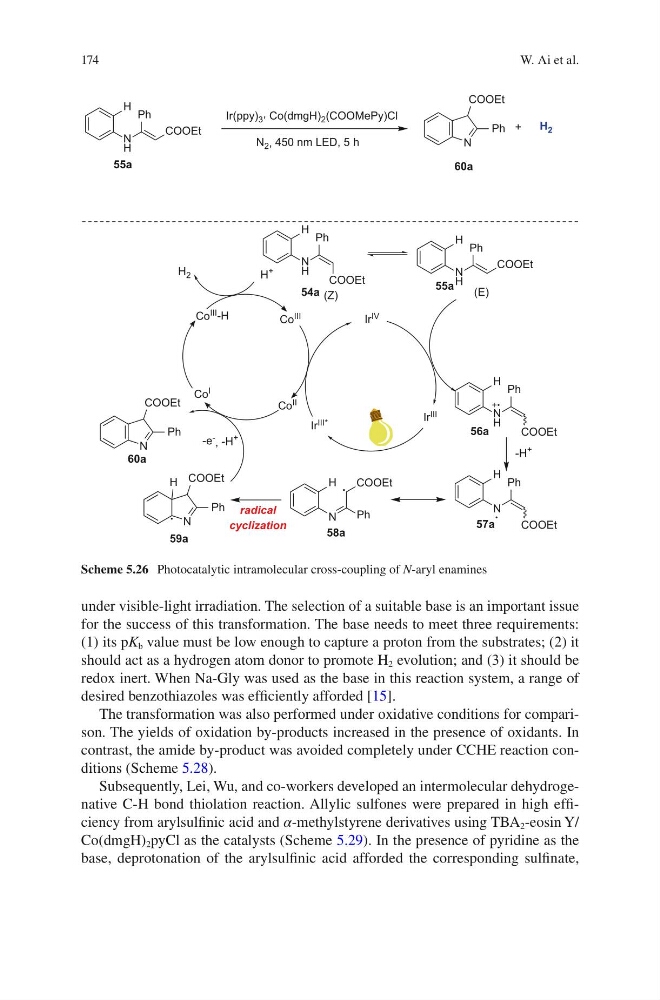
Scheme 5.26 Photocatalytic intramolecular cross-coupling of N-aryl enamines
W. Ai et al.
under visible-light irradiation. The selection of a suitable base is an important issue
for the success of this transformation. The base needs to meet three requirements:
(1) its pK b value must be low enough to capture a proton from the substrates; (2) it
should act as a hydrogen atom donor to promote H 2 evolution; and (3) it should be
redox inert. When Na-Gly was used as the base in this reaction system, a range of
desired benzothiazoles was efficiently afforded [15].
The transformation was also performed under oxidative conditions for comparison. The yields of oxidation by-products increased in the presence of oxidants. In
contrast, the amide by-product was avoided completely under CCHE reaction conditions (Scheme 5.28).
Subsequently, Lei, Wu, and co-workers developed an intermolecular dehydrogenative C-H bond thiolation reaction. Allylic sulfones were prepared in high efficiency from arylsulfinic acid and α-methylstyrene derivatives using TBA 2 -eosin Y/
Co(dmgH) 2 pyCl as the catalysts (Scheme 5.29). In the presence of pyridine as the
base, deprotonation of the arylsulfinic acid afforded the corresponding sulfinate,
(E)
54a (Z)
55a
N
H
Ph
COOEt
H
N
H
Ph
H
COOEt
Co
I
Co
II
Co
III
Co
III -H
Ir IV
Ir III
Ir III*
N
H
Ph
H
COOEt
N
Ph
H
COOEt
-H
+
N
Ph
H
COOEt
N
H COOEt
Ph
N
COOEt
Ph
H
+
H 2
-e - , -H
+
radical
cyclization
N
H
Ph
COOEt
H
N
COOEt
Ph +
H 2
Ir(ppy) 3 , Co(dmgH) 2 (COOMePy)Cl
N 2 , 450 nm LED, 5 h
56a
57a
58a
59a
60a
55a
60a
Scheme 5.26 Photocatalytic intramolecular cross-coupling of N-aryl enamines
W. Ai et al.