

12
[4–12], transition metal-free oxidative coupling [13–20], transition metal- catalyzed
electrooxidative coupling [21, 22], and transition metal-catalyzed oxidative coupling
without evident oxidants [23–31] are not discussed in this chapter.
2.2 Inorganic Oxidants
In the presence of slowly adding iodine as oxidant, oxidative homo-coupling of
organostannanes was achieved via copper and manganese catalysis (Scheme 2.3)
[32]. Aryl-, alkenyl-, and alkynylstannanes were efficiently converted to symmetrical biaryls, 1,3-dienes, and 1,3-diynes.
By using copper salts or silver salts as oxidants, palladium-catalyzed oxidative
homo-couplings of organostannanes, arylboronic acids, and n-butyl alkynyltellurides were achieved to afford various symmetrical biaryls, 1,3-dienes, and 1,3-diynes
under mild conditions (Scheme 2.4) [33–36]. Copper(II) salts such as CuCl 2 and
Cu(NO 3 ) 2 and silver(I) salts such as AgNO 3 and AgOAc were effective oxidants in
these processes.
In the presence of Ag 2 O as oxidant, CrCl 2 could catalyze oxidative homocoupling of alkyl-, alkenyl-, and arylboronic acids under mild conditions
(Scheme 2.5) [37]. The reaction of an equimolar amount of arylboronic acid and
alkyl boronic acid was also tested, in which a 1:1.1 mixture of Csp
2
–Csp
3
crosscoupling product and Csp
3
–Csp
3
homo-coupling product was obtained.
Potassium alkenyltrifluoroborates were also suitable substrates in the palladiumcatalyzed oxidative homo-coupling using Ag 2 O as oxidant to afford symmetrical
1,3-dienes (Scheme 2.6) [38]. The oxidative cross-coupling of different potassium
alkenyltrifluoroborates was also attempted, in which cross-coupling products were
obtained as major products in most cases.
Generally, transition metal-catalyzed oxidative cross-coupling involving two
organometallic compounds using inorganic oxidants was considered to proceed via
the mechanism shown in Scheme 2.7. Taking palladium catalysis as example, the
initial step involves the transmetalation of one organometallic compound with
Pd(II) catalyst. The obtained intermediate R
1
Pd(II)X then undergoes a second transmetalation with another organometallic compound to provide R
1
Pd(II)R
2
, which
undergoes reductive elimination to furnish the cross-coupling product and Pd(0).
Finally, the inorganic oxidant oxidizes Pd(0) species to regenerate Pd(II) species.
[TM]
R
1
M
R
2
X
+
R
1
R
2
Nu
E
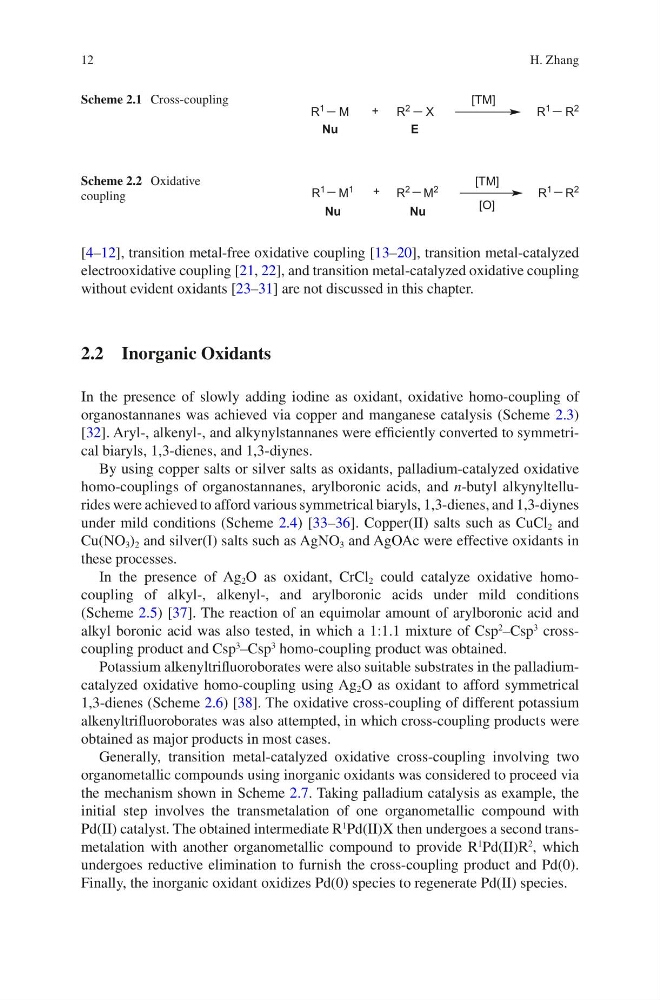
Scheme 2.1 Cross-coupling
[TM]
R
1
M
1
R
2
M
2
+
R
1
R
2
[O]
Nu
Nu
Scheme 2.2 Oxidative
coupling
H. Zhang
[4–12], transition metal-free oxidative coupling [13–20], transition metal- catalyzed
electrooxidative coupling [21, 22], and transition metal-catalyzed oxidative coupling
without evident oxidants [23–31] are not discussed in this chapter.
2.2 Inorganic Oxidants
In the presence of slowly adding iodine as oxidant, oxidative homo-coupling of
organostannanes was achieved via copper and manganese catalysis (Scheme 2.3)
[32]. Aryl-, alkenyl-, and alkynylstannanes were efficiently converted to symmetrical biaryls, 1,3-dienes, and 1,3-diynes.
By using copper salts or silver salts as oxidants, palladium-catalyzed oxidative
homo-couplings of organostannanes, arylboronic acids, and n-butyl alkynyltellurides were achieved to afford various symmetrical biaryls, 1,3-dienes, and 1,3-diynes
under mild conditions (Scheme 2.4) [33–36]. Copper(II) salts such as CuCl 2 and
Cu(NO 3 ) 2 and silver(I) salts such as AgNO 3 and AgOAc were effective oxidants in
these processes.
In the presence of Ag 2 O as oxidant, CrCl 2 could catalyze oxidative homocoupling of alkyl-, alkenyl-, and arylboronic acids under mild conditions
(Scheme 2.5) [37]. The reaction of an equimolar amount of arylboronic acid and
alkyl boronic acid was also tested, in which a 1:1.1 mixture of Csp
2
–Csp
3
crosscoupling product and Csp
3
–Csp
3
homo-coupling product was obtained.
Potassium alkenyltrifluoroborates were also suitable substrates in the palladiumcatalyzed oxidative homo-coupling using Ag 2 O as oxidant to afford symmetrical
1,3-dienes (Scheme 2.6) [38]. The oxidative cross-coupling of different potassium
alkenyltrifluoroborates was also attempted, in which cross-coupling products were
obtained as major products in most cases.
Generally, transition metal-catalyzed oxidative cross-coupling involving two
organometallic compounds using inorganic oxidants was considered to proceed via
the mechanism shown in Scheme 2.7. Taking palladium catalysis as example, the
initial step involves the transmetalation of one organometallic compound with
Pd(II) catalyst. The obtained intermediate R
1
Pd(II)X then undergoes a second transmetalation with another organometallic compound to provide R
1
Pd(II)R
2
, which
undergoes reductive elimination to furnish the cross-coupling product and Pd(0).
Finally, the inorganic oxidant oxidizes Pd(0) species to regenerate Pd(II) species.
[TM]
R
1
M
R
2
X
+
R
1
R
2
Nu
E
Scheme 2.1 Cross-coupling
[TM]
R
1
M
1
R
2
M
2
+
R
1
R
2
[O]
Nu
Nu
Scheme 2.2 Oxidative
coupling
H. Zhang