

161
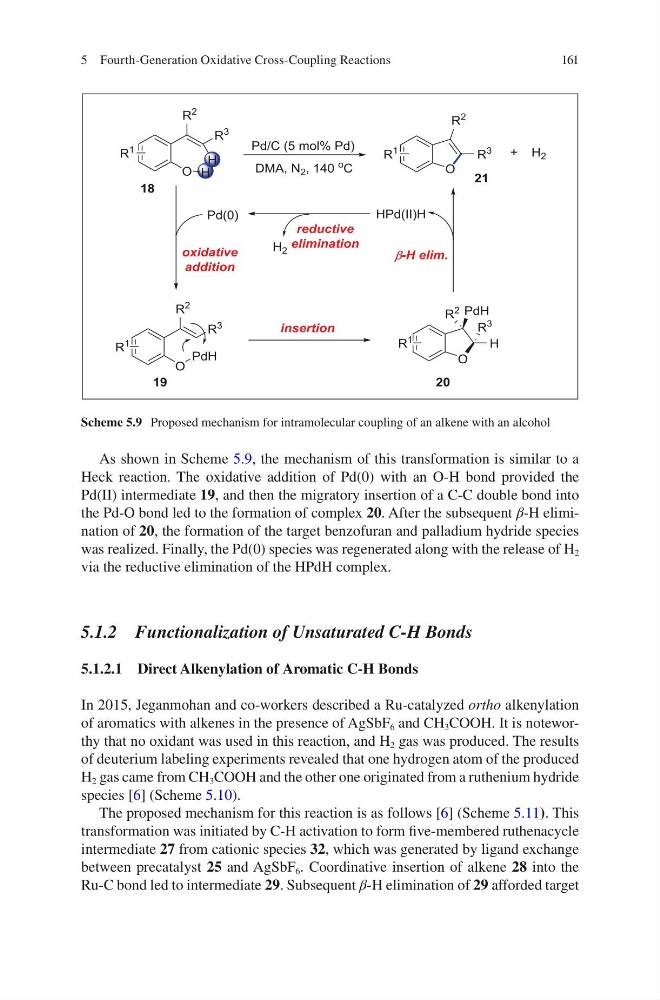
As shown in Scheme 5.9, the mechanism of this transformation is similar to a
Heck reaction. The oxidative addition of Pd(0) with an O-H bond provided the
Pd(II) intermediate 19, and then the migratory insertion of a C-C double bond into
the Pd-O bond led to the formation of complex 20. After the subsequent β-H elimination of 20, the formation of the target benzofuran and palladium hydride species
was realized. Finally, the Pd(0) species was regenerated along with the release of H 2
via the reductive elimination of the HPdH complex.
5.1.2 Functionalization of Unsaturated C-H Bonds
5.1.2.1 Direct Alkenylation of Aromatic C-H Bonds
In 2015, Jeganmohan and co-workers described a Ru-catalyzed ortho alkenylation
of aromatics with alkenes in the presence of AgSbF 6 and CH 3 COOH. It is noteworthy that no oxidant was used in this reaction, and H 2 gas was produced. The results
of deuterium labeling experiments revealed that one hydrogen atom of the produced
H 2 gas came from CH 3 COOH and the other one originated from a ruthenium hydride
species [6] (Scheme 5.10).
The proposed mechanism for this reaction is as follows [6] (Scheme 5.11). This
transformation was initiated by C-H activation to form five-membered ruthenacycle
intermediate 27 from cationic species 32, which was generated by ligand exchange
between precatalyst 25 and AgSbF 6 . Coordinative insertion of alkene 28 into the
Ru-C bond led to intermediate 29. Subsequent β-H elimination of 29 afforded target
Scheme 5.9 Proposed mechanism for intramolecular coupling of an alkene with an alcohol
5 Fourth-Generation Oxidative Cross-Coupling Reactions
As shown in Scheme 5.9, the mechanism of this transformation is similar to a
Heck reaction. The oxidative addition of Pd(0) with an O-H bond provided the
Pd(II) intermediate 19, and then the migratory insertion of a C-C double bond into
the Pd-O bond led to the formation of complex 20. After the subsequent β-H elimination of 20, the formation of the target benzofuran and palladium hydride species
was realized. Finally, the Pd(0) species was regenerated along with the release of H 2
via the reductive elimination of the HPdH complex.
5.1.2 Functionalization of Unsaturated C-H Bonds
5.1.2.1 Direct Alkenylation of Aromatic C-H Bonds
In 2015, Jeganmohan and co-workers described a Ru-catalyzed ortho alkenylation
of aromatics with alkenes in the presence of AgSbF 6 and CH 3 COOH. It is noteworthy that no oxidant was used in this reaction, and H 2 gas was produced. The results
of deuterium labeling experiments revealed that one hydrogen atom of the produced
H 2 gas came from CH 3 COOH and the other one originated from a ruthenium hydride
species [6] (Scheme 5.10).
The proposed mechanism for this reaction is as follows [6] (Scheme 5.11). This
transformation was initiated by C-H activation to form five-membered ruthenacycle
intermediate 27 from cationic species 32, which was generated by ligand exchange
between precatalyst 25 and AgSbF 6 . Coordinative insertion of alkene 28 into the
Ru-C bond led to intermediate 29. Subsequent β-H elimination of 29 afforded target
Scheme 5.9 Proposed mechanism for intramolecular coupling of an alkene with an alcohol
5 Fourth-Generation Oxidative Cross-Coupling Reactions