

139
which supports the radical process. Based on the above results, the author proposed
a putative mechanism. First, DDQ oxidizes phenol to produce an HDDQ radical and
phenol radical (A). By stabilizing the resonance structure of the phenolic radical,
FeCl 3 role as a Lewis acid to promote the radical transfer from an O-radical (A) to
C-radical (B) and then radical addition with alkenes takes place to produce the intermediate (C). Finally, a hydrogen radical from C is trapped by an HDDQ radical, and
the final oxidative C-O coupling product dihydrobenzofuran is obtained.
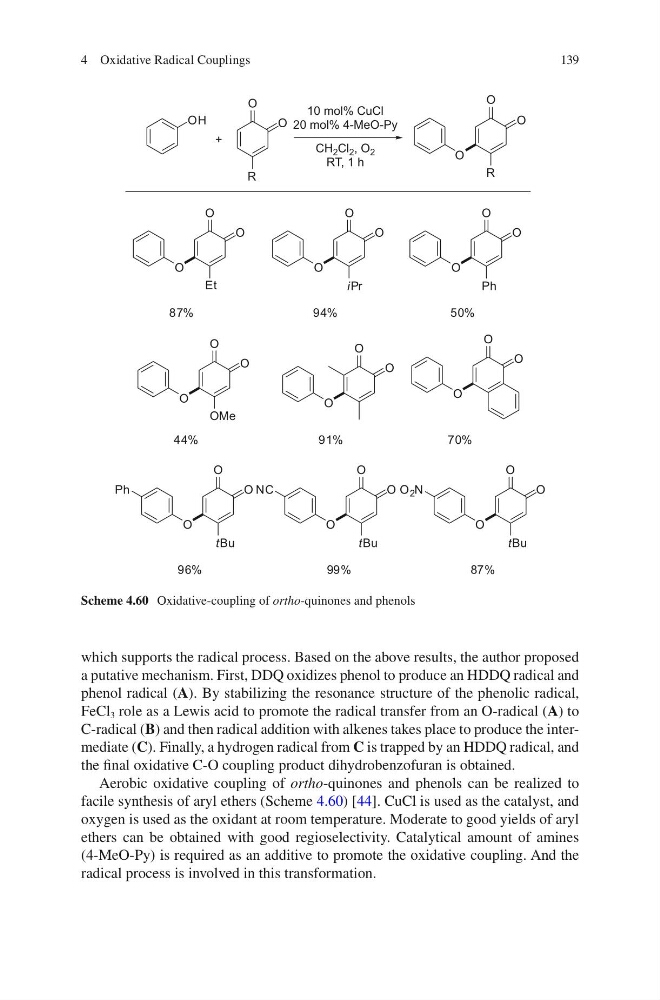
Aerobic oxidative coupling of ortho-quinones and phenols can be realized to
facile synthesis of aryl ethers (Scheme 4.60) [44]. CuCl is used as the catalyst, and
oxygen is used as the oxidant at room temperature. Moderate to good yields of aryl
ethers can be obtained with good regioselectivity. Catalytical amount of amines
(4-MeO-Py) is required as an additive to promote the oxidative coupling. And the
radical process is involved in this transformation.
+
10 mol% CuCl
20 mol% 4-MeO-Py
CH 2 Cl 2 , O 2
RT, 1 h
OH
O
O
R
O
O
R
O
O
O
Et
O
87%
O
O
iPr
O
94%
O
O
Ph
O
50%
O
O
OMe
O
44%
O
O
O
91%
O
O
O
70%
O
O
tBu
O
96%
Ph
O
O
tBu
O
99%
NC
O
O
tBu
O
87%
O 2 N
Scheme 4.60 Oxidative-coupling of ortho-quinones and phenols
4 Oxidative Radical Couplings
which supports the radical process. Based on the above results, the author proposed
a putative mechanism. First, DDQ oxidizes phenol to produce an HDDQ radical and
phenol radical (A). By stabilizing the resonance structure of the phenolic radical,
FeCl 3 role as a Lewis acid to promote the radical transfer from an O-radical (A) to
C-radical (B) and then radical addition with alkenes takes place to produce the intermediate (C). Finally, a hydrogen radical from C is trapped by an HDDQ radical, and
the final oxidative C-O coupling product dihydrobenzofuran is obtained.
Aerobic oxidative coupling of ortho-quinones and phenols can be realized to
facile synthesis of aryl ethers (Scheme 4.60) [44]. CuCl is used as the catalyst, and
oxygen is used as the oxidant at room temperature. Moderate to good yields of aryl
ethers can be obtained with good regioselectivity. Catalytical amount of amines
(4-MeO-Py) is required as an additive to promote the oxidative coupling. And the
radical process is involved in this transformation.
+
10 mol% CuCl
20 mol% 4-MeO-Py
CH 2 Cl 2 , O 2
RT, 1 h
OH
O
O
R
O
O
R
O
O
O
Et
O
87%
O
O
iPr
O
94%
O
O
Ph
O
50%
O
O
OMe
O
44%
O
O
O
91%
O
O
O
70%
O
O
tBu
O
96%
Ph
O
O
tBu
O
99%
NC
O
O
tBu
O
87%
O 2 N
Scheme 4.60 Oxidative-coupling of ortho-quinones and phenols
4 Oxidative Radical Couplings