

136
radical by the coordination of the transition metal, which allowed the selective radical/radical cross-coupling with the transient sp3 carbon radical to construct C-N
bonds. Various C(sp3)-H bonds could be coupled with N-alkoxyamides in good
yields through this radical amidation strategy.
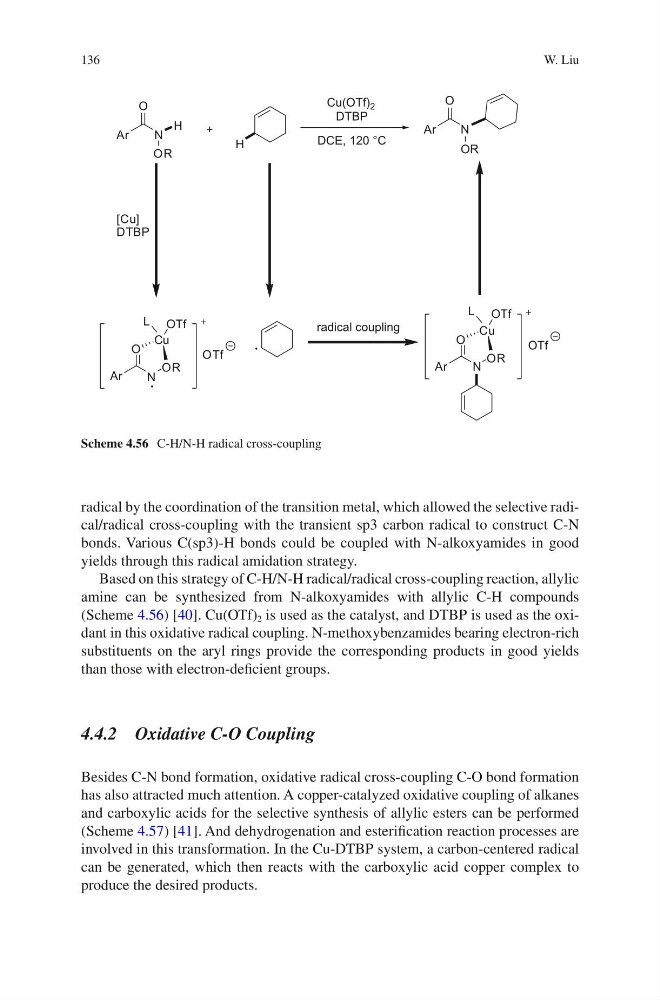
Based on this strategy of C-H/N-H radical/radical cross-coupling reaction, allylic
amine can be synthesized from N-alkoxyamides with allylic C-H compounds
(Scheme 4.56) [40]. Cu(OTf) 2 is used as the catalyst, and DTBP is used as the oxidant in this oxidative radical coupling. N-methoxybenzamides bearing electron-rich
substituents on the aryl rings provide the corresponding products in good yields
than those with electron-deficient groups.
4.4.2 Oxidative C-O Coupling
Besides C-N bond formation, oxidative radical cross-coupling C-O bond formation
has also attracted much attention. A copper-catalyzed oxidative coupling of alkanes
and carboxylic acids for the selective synthesis of allylic esters can be performed
(Scheme 4.57) [41]. And dehydrogenation and esterification reaction processes are
involved in this transformation. In the Cu-DTBP system, a carbon-centered radical
can be generated, which then reacts with the carboxylic acid copper complex to
produce the desired products.
Cu(OTf) 2
DTBP
+
DCE, 120 °C
Ar
OR
N
O
H
Ar
OR
N
O
H
Ar
N
O
[Cu]
DTBP
OR
Cu
OTf
L
OTf
radical coupling
Ar
N
O
OR
Cu
OTf
L
OTf
Scheme 4.56 C-H/N-H radical cross-coupling
W. Liu
radical by the coordination of the transition metal, which allowed the selective radical/radical cross-coupling with the transient sp3 carbon radical to construct C-N
bonds. Various C(sp3)-H bonds could be coupled with N-alkoxyamides in good
yields through this radical amidation strategy.
Based on this strategy of C-H/N-H radical/radical cross-coupling reaction, allylic
amine can be synthesized from N-alkoxyamides with allylic C-H compounds
(Scheme 4.56) [40]. Cu(OTf) 2 is used as the catalyst, and DTBP is used as the oxidant in this oxidative radical coupling. N-methoxybenzamides bearing electron-rich
substituents on the aryl rings provide the corresponding products in good yields
than those with electron-deficient groups.
4.4.2 Oxidative C-O Coupling
Besides C-N bond formation, oxidative radical cross-coupling C-O bond formation
has also attracted much attention. A copper-catalyzed oxidative coupling of alkanes
and carboxylic acids for the selective synthesis of allylic esters can be performed
(Scheme 4.57) [41]. And dehydrogenation and esterification reaction processes are
involved in this transformation. In the Cu-DTBP system, a carbon-centered radical
can be generated, which then reacts with the carboxylic acid copper complex to
produce the desired products.
Cu(OTf) 2
DTBP
+
DCE, 120 °C
Ar
OR
N
O
H
Ar
OR
N
O
H
Ar
N
O
[Cu]
DTBP
OR
Cu
OTf
L
OTf
radical coupling
Ar
N
O
OR
Cu
OTf
L
OTf
Scheme 4.56 C-H/N-H radical cross-coupling
W. Liu