

112
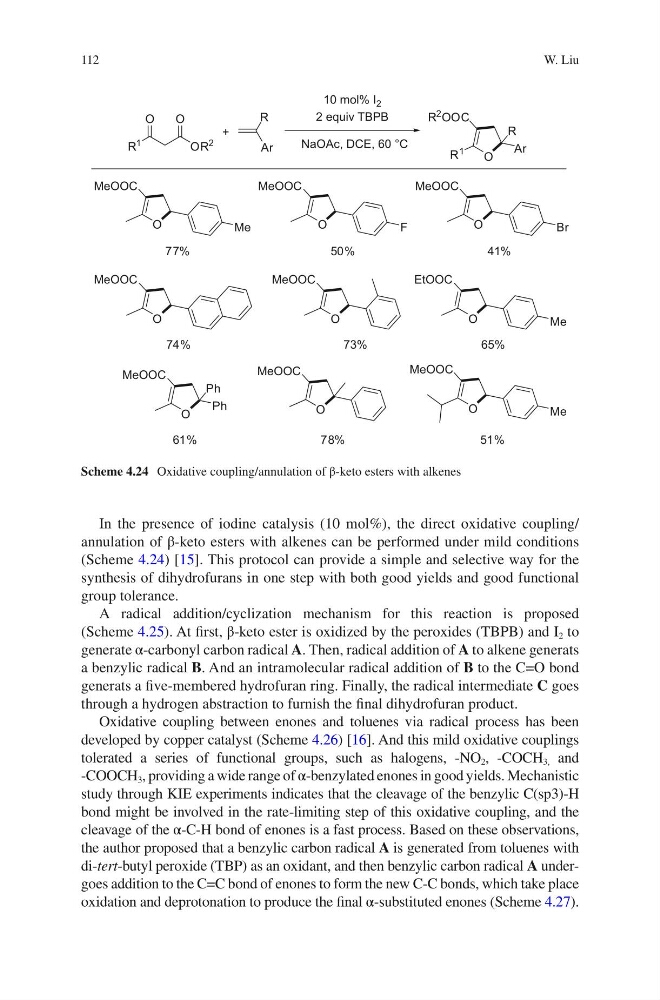
In the presence of iodine catalysis (10 mol%), the direct oxidative coupling/
annulation of β-keto esters with alkenes can be performed under mild conditions
(Scheme 4.24) [15]. This protocol can provide a simple and selective way for the
synthesis of dihydrofurans in one step with both good yields and good functional
group tolerance.
A radical addition/cyclization mechanism for this reaction is proposed
(Scheme 4.25). At first, β-keto ester is oxidized by the peroxides (TBPB) and I 2 to
generate α-carbonyl carbon radical A. Then, radical addition of A to alkene generats
a benzylic radical B. And an intramolecular radical addition of B to the C=O bond
generats a five-membered hydrofuran ring. Finally, the radical intermediate C goes
through a hydrogen abstraction to furnish the final dihydrofuran product.
Oxidative coupling between enones and toluenes via radical process has been
developed by copper catalyst (Scheme 4.26) [16]. And this mild oxidative couplings
tolerated a series of functional groups, such as halogens, -NO 2 , -COCH 3, and
-COOCH 3 , providing a wide range of α-benzylated enones in good yields. Mechanistic
study through KIE experiments indicates that the cleavage of the benzylic C(sp3)-H
bond might be involved in the rate-limiting step of this oxidative coupling, and the
cleavage of the α-C-H bond of enones is a fast process. Based on these observations,
the author proposed that a benzylic carbon radical A is generated from toluenes with
di-tert-butyl peroxide (TBP) as an oxidant, and then benzylic carbon radical A undergoes addition to the C=C bond of enones to form the new C-C bonds, which take place
oxidation and deprotonation to produce the final α-substituted enones (Scheme 4.27).
O
OR 2
O
+
10 mol% I 2
2 equiv TBPB
NaOAc, DCE, 60 °C
R 1
Ar
R
O
R
2 OOC
R
1
Ar
R
O
MeOOC
Me
77%
O
MeOOC
F
50%
O
MeOOC
Br
41%
O
MeOOC
74%
O
MeOOC
73%
O
EtOOC
Me
65%
O
MeOOC
Ph
61%
O
MeOOC
78%
O
MeOOC
Me
51%
Ph
Scheme 4.24 Oxidative coupling/annulation of β-keto esters with alkenes
W. Liu
In the presence of iodine catalysis (10 mol%), the direct oxidative coupling/
annulation of β-keto esters with alkenes can be performed under mild conditions
(Scheme 4.24) [15]. This protocol can provide a simple and selective way for the
synthesis of dihydrofurans in one step with both good yields and good functional
group tolerance.
A radical addition/cyclization mechanism for this reaction is proposed
(Scheme 4.25). At first, β-keto ester is oxidized by the peroxides (TBPB) and I 2 to
generate α-carbonyl carbon radical A. Then, radical addition of A to alkene generats
a benzylic radical B. And an intramolecular radical addition of B to the C=O bond
generats a five-membered hydrofuran ring. Finally, the radical intermediate C goes
through a hydrogen abstraction to furnish the final dihydrofuran product.
Oxidative coupling between enones and toluenes via radical process has been
developed by copper catalyst (Scheme 4.26) [16]. And this mild oxidative couplings
tolerated a series of functional groups, such as halogens, -NO 2 , -COCH 3, and
-COOCH 3 , providing a wide range of α-benzylated enones in good yields. Mechanistic
study through KIE experiments indicates that the cleavage of the benzylic C(sp3)-H
bond might be involved in the rate-limiting step of this oxidative coupling, and the
cleavage of the α-C-H bond of enones is a fast process. Based on these observations,
the author proposed that a benzylic carbon radical A is generated from toluenes with
di-tert-butyl peroxide (TBP) as an oxidant, and then benzylic carbon radical A undergoes addition to the C=C bond of enones to form the new C-C bonds, which take place
oxidation and deprotonation to produce the final α-substituted enones (Scheme 4.27).
O
OR 2
O
+
10 mol% I 2
2 equiv TBPB
NaOAc, DCE, 60 °C
R 1
Ar
R
O
R
2 OOC
R
1
Ar
R
O
MeOOC
Me
77%
O
MeOOC
F
50%
O
MeOOC
Br
41%
O
MeOOC
74%
O
MeOOC
73%
O
EtOOC
Me
65%
O
MeOOC
Ph
61%
O
MeOOC
78%
O
MeOOC
Me
51%
Ph
Scheme 4.24 Oxidative coupling/annulation of β-keto esters with alkenes
W. Liu