

108
C3-position. Importantly, indoles can regioselective cross-coupled with 1,4-dioxane
at C2-position using NiF 2 as catalyst. And the KIE experiments indicated that
C(sp3)-H bond cleavage of 1,4-dioxane may be one of the rate-determining steps of
this procedure. However, the origin of the regioselectivity switched by the different
nickel catalysis is unclear.
Synthesis of oxindoles from anilides is one of the useful methods in organic
synthesis of heterocycles. An alternative Cu-mediated intramolecular oxidative C-C
bond formation between an enolate C-H bond and an aromatic C-H bond via radical
intermediates was achieved (Scheme 4.20) [11]. This method provides a more direct
solution to prepare oxindoles without pre-activation of the anilide derivatives with
traditional Pd-catalyzed C-N amination protocols.
1 equiv t-BuOOt-Bu
120
o
C, 24 h
+
YR 3
R
2
H
R 1
0.2-2 equiv t-BuONa
R
1
YR
3
R
2
NC
NMe 2
N
O
57% (a:m:p=42:2:56)
NC
N
O
53% (a:m:p=16:0:84)
56% (a:m:p=15:0:85)
MeO
O
O
51% (a:m:p=39:0:61)
O
O
O
47% (4-:6-=90:10)
MeO
O
O
MeO
49% (4-:2-=64:36)
NC
O
CN
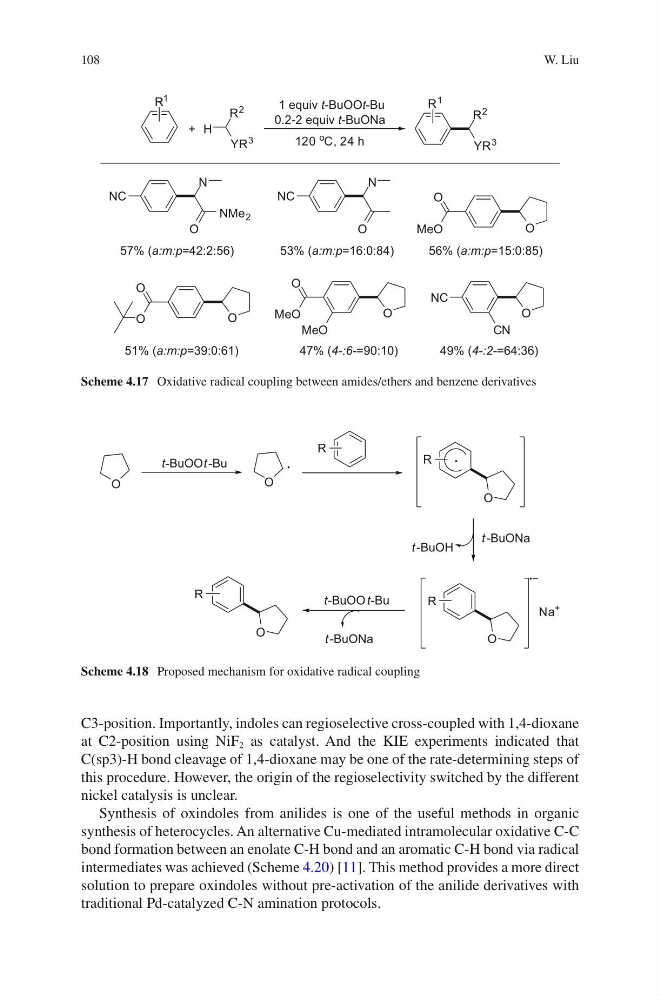
Scheme 4.17 Oxidative radical coupling between amides/ethers and benzene derivatives
t-BuOOt -Bu
O
O
R
R
O
t -BuONa
R
O
t -BuOH
Na
+
t-BuOO t-Bu
R
O
t -BuONa
Scheme 4.18 Proposed mechanism for oxidative radical coupling
W. Liu
C3-position. Importantly, indoles can regioselective cross-coupled with 1,4-dioxane
at C2-position using NiF 2 as catalyst. And the KIE experiments indicated that
C(sp3)-H bond cleavage of 1,4-dioxane may be one of the rate-determining steps of
this procedure. However, the origin of the regioselectivity switched by the different
nickel catalysis is unclear.
Synthesis of oxindoles from anilides is one of the useful methods in organic
synthesis of heterocycles. An alternative Cu-mediated intramolecular oxidative C-C
bond formation between an enolate C-H bond and an aromatic C-H bond via radical
intermediates was achieved (Scheme 4.20) [11]. This method provides a more direct
solution to prepare oxindoles without pre-activation of the anilide derivatives with
traditional Pd-catalyzed C-N amination protocols.
1 equiv t-BuOOt-Bu
120
o
C, 24 h
+
YR 3
R
2
H
R 1
0.2-2 equiv t-BuONa
R
1
YR
3
R
2
NC
NMe 2
N
O
57% (a:m:p=42:2:56)
NC
N
O
53% (a:m:p=16:0:84)
56% (a:m:p=15:0:85)
MeO
O
O
51% (a:m:p=39:0:61)
O
O
O
47% (4-:6-=90:10)
MeO
O
O
MeO
49% (4-:2-=64:36)
NC
O
CN
Scheme 4.17 Oxidative radical coupling between amides/ethers and benzene derivatives
t-BuOOt -Bu
O
O
R
R
O
t -BuONa
R
O
t -BuOH
Na
+
t-BuOO t-Bu
R
O
t -BuONa
Scheme 4.18 Proposed mechanism for oxidative radical coupling
W. Liu