

106
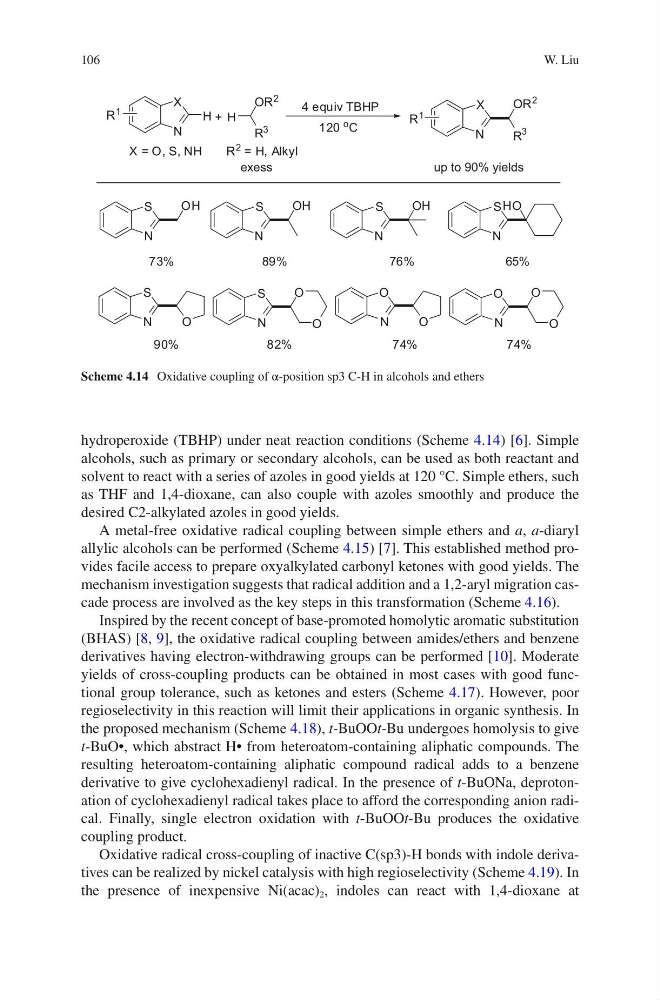
hydroperoxide (TBHP) under neat reaction conditions (Scheme 4.14) [6]. Simple
alcohols, such as primary or secondary alcohols, can be used as both reactant and
solvent to react with a series of azoles in good yields at 120 °C. Simple ethers, such
as THF and 1,4-dioxane, can also couple with azoles smoothly and produce the
desired C2-alkylated azoles in good yields.
A metal-free oxidative radical coupling between simple ethers and a, a-diaryl
allylic alcohols can be performed (Scheme 4.15) [7]. This established method provides facile access to prepare oxyalkylated carbonyl ketones with good yields. The
mechanism investigation suggests that radical addition and a 1,2-aryl migration cascade process are involved as the key steps in this transformation (Scheme 4.16).
Inspired by the recent concept of base-promoted homolytic aromatic substitution
(BHAS) [8, 9], the oxidative radical coupling between amides/ethers and benzene
derivatives having electron-withdrawing groups can be performed [10]. Moderate
yields of cross-coupling products can be obtained in most cases with good functional group tolerance, such as ketones and esters (Scheme 4.17). However, poor
regioselectivity in this reaction will limit their applications in organic synthesis. In
the proposed mechanism (Scheme 4.18), t-BuOOt-Bu undergoes homolysis to give
t-BuO•, which abstract H• from heteroatom-containing aliphatic compounds. The
resulting heteroatom-containing aliphatic compound radical adds to a benzene
derivative to give cyclohexadienyl radical. In the presence of t-BuONa, deprotonation of cyclohexadienyl radical takes place to afford the corresponding anion radical. Finally, single electron oxidation with t-BuOOt-Bu produces the oxidative
coupling product.
Oxidative radical cross-coupling of inactive C(sp3)-H bonds with indole derivatives can be realized by nickel catalysis with high regioselectivity (Scheme 4.19). In
the presence of inexpensive Ni(acac) 2 , indoles can react with 1,4-dioxane at
R 1
4 equiv TBHP
120
o
C
+
R 1
exess
up to 90% yields
73%
8 9%
76%
6 5%
N
X
H
X = O, S, NH
R 3
OR 2
H
R 2 = H, Alkyl
N
X
R
3
OR 2
N
S
OH
N
S
OH
N
S
OH
N
S HO
N
S
O
N
O
O
90%
7 4%
N
S
O
O
82%
N
O
74%
O
O
Scheme 4.14 Oxidative coupling of α-position sp3 C-H in alcohols and ethers
W. Liu
hydroperoxide (TBHP) under neat reaction conditions (Scheme 4.14) [6]. Simple
alcohols, such as primary or secondary alcohols, can be used as both reactant and
solvent to react with a series of azoles in good yields at 120 °C. Simple ethers, such
as THF and 1,4-dioxane, can also couple with azoles smoothly and produce the
desired C2-alkylated azoles in good yields.
A metal-free oxidative radical coupling between simple ethers and a, a-diaryl
allylic alcohols can be performed (Scheme 4.15) [7]. This established method provides facile access to prepare oxyalkylated carbonyl ketones with good yields. The
mechanism investigation suggests that radical addition and a 1,2-aryl migration cascade process are involved as the key steps in this transformation (Scheme 4.16).
Inspired by the recent concept of base-promoted homolytic aromatic substitution
(BHAS) [8, 9], the oxidative radical coupling between amides/ethers and benzene
derivatives having electron-withdrawing groups can be performed [10]. Moderate
yields of cross-coupling products can be obtained in most cases with good functional group tolerance, such as ketones and esters (Scheme 4.17). However, poor
regioselectivity in this reaction will limit their applications in organic synthesis. In
the proposed mechanism (Scheme 4.18), t-BuOOt-Bu undergoes homolysis to give
t-BuO•, which abstract H• from heteroatom-containing aliphatic compounds. The
resulting heteroatom-containing aliphatic compound radical adds to a benzene
derivative to give cyclohexadienyl radical. In the presence of t-BuONa, deprotonation of cyclohexadienyl radical takes place to afford the corresponding anion radical. Finally, single electron oxidation with t-BuOOt-Bu produces the oxidative
coupling product.
Oxidative radical cross-coupling of inactive C(sp3)-H bonds with indole derivatives can be realized by nickel catalysis with high regioselectivity (Scheme 4.19). In
the presence of inexpensive Ni(acac) 2 , indoles can react with 1,4-dioxane at
R 1
4 equiv TBHP
120
o
C
+
R 1
exess
up to 90% yields
73%
8 9%
76%
6 5%
N
X
H
X = O, S, NH
R 3
OR 2
H
R 2 = H, Alkyl
N
X
R
3
OR 2
N
S
OH
N
S
OH
N
S
OH
N
S HO
N
S
O
N
O
O
90%
7 4%
N
S
O
O
82%
N
O
74%
O
O
Scheme 4.14 Oxidative coupling of α-position sp3 C-H in alcohols and ethers
W. Liu