

104
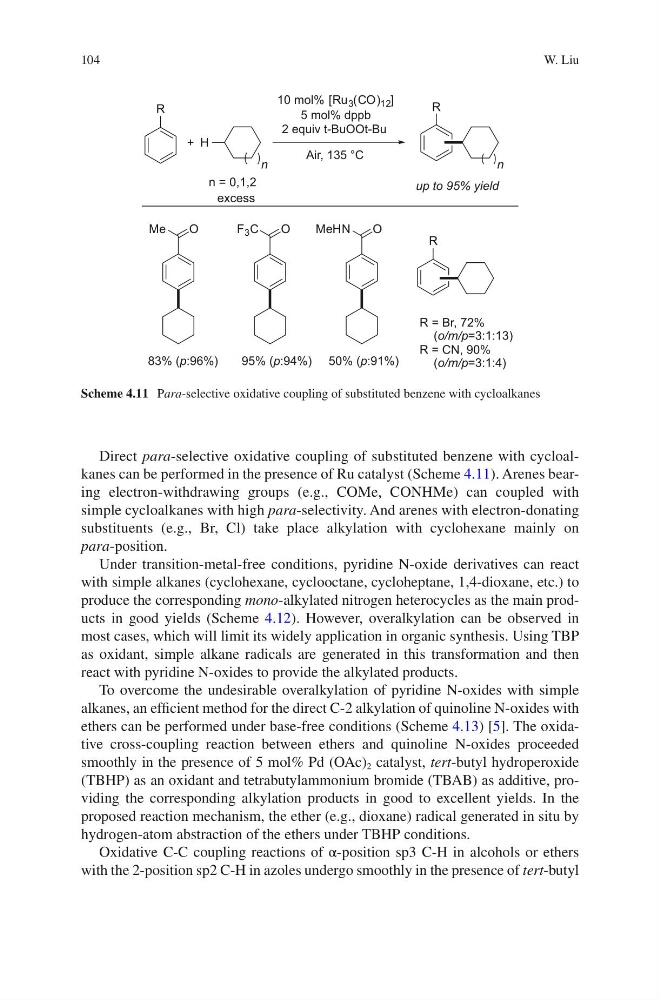
Direct para-selective oxidative coupling of substituted benzene with cycloalkanes can be performed in the presence of Ru catalyst (Scheme 4.11). Arenes bearing electron-withdrawing groups (e.g., COMe, CONHMe) can coupled with
simple cycloalkanes with high para-selectivity. And arenes with electron-donating
substituents (e.g., Br, Cl) take place alkylation with cyclohexane mainly on
para-position.
Under transition-metal-free conditions, pyridine N-oxide derivatives can react
with simple alkanes (cyclohexane, cyclooctane, cycloheptane, 1,4-dioxane, etc.) to
produce the corresponding mono-alkylated nitrogen heterocycles as the main products in good yields (Scheme 4.12). However, overalkylation can be observed in
most cases, which will limit its widely application in organic synthesis. Using TBP
as oxidant, simple alkane radicals are generated in this transformation and then
react with pyridine N-oxides to provide the alkylated products.
To overcome the undesirable overalkylation of pyridine N-oxides with simple
alkanes, an efficient method for the direct C-2 alkylation of quinoline N-oxides with
ethers can be performed under base-free conditions (Scheme 4.13) [5]. The oxidative cross-coupling reaction between ethers and quinoline N-oxides proceeded
smoothly in the presence of 5 mol% Pd (OAc) 2 catalyst, tert-butyl hydroperoxide
(TBHP) as an oxidant and tetrabutylammonium bromide (TBAB) as additive, providing the corresponding alkylation products in good to excellent yields. In the
proposed reaction mechanism, the ether (e.g., dioxane) radical generated in situ by
hydrogen- atom abstraction of the ethers under TBHP conditions.
Oxidative C-C coupling reactions of α-position sp3 C-H in alcohols or ethers
with the 2-position sp2 C-H in azoles undergo smoothly in the presence of tert-butyl
10 mol% [Ru 3 (CO) 12 ]
5 mol% dppb
2 equiv t-BuOOt-Bu
Air, 135 °C
+ H
excess
n
n = 0,1,2
R
R
n
up to 95% yield
83% (p:96%)
95% (p:94%) 50% (p:91%)
R
R = Br, 72%
(o/m/p=3:1:13)
R = CN, 90%
(o/m/p=3:1:4)
Me
O
F 3 C
O
MeHN
O
Scheme 4.11 Para-selective oxidative coupling of substituted benzene with cycloalkanes
W. Liu
Direct para-selective oxidative coupling of substituted benzene with cycloalkanes can be performed in the presence of Ru catalyst (Scheme 4.11). Arenes bearing electron-withdrawing groups (e.g., COMe, CONHMe) can coupled with
simple cycloalkanes with high para-selectivity. And arenes with electron-donating
substituents (e.g., Br, Cl) take place alkylation with cyclohexane mainly on
para-position.
Under transition-metal-free conditions, pyridine N-oxide derivatives can react
with simple alkanes (cyclohexane, cyclooctane, cycloheptane, 1,4-dioxane, etc.) to
produce the corresponding mono-alkylated nitrogen heterocycles as the main products in good yields (Scheme 4.12). However, overalkylation can be observed in
most cases, which will limit its widely application in organic synthesis. Using TBP
as oxidant, simple alkane radicals are generated in this transformation and then
react with pyridine N-oxides to provide the alkylated products.
To overcome the undesirable overalkylation of pyridine N-oxides with simple
alkanes, an efficient method for the direct C-2 alkylation of quinoline N-oxides with
ethers can be performed under base-free conditions (Scheme 4.13) [5]. The oxidative cross-coupling reaction between ethers and quinoline N-oxides proceeded
smoothly in the presence of 5 mol% Pd (OAc) 2 catalyst, tert-butyl hydroperoxide
(TBHP) as an oxidant and tetrabutylammonium bromide (TBAB) as additive, providing the corresponding alkylation products in good to excellent yields. In the
proposed reaction mechanism, the ether (e.g., dioxane) radical generated in situ by
hydrogen- atom abstraction of the ethers under TBHP conditions.
Oxidative C-C coupling reactions of α-position sp3 C-H in alcohols or ethers
with the 2-position sp2 C-H in azoles undergo smoothly in the presence of tert-butyl
10 mol% [Ru 3 (CO) 12 ]
5 mol% dppb
2 equiv t-BuOOt-Bu
Air, 135 °C
+ H
excess
n
n = 0,1,2
R
R
n
up to 95% yield
83% (p:96%)
95% (p:94%) 50% (p:91%)
R
R = Br, 72%
(o/m/p=3:1:13)
R = CN, 90%
(o/m/p=3:1:4)
Me
O
F 3 C
O
MeHN
O
Scheme 4.11 Para-selective oxidative coupling of substituted benzene with cycloalkanes
W. Liu