

Anisotropic Magnetic Spin Interactions of Transition Metal …
49
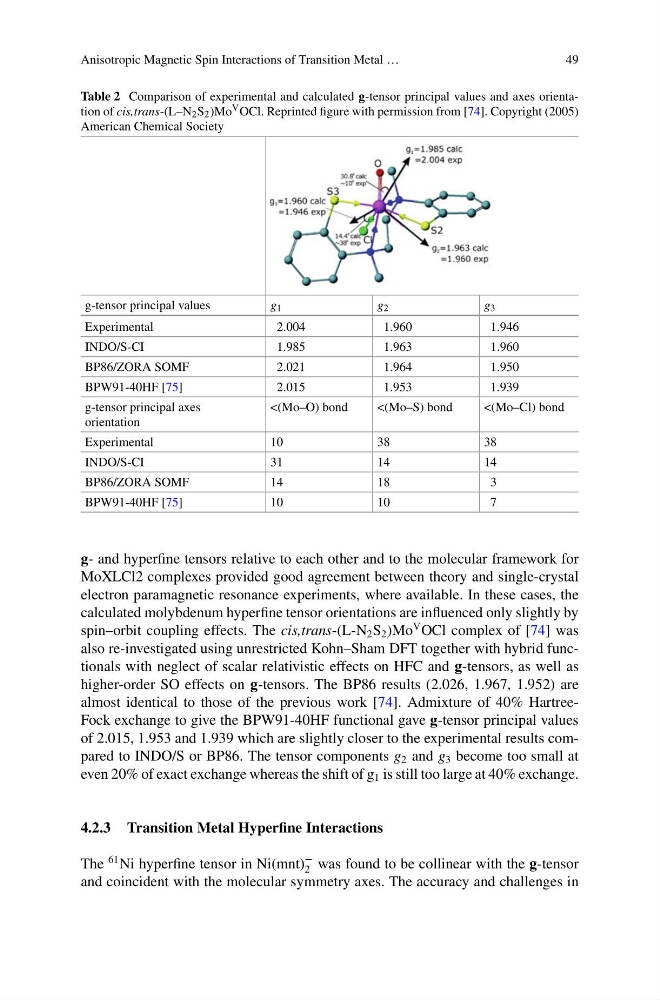
Table 2 Comparison of experimental and calculated g-tensor principal values and axes orientation of cis,trans-(L–N 2 S 2 )Mo V OCl. Reprinted figure with permission from [74]. Copyright (2005)
American Chemical Society
g-tensor principal values
g 1
g 2
g 3
Experimental
2.004
1.960
1.946
INDO/S-CI
1.985
1.963
1.960
BP86/ZORA SOMF
2.021
1.964
1.950
BPW91-40HF [75]
2.015
1.953
1.939
g-tensor principal axes
orientation
<(Mo–O) bond
<(Mo–S) bond
<(Mo–Cl) bond
Experimental
10
38
38
INDO/S-CI
31
14
14
BP86/ZORA SOMF
14
18
3
BPW91-40HF [75]
10
10
7
g- and hyperfine tensors relative to each other and to the molecular framework for
MoXLCl2 complexes provided good agreement between theory and single-crystal
electron paramagnetic resonance experiments, where available. In these cases, the
calculated molybdenum hyperfine tensor orientations are influenced only slightly by
spin–orbit coupling effects. The cis,trans-(L-N 2 S 2 )Mo
V OCl complex of [74] was
also re-investigated using unrestricted Kohn–Sham DFT together with hybrid functionals with neglect of scalar relativistic effects on HFC and g-tensors, as well as
higher-order SO effects on g-tensors. The BP86 results (2.026, 1.967, 1.952) are
almost identical to those of the previous work [74]. Admixture of 40% HartreeFock exchange to give the BPW91-40HF functional gave g-tensor principal values
of 2.015, 1.953 and 1.939 which are slightly closer to the experimental results compared to INDO/S or BP86. The tensor components g 2 and g 3 become too small at
even 20% of exact exchange whereas the shift of g 1 is still too large at 40% exchange.
4.2.3 Transition Metal Hyperfine Interactions
The
61 Ni hyperfine tensor in Ni(mnt)
−
2 was found to be collinear with the g-tensor
and coincident with the molecular symmetry axes. The accuracy and challenges in
49
Table 2 Comparison of experimental and calculated g-tensor principal values and axes orientation of cis,trans-(L–N 2 S 2 )Mo V OCl. Reprinted figure with permission from [74]. Copyright (2005)
American Chemical Society
g-tensor principal values
g 1
g 2
g 3
Experimental
2.004
1.960
1.946
INDO/S-CI
1.985
1.963
1.960
BP86/ZORA SOMF
2.021
1.964
1.950
BPW91-40HF [75]
2.015
1.953
1.939
g-tensor principal axes
orientation
<(Mo–O) bond
<(Mo–S) bond
<(Mo–Cl) bond
Experimental
10
38
38
INDO/S-CI
31
14
14
BP86/ZORA SOMF
14
18
3
BPW91-40HF [75]
10
10
7
g- and hyperfine tensors relative to each other and to the molecular framework for
MoXLCl2 complexes provided good agreement between theory and single-crystal
electron paramagnetic resonance experiments, where available. In these cases, the
calculated molybdenum hyperfine tensor orientations are influenced only slightly by
spin–orbit coupling effects. The cis,trans-(L-N 2 S 2 )Mo
V OCl complex of [74] was
also re-investigated using unrestricted Kohn–Sham DFT together with hybrid functionals with neglect of scalar relativistic effects on HFC and g-tensors, as well as
higher-order SO effects on g-tensors. The BP86 results (2.026, 1.967, 1.952) are
almost identical to those of the previous work [74]. Admixture of 40% HartreeFock exchange to give the BPW91-40HF functional gave g-tensor principal values
of 2.015, 1.953 and 1.939 which are slightly closer to the experimental results compared to INDO/S or BP86. The tensor components g 2 and g 3 become too small at
even 20% of exact exchange whereas the shift of g 1 is still too large at 40% exchange.
4.2.3 Transition Metal Hyperfine Interactions
The
61 Ni hyperfine tensor in Ni(mnt)
−
2 was found to be collinear with the g-tensor
and coincident with the molecular symmetry axes. The accuracy and challenges in