

Challenges in Modelling Metalloenzymes
515
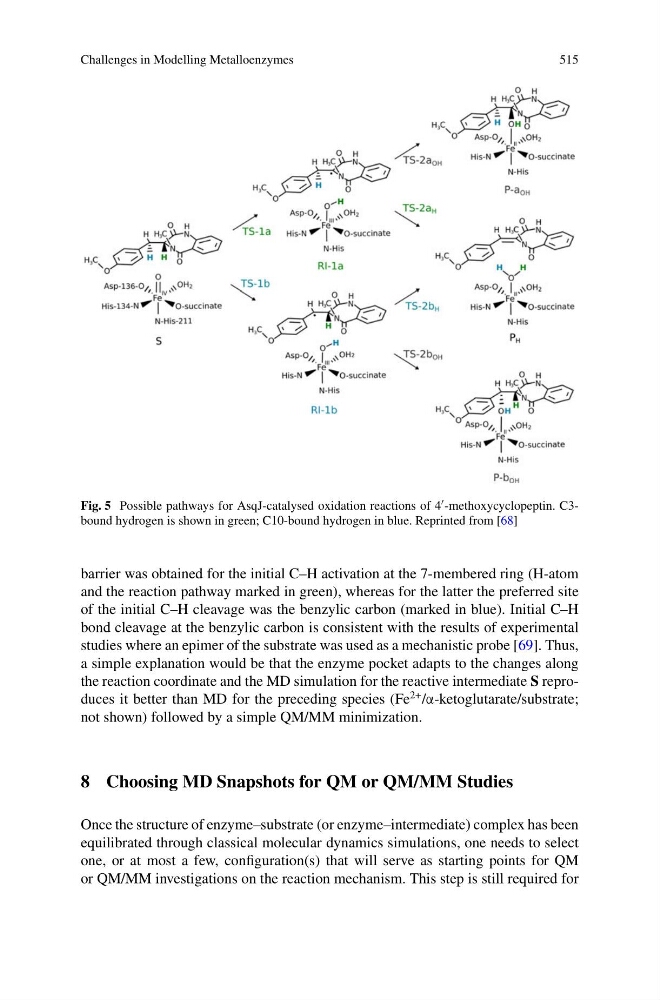
Fig. 5 Possible pathways for AsqJ-catalysed oxidation reactions of 4 -methoxycyclopeptin. C3bound hydrogen is shown in green; C10-bound hydrogen in blue. Reprinted from [68]
barrier was obtained for the initial C–H activation at the 7-membered ring (H-atom
and the reaction pathway marked in green), whereas for the latter the preferred site
of the initial C–H cleavage was the benzylic carbon (marked in blue). Initial C–H
bond cleavage at the benzylic carbon is consistent with the results of experimental
studies where an epimer of the substrate was used as a mechanistic probe [69]. Thus,
a simple explanation would be that the enzyme pocket adapts to the changes along
the reaction coordinate and the MD simulation for the reactive intermediate S reproduces it better than MD for the preceding species (Fe
2+ /α-ketoglutarate/substrate;
not shown) followed by a simple QM/MM minimization.
8 Choosing MD Snapshots for QM or QM/MM Studies
Once the structure of enzyme–substrate (or enzyme–intermediate) complex has been
equilibrated through classical molecular dynamics simulations, one needs to select
one, or at most a few, configuration(s) that will serve as starting points for QM
or QM/MM investigations on the reaction mechanism. This step is still required for
515
Fig. 5 Possible pathways for AsqJ-catalysed oxidation reactions of 4 -methoxycyclopeptin. C3bound hydrogen is shown in green; C10-bound hydrogen in blue. Reprinted from [68]
barrier was obtained for the initial C–H activation at the 7-membered ring (H-atom
and the reaction pathway marked in green), whereas for the latter the preferred site
of the initial C–H cleavage was the benzylic carbon (marked in blue). Initial C–H
bond cleavage at the benzylic carbon is consistent with the results of experimental
studies where an epimer of the substrate was used as a mechanistic probe [69]. Thus,
a simple explanation would be that the enzyme pocket adapts to the changes along
the reaction coordinate and the MD simulation for the reactive intermediate S reproduces it better than MD for the preceding species (Fe
2+ /α-ketoglutarate/substrate;
not shown) followed by a simple QM/MM minimization.
8 Choosing MD Snapshots for QM or QM/MM Studies
Once the structure of enzyme–substrate (or enzyme–intermediate) complex has been
equilibrated through classical molecular dynamics simulations, one needs to select
one, or at most a few, configuration(s) that will serve as starting points for QM
or QM/MM investigations on the reaction mechanism. This step is still required for