

508
T. Borowski and M. Szaleniec
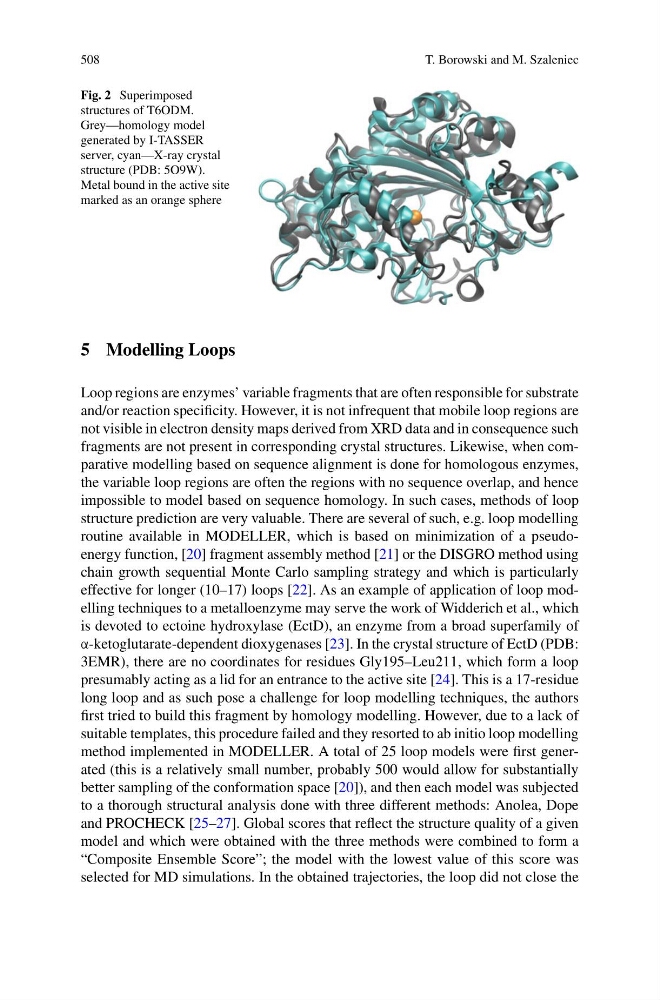
Fig. 2 Superimposed
structures of T6ODM.
Grey—homology model
generated by I-TASSER
server, cyan—X-ray crystal
structure (PDB: 5O9W).
Metal bound in the active site
marked as an orange sphere
5 Modelling Loops
Loop regions are enzymes’ variable fragments that are often responsible for substrate
and/or reaction specificity. However, it is not infrequent that mobile loop regions are
not visible in electron density maps derived from XRD data and in consequence such
fragments are not present in corresponding crystal structures. Likewise, when comparative modelling based on sequence alignment is done for homologous enzymes,
the variable loop regions are often the regions with no sequence overlap, and hence
impossible to model based on sequence homology. In such cases, methods of loop
structure prediction are very valuable. There are several of such, e.g. loop modelling
routine available in MODELLER, which is based on minimization of a pseudoenergy function, [20] fragment assembly method [21] or the DISGRO method using
chain growth sequential Monte Carlo sampling strategy and which is particularly
effective for longer (10–17) loops [22]. As an example of application of loop modelling techniques to a metalloenzyme may serve the work of Widderich et al., which
is devoted to ectoine hydroxylase (EctD), an enzyme from a broad superfamily of
α-ketoglutarate-dependent dioxygenases [23]. In the crystal structure of EctD (PDB:
3EMR), there are no coordinates for residues Gly195–Leu211, which form a loop
presumably acting as a lid for an entrance to the active site [24]. This is a 17-residue
long loop and as such pose a challenge for loop modelling techniques, the authors
first tried to build this fragment by homology modelling. However, due to a lack of
suitable templates, this procedure failed and they resorted to ab initio loop modelling
method implemented in MODELLER. A total of 25 loop models were first generated (this is a relatively small number, probably 500 would allow for substantially
better sampling of the conformation space [20]), and then each model was subjected
to a thorough structural analysis done with three different methods: Anolea, Dope
and PROCHECK [25–27]. Global scores that reflect the structure quality of a given
model and which were obtained with the three methods were combined to form a
“Composite Ensemble Score”; the model with the lowest value of this score was
selected for MD simulations. In the obtained trajectories, the loop did not close the
T. Borowski and M. Szaleniec
Fig. 2 Superimposed
structures of T6ODM.
Grey—homology model
generated by I-TASSER
server, cyan—X-ray crystal
structure (PDB: 5O9W).
Metal bound in the active site
marked as an orange sphere
5 Modelling Loops
Loop regions are enzymes’ variable fragments that are often responsible for substrate
and/or reaction specificity. However, it is not infrequent that mobile loop regions are
not visible in electron density maps derived from XRD data and in consequence such
fragments are not present in corresponding crystal structures. Likewise, when comparative modelling based on sequence alignment is done for homologous enzymes,
the variable loop regions are often the regions with no sequence overlap, and hence
impossible to model based on sequence homology. In such cases, methods of loop
structure prediction are very valuable. There are several of such, e.g. loop modelling
routine available in MODELLER, which is based on minimization of a pseudoenergy function, [20] fragment assembly method [21] or the DISGRO method using
chain growth sequential Monte Carlo sampling strategy and which is particularly
effective for longer (10–17) loops [22]. As an example of application of loop modelling techniques to a metalloenzyme may serve the work of Widderich et al., which
is devoted to ectoine hydroxylase (EctD), an enzyme from a broad superfamily of
α-ketoglutarate-dependent dioxygenases [23]. In the crystal structure of EctD (PDB:
3EMR), there are no coordinates for residues Gly195–Leu211, which form a loop
presumably acting as a lid for an entrance to the active site [24]. This is a 17-residue
long loop and as such pose a challenge for loop modelling techniques, the authors
first tried to build this fragment by homology modelling. However, due to a lack of
suitable templates, this procedure failed and they resorted to ab initio loop modelling
method implemented in MODELLER. A total of 25 loop models were first generated (this is a relatively small number, probably 500 would allow for substantially
better sampling of the conformation space [20]), and then each model was subjected
to a thorough structural analysis done with three different methods: Anolea, Dope
and PROCHECK [25–27]. Global scores that reflect the structure quality of a given
model and which were obtained with the three methods were combined to form a
“Composite Ensemble Score”; the model with the lowest value of this score was
selected for MD simulations. In the obtained trajectories, the loop did not close the