

490
T. Marinoet al.
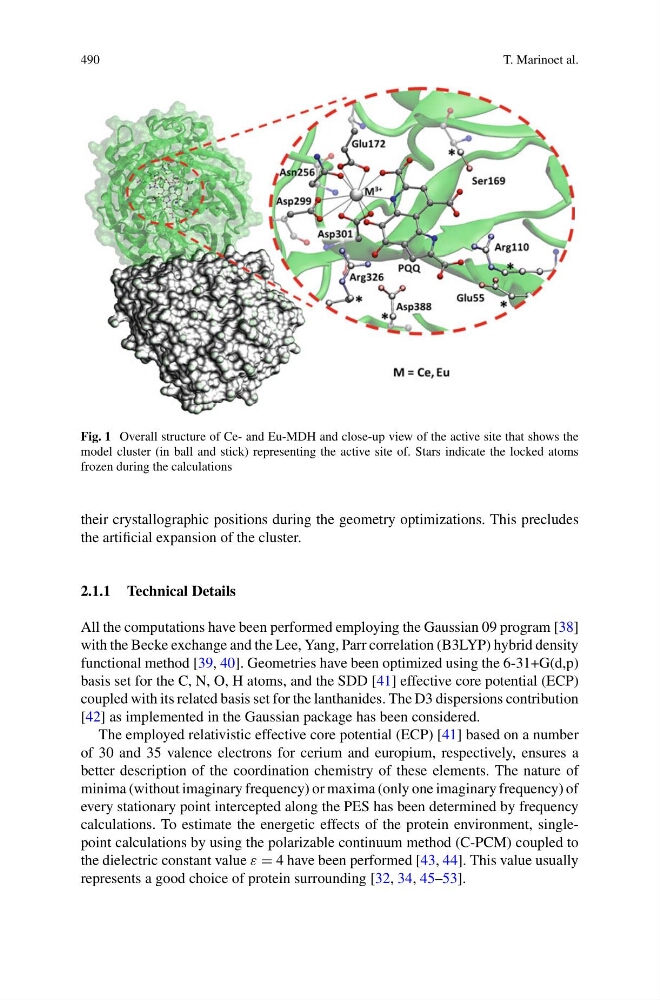
Fig. 1 Overall structure of Ce- and Eu-MDH and close-up view of the active site that shows the
model cluster (in ball and stick) representing the active site of. Stars indicate the locked atoms
frozen during the calculations
their crystallographic positions during the geometry optimizations. This precludes
the artificial expansion of the cluster.
2.1.1 Technical Details
All the computations have been performed employing the Gaussian 09 program [38]
with the Becke exchange and the Lee, Yang, Parr correlation (B3LYP) hybrid density
functional method [39, 40]. Geometries have been optimized using the 6-31+G(d,p)
basis set for the C, N, O, H atoms, and the SDD [41] effective core potential (ECP)
coupled with its related basis set for the lanthanides. The D3 dispersions contribution
[42] as implemented in the Gaussian package has been considered.
The employed relativistic effective core potential (ECP) [41] based on a number
of 30 and 35 valence electrons for cerium and europium, respectively, ensures a
better description of the coordination chemistry of these elements. The nature of
minima (without imaginary frequency) or maxima (only one imaginary frequency) of
every stationary point intercepted along the PES has been determined by frequency
calculations. To estimate the energetic effects of the protein environment, singlepoint calculations by using the polarizable continuum method (C-PCM) coupled to
the dielectric constant value ε 4 have been performed [43, 44]. This value usually
represents a good choice of protein surrounding [32, 34, 45–53].
T. Marinoet al.
Fig. 1 Overall structure of Ce- and Eu-MDH and close-up view of the active site that shows the
model cluster (in ball and stick) representing the active site of. Stars indicate the locked atoms
frozen during the calculations
their crystallographic positions during the geometry optimizations. This precludes
the artificial expansion of the cluster.
2.1.1 Technical Details
All the computations have been performed employing the Gaussian 09 program [38]
with the Becke exchange and the Lee, Yang, Parr correlation (B3LYP) hybrid density
functional method [39, 40]. Geometries have been optimized using the 6-31+G(d,p)
basis set for the C, N, O, H atoms, and the SDD [41] effective core potential (ECP)
coupled with its related basis set for the lanthanides. The D3 dispersions contribution
[42] as implemented in the Gaussian package has been considered.
The employed relativistic effective core potential (ECP) [41] based on a number
of 30 and 35 valence electrons for cerium and europium, respectively, ensures a
better description of the coordination chemistry of these elements. The nature of
minima (without imaginary frequency) or maxima (only one imaginary frequency) of
every stationary point intercepted along the PES has been determined by frequency
calculations. To estimate the energetic effects of the protein environment, singlepoint calculations by using the polarizable continuum method (C-PCM) coupled to
the dielectric constant value ε 4 have been performed [43, 44]. This value usually
represents a good choice of protein surrounding [32, 34, 45–53].