

488
T. Marinoet al.
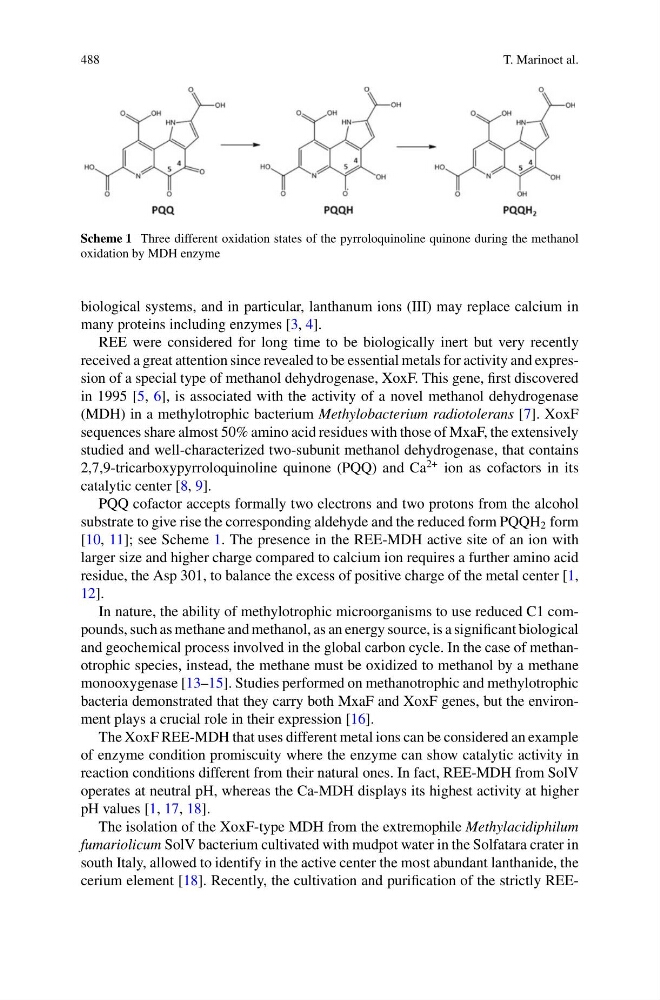
Scheme 1 Three different oxidation states of the pyrroloquinoline quinone during the methanol
oxidation by MDH enzyme
biological systems, and in particular, lanthanum ions (III) may replace calcium in
many proteins including enzymes [3, 4].
REE were considered for long time to be biologically inert but very recently
received a great attention since revealed to be essential metals for activity and expression of a special type of methanol dehydrogenase, XoxF. This gene, first discovered
in 1995 [5, 6], is associated with the activity of a novel methanol dehydrogenase
(MDH) in a methylotrophic bacterium Methylobacterium radiotolerans [7]. XoxF
sequences share almost 50% amino acid residues with those of MxaF, the extensively
studied and well-characterized two-subunit methanol dehydrogenase, that contains
2,7,9-tricarboxypyrroloquinoline quinone (PQQ) and Ca
2+ ion as cofactors in its
catalytic center [8, 9].
PQQ cofactor accepts formally two electrons and two protons from the alcohol
substrate to give rise the corresponding aldehyde and the reduced form PQQH 2 form
[10, 11]; see Scheme 1. The presence in the REE-MDH active site of an ion with
larger size and higher charge compared to calcium ion requires a further amino acid
residue, the Asp 301, to balance the excess of positive charge of the metal center [1,
12].
In nature, the ability of methylotrophic microorganisms to use reduced C1 compounds, such as methane and methanol, as an energy source, is a significant biological
and geochemical process involved in the global carbon cycle. In the case of methanotrophic species, instead, the methane must be oxidized to methanol by a methane
monooxygenase [13–15]. Studies performed on methanotrophic and methylotrophic
bacteria demonstrated that they carry both MxaF and XoxF genes, but the environment plays a crucial role in their expression [16].
The XoxF REE-MDH that uses different metal ions can be considered an example
of enzyme condition promiscuity where the enzyme can show catalytic activity in
reaction conditions different from their natural ones. In fact, REE-MDH from SolV
operates at neutral pH, whereas the Ca-MDH displays its highest activity at higher
pH values [1, 17, 18].
The isolation of the XoxF-type MDH from the extremophile Methylacidiphilum
fumariolicum SolV bacterium cultivated with mudpot water in the Solfatara crater in
south Italy, allowed to identify in the active center the most abundant lanthanide, the
cerium element [18]. Recently, the cultivation and purification of the strictly REE-
T. Marinoet al.
Scheme 1 Three different oxidation states of the pyrroloquinoline quinone during the methanol
oxidation by MDH enzyme
biological systems, and in particular, lanthanum ions (III) may replace calcium in
many proteins including enzymes [3, 4].
REE were considered for long time to be biologically inert but very recently
received a great attention since revealed to be essential metals for activity and expression of a special type of methanol dehydrogenase, XoxF. This gene, first discovered
in 1995 [5, 6], is associated with the activity of a novel methanol dehydrogenase
(MDH) in a methylotrophic bacterium Methylobacterium radiotolerans [7]. XoxF
sequences share almost 50% amino acid residues with those of MxaF, the extensively
studied and well-characterized two-subunit methanol dehydrogenase, that contains
2,7,9-tricarboxypyrroloquinoline quinone (PQQ) and Ca
2+ ion as cofactors in its
catalytic center [8, 9].
PQQ cofactor accepts formally two electrons and two protons from the alcohol
substrate to give rise the corresponding aldehyde and the reduced form PQQH 2 form
[10, 11]; see Scheme 1. The presence in the REE-MDH active site of an ion with
larger size and higher charge compared to calcium ion requires a further amino acid
residue, the Asp 301, to balance the excess of positive charge of the metal center [1,
12].
In nature, the ability of methylotrophic microorganisms to use reduced C1 compounds, such as methane and methanol, as an energy source, is a significant biological
and geochemical process involved in the global carbon cycle. In the case of methanotrophic species, instead, the methane must be oxidized to methanol by a methane
monooxygenase [13–15]. Studies performed on methanotrophic and methylotrophic
bacteria demonstrated that they carry both MxaF and XoxF genes, but the environment plays a crucial role in their expression [16].
The XoxF REE-MDH that uses different metal ions can be considered an example
of enzyme condition promiscuity where the enzyme can show catalytic activity in
reaction conditions different from their natural ones. In fact, REE-MDH from SolV
operates at neutral pH, whereas the Ca-MDH displays its highest activity at higher
pH values [1, 17, 18].
The isolation of the XoxF-type MDH from the extremophile Methylacidiphilum
fumariolicum SolV bacterium cultivated with mudpot water in the Solfatara crater in
south Italy, allowed to identify in the active center the most abundant lanthanide, the
cerium element [18]. Recently, the cultivation and purification of the strictly REE-