

Applications of Computational Chemistry to Selected Problems …
483
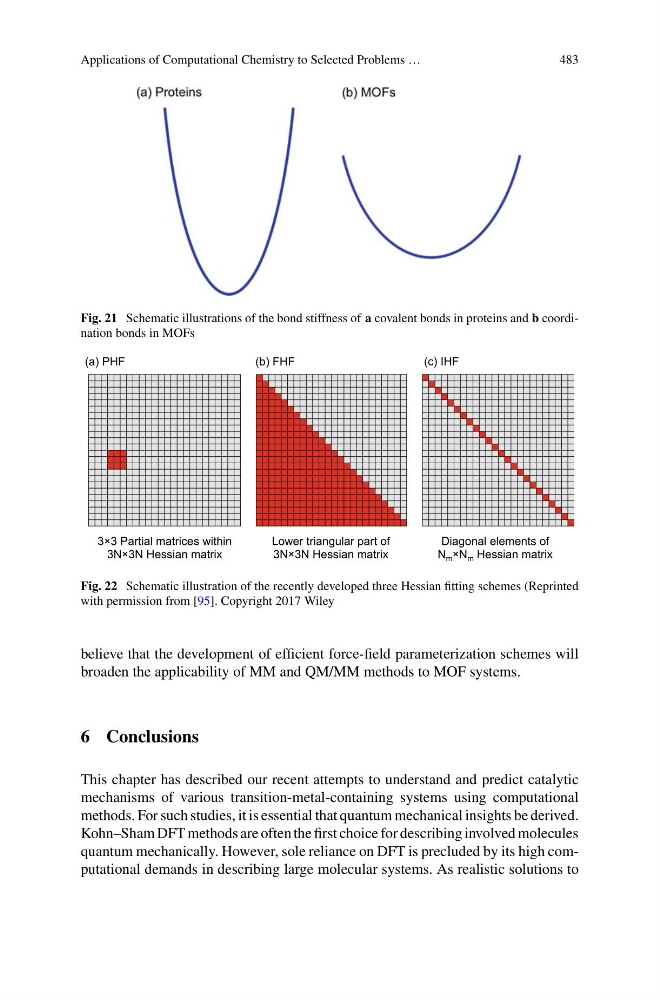
Fig. 21 Schematic illustrations of the bond stiffness of a covalent bonds in proteins and b coordination bonds in MOFs
(a) PHF
(b) FHF
(c) IHF
3×3 Partial matrices within
3N×3N Hessian matrix
Lower triangular part of
3N×3N Hessian matrix
Diagonal elements of
N m ×N m Hessian matrix
Fig. 22 Schematic illustration of the recently developed three Hessian fitting schemes (Reprinted
with permission from [95]. Copyright 2017 Wiley
believe that the development of efficient force-field parameterization schemes will
broaden the applicability of MM and QM/MM methods to MOF systems.
6 Conclusions
This chapter has described our recent attempts to understand and predict catalytic
mechanisms of various transition-metal-containing systems using computational
methods. For such studies, it is essential that quantum mechanical insights be derived.
Kohn–Sham DFT methods are often the first choice for describing involved molecules
quantum mechanically. However, sole reliance on DFT is precluded by its high computational demands in describing large molecular systems. As realistic solutions to
483
Fig. 21 Schematic illustrations of the bond stiffness of a covalent bonds in proteins and b coordination bonds in MOFs
(a) PHF
(b) FHF
(c) IHF
3×3 Partial matrices within
3N×3N Hessian matrix
Lower triangular part of
3N×3N Hessian matrix
Diagonal elements of
N m ×N m Hessian matrix
Fig. 22 Schematic illustration of the recently developed three Hessian fitting schemes (Reprinted
with permission from [95]. Copyright 2017 Wiley
believe that the development of efficient force-field parameterization schemes will
broaden the applicability of MM and QM/MM methods to MOF systems.
6 Conclusions
This chapter has described our recent attempts to understand and predict catalytic
mechanisms of various transition-metal-containing systems using computational
methods. For such studies, it is essential that quantum mechanical insights be derived.
Kohn–Sham DFT methods are often the first choice for describing involved molecules
quantum mechanically. However, sole reliance on DFT is precluded by its high computational demands in describing large molecular systems. As realistic solutions to