

Applications of Computational Chemistry to Selected Problems …
473
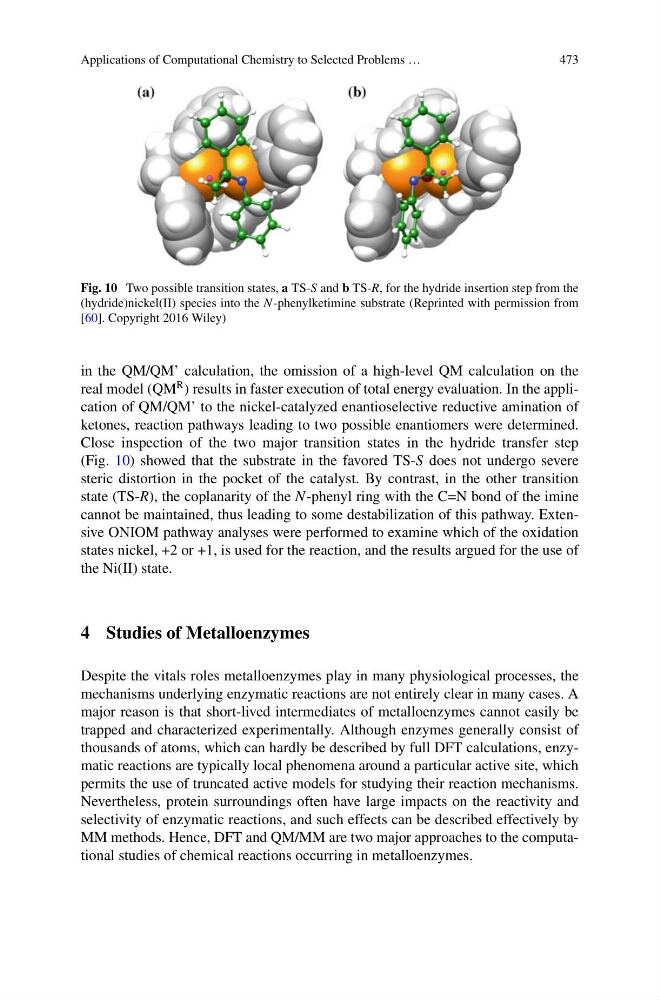
Fig. 10 Two possible transition states, a TS-S and b TS-R, for the hydride insertion step from the
(hydride)nickel(II) species into the N-phenylketimine substrate (Reprinted with permission from
[60]. Copyright 2016 Wiley)
in the QM/QM’ calculation, the omission of a high-level QM calculation on the
real model (QM
R ) results in faster execution of total energy evaluation. In the application of QM/QM’ to the nickel-catalyzed enantioselective reductive amination of
ketones, reaction pathways leading to two possible enantiomers were determined.
Close inspection of the two major transition states in the hydride transfer step
(Fig. 10) showed that the substrate in the favored TS-S does not undergo severe
steric distortion in the pocket of the catalyst. By contrast, in the other transition
state (TS-R), the coplanarity of the N-phenyl ring with the C=N bond of the imine
cannot be maintained, thus leading to some destabilization of this pathway. Extensive ONIOM pathway analyses were performed to examine which of the oxidation
states nickel, +2 or +1, is used for the reaction, and the results argued for the use of
the Ni(II) state.
4 Studies of Metalloenzymes
Despite the vitals roles metalloenzymes play in many physiological processes, the
mechanisms underlying enzymatic reactions are not entirely clear in many cases. A
major reason is that short-lived intermediates of metalloenzymes cannot easily be
trapped and characterized experimentally. Although enzymes generally consist of
thousands of atoms, which can hardly be described by full DFT calculations, enzymatic reactions are typically local phenomena around a particular active site, which
permits the use of truncated active models for studying their reaction mechanisms.
Nevertheless, protein surroundings often have large impacts on the reactivity and
selectivity of enzymatic reactions, and such effects can be described effectively by
MM methods. Hence, DFT and QM/MM are two major approaches to the computational studies of chemical reactions occurring in metalloenzymes.
473
Fig. 10 Two possible transition states, a TS-S and b TS-R, for the hydride insertion step from the
(hydride)nickel(II) species into the N-phenylketimine substrate (Reprinted with permission from
[60]. Copyright 2016 Wiley)
in the QM/QM’ calculation, the omission of a high-level QM calculation on the
real model (QM
R ) results in faster execution of total energy evaluation. In the application of QM/QM’ to the nickel-catalyzed enantioselective reductive amination of
ketones, reaction pathways leading to two possible enantiomers were determined.
Close inspection of the two major transition states in the hydride transfer step
(Fig. 10) showed that the substrate in the favored TS-S does not undergo severe
steric distortion in the pocket of the catalyst. By contrast, in the other transition
state (TS-R), the coplanarity of the N-phenyl ring with the C=N bond of the imine
cannot be maintained, thus leading to some destabilization of this pathway. Extensive ONIOM pathway analyses were performed to examine which of the oxidation
states nickel, +2 or +1, is used for the reaction, and the results argued for the use of
the Ni(II) state.
4 Studies of Metalloenzymes
Despite the vitals roles metalloenzymes play in many physiological processes, the
mechanisms underlying enzymatic reactions are not entirely clear in many cases. A
major reason is that short-lived intermediates of metalloenzymes cannot easily be
trapped and characterized experimentally. Although enzymes generally consist of
thousands of atoms, which can hardly be described by full DFT calculations, enzymatic reactions are typically local phenomena around a particular active site, which
permits the use of truncated active models for studying their reaction mechanisms.
Nevertheless, protein surroundings often have large impacts on the reactivity and
selectivity of enzymatic reactions, and such effects can be described effectively by
MM methods. Hence, DFT and QM/MM are two major approaches to the computational studies of chemical reactions occurring in metalloenzymes.