

The Quest for Accurate Theoretical Models of Metalloenzymes …
451
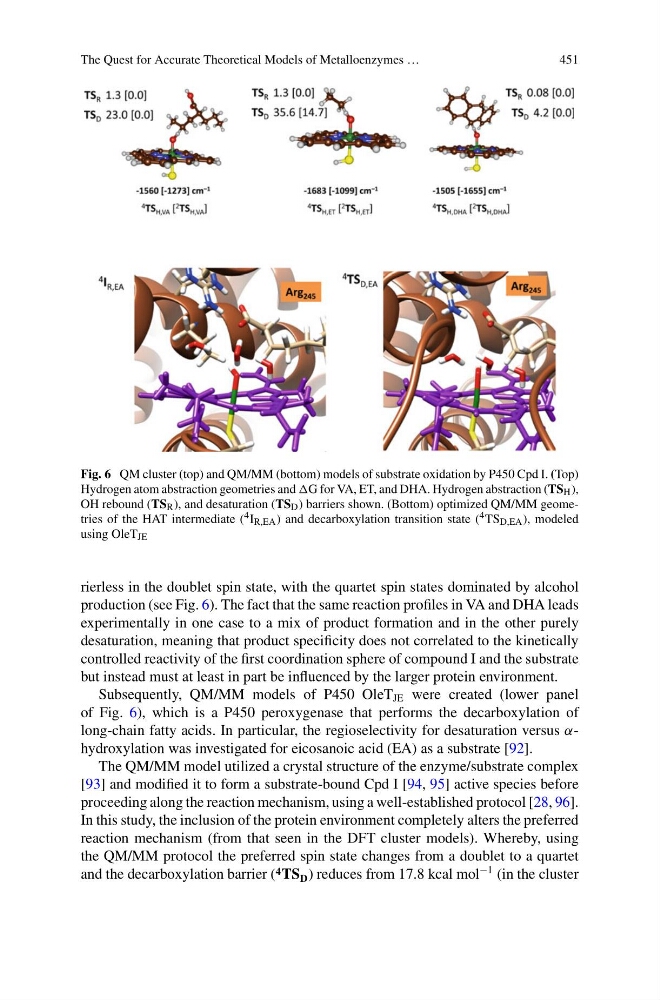
Fig. 6 QM cluster (top) and QM/MM (bottom) models of substrate oxidation by P450 Cpd I. (Top)
Hydrogen atom abstraction geometries and G for VA, ET, and DHA. Hydrogen abstraction (TS H ),
OH rebound (TS R ), and desaturation (TS D ) barriers shown. (Bottom) optimized QM/MM geometries of the HAT intermediate ( 4 I R,EA ) and decarboxylation transition state ( 4 TS D,EA ), modeled
using OleT JE
rierless in the doublet spin state, with the quartet spin states dominated by alcohol
production (see Fig. 6). The fact that the same reaction profiles in VA and DHA leads
experimentally in one case to a mix of product formation and in the other purely
desaturation, meaning that product specificity does not correlated to the kinetically
controlled reactivity of the first coordination sphere of compound I and the substrate
but instead must at least in part be influenced by the larger protein environment.
Subsequently, QM/MM models of P450 OleT JE were created (lower panel
of Fig. 6), which is a P450 peroxygenase that performs the decarboxylation of
long-chain fatty acids. In particular, the regioselectivity for desaturation versus αhydroxylation was investigated for eicosanoic acid (EA) as a substrate [92].
The QM/MM model utilized a crystal structure of the enzyme/substrate complex
[93] and modified it to form a substrate-bound Cpd I [94, 95] active species before
proceeding along the reaction mechanism, using a well-established protocol [28, 96].
In this study, the inclusion of the protein environment completely alters the preferred
reaction mechanism (from that seen in the DFT cluster models). Whereby, using
the QM/MM protocol the preferred spin state changes from a doublet to a quartet
and the decarboxylation barrier ( 4 TS D ) reduces from 17.8 kcal mol
−1 (in the cluster
451
Fig. 6 QM cluster (top) and QM/MM (bottom) models of substrate oxidation by P450 Cpd I. (Top)
Hydrogen atom abstraction geometries and G for VA, ET, and DHA. Hydrogen abstraction (TS H ),
OH rebound (TS R ), and desaturation (TS D ) barriers shown. (Bottom) optimized QM/MM geometries of the HAT intermediate ( 4 I R,EA ) and decarboxylation transition state ( 4 TS D,EA ), modeled
using OleT JE
rierless in the doublet spin state, with the quartet spin states dominated by alcohol
production (see Fig. 6). The fact that the same reaction profiles in VA and DHA leads
experimentally in one case to a mix of product formation and in the other purely
desaturation, meaning that product specificity does not correlated to the kinetically
controlled reactivity of the first coordination sphere of compound I and the substrate
but instead must at least in part be influenced by the larger protein environment.
Subsequently, QM/MM models of P450 OleT JE were created (lower panel
of Fig. 6), which is a P450 peroxygenase that performs the decarboxylation of
long-chain fatty acids. In particular, the regioselectivity for desaturation versus αhydroxylation was investigated for eicosanoic acid (EA) as a substrate [92].
The QM/MM model utilized a crystal structure of the enzyme/substrate complex
[93] and modified it to form a substrate-bound Cpd I [94, 95] active species before
proceeding along the reaction mechanism, using a well-established protocol [28, 96].
In this study, the inclusion of the protein environment completely alters the preferred
reaction mechanism (from that seen in the DFT cluster models). Whereby, using
the QM/MM protocol the preferred spin state changes from a doublet to a quartet
and the decarboxylation barrier ( 4 TS D ) reduces from 17.8 kcal mol
−1 (in the cluster