

The Quest for Accurate Theoretical Models of Metalloenzymes …
443
QM region, which is particularly relevant as often there are chemical bonds between
the two regions. Often these bonds are capped and the QM region is calculated using
hydrogen-link atoms [15].
Two main approaches are available in the literature for the interaction of the MM
atoms with the QM atoms, namely mechanical embedding [34] and electrostatic
embedding protocols [18]. Mechanical embedding protocols consider the electrostatic interaction between initial charges in the MM region and QM regions; however, only with an electrostatic methodology are MM charges incorporated into the
QM Hamiltonian explicitly. Convergence studies on QM/MM models, with over
40 different QM regions, showed that the absolute mean deviation increased from
1.7 kcal mol
−1 using a mechanical embedding protocol to around 5 kcal mol
−1 when
electronic embedding was considered [35]. Therefore, while electrostatic embedding may be considered more accurate, when using such a protocol the choice of
QM region is extremely important.
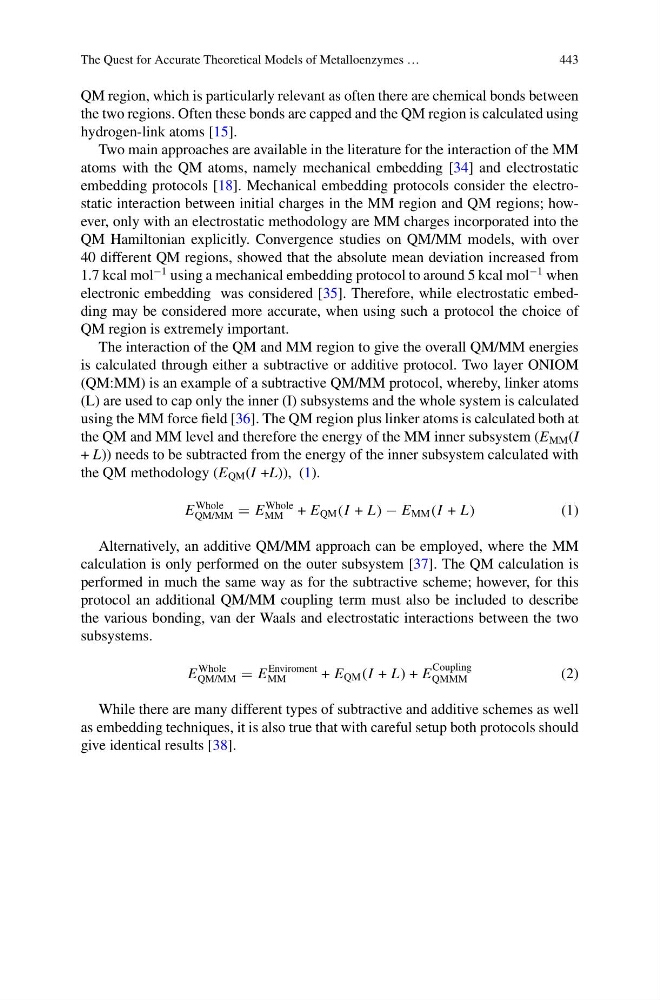
The interaction of the QM and MM region to give the overall QM/MM energies
is calculated through either a subtractive or additive protocol. Two layer ONIOM
(QM:MM) is an example of a subtractive QM/MM protocol, whereby, linker atoms
(L) are used to cap only the inner (I) subsystems and the whole system is calculated
using the MM force field [36]. The QM region plus linker atoms is calculated both at
the QM and MM level and therefore the energy of the MM inner subsystem (E MM (I
+ L)) needs to be subtracted from the energy of the inner subsystem calculated with
the QM methodology (E QM (I +L)), (1).
E
Whole
QM/MM E
Whole
MM + E QM (I + L) − E MM (I + L)
(1)
Alternatively, an additive QM/MM approach can be employed, where the MM
calculation is only performed on the outer subsystem [37]. The QM calculation is
performed in much the same way as for the subtractive scheme; however, for this
protocol an additional QM/MM coupling term must also be included to describe
the various bonding, van der Waals and electrostatic interactions between the two
subsystems.
E
Whole
QM/MM E
Enviroment
MM
+ E QM (I + L) + E
Coupling
QMMM
(2)
While there are many different types of subtractive and additive schemes as well
as embedding techniques, it is also true that with careful setup both protocols should
give identical results [38].
443
QM region, which is particularly relevant as often there are chemical bonds between
the two regions. Often these bonds are capped and the QM region is calculated using
hydrogen-link atoms [15].
Two main approaches are available in the literature for the interaction of the MM
atoms with the QM atoms, namely mechanical embedding [34] and electrostatic
embedding protocols [18]. Mechanical embedding protocols consider the electrostatic interaction between initial charges in the MM region and QM regions; however, only with an electrostatic methodology are MM charges incorporated into the
QM Hamiltonian explicitly. Convergence studies on QM/MM models, with over
40 different QM regions, showed that the absolute mean deviation increased from
1.7 kcal mol
−1 using a mechanical embedding protocol to around 5 kcal mol
−1 when
electronic embedding was considered [35]. Therefore, while electrostatic embedding may be considered more accurate, when using such a protocol the choice of
QM region is extremely important.
The interaction of the QM and MM region to give the overall QM/MM energies
is calculated through either a subtractive or additive protocol. Two layer ONIOM
(QM:MM) is an example of a subtractive QM/MM protocol, whereby, linker atoms
(L) are used to cap only the inner (I) subsystems and the whole system is calculated
using the MM force field [36]. The QM region plus linker atoms is calculated both at
the QM and MM level and therefore the energy of the MM inner subsystem (E MM (I
+ L)) needs to be subtracted from the energy of the inner subsystem calculated with
the QM methodology (E QM (I +L)), (1).
E
Whole
QM/MM E
Whole
MM + E QM (I + L) − E MM (I + L)
(1)
Alternatively, an additive QM/MM approach can be employed, where the MM
calculation is only performed on the outer subsystem [37]. The QM calculation is
performed in much the same way as for the subtractive scheme; however, for this
protocol an additional QM/MM coupling term must also be included to describe
the various bonding, van der Waals and electrostatic interactions between the two
subsystems.
E
Whole
QM/MM E
Enviroment
MM
+ E QM (I + L) + E
Coupling
QMMM
(2)
While there are many different types of subtractive and additive schemes as well
as embedding techniques, it is also true that with careful setup both protocols should
give identical results [38].