

The Quest for Accurate Theoretical Models of Metalloenzymes …
441
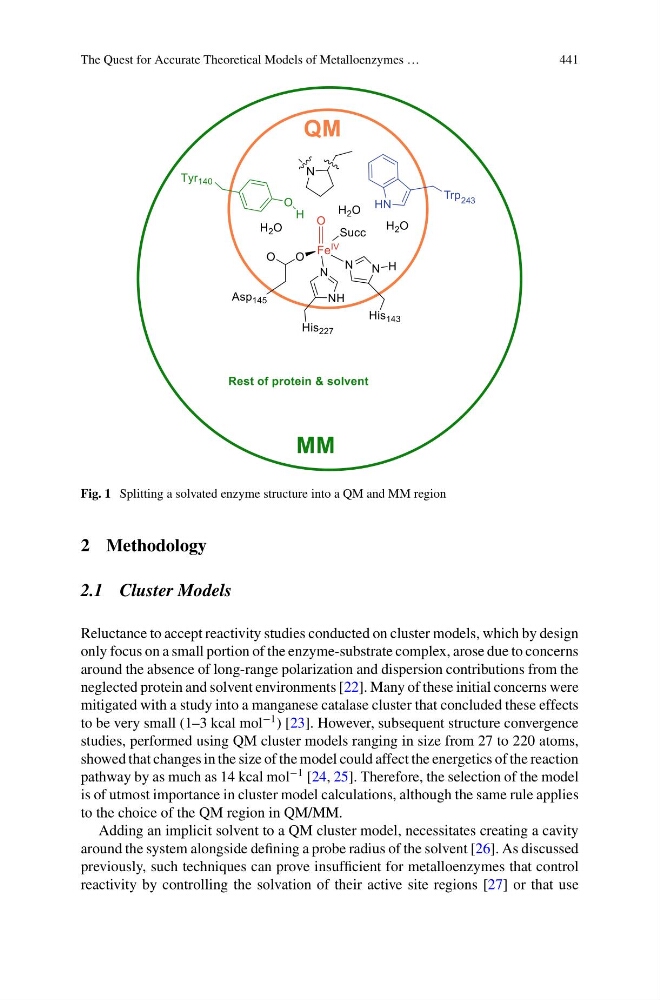
Fig. 1 Splitting a solvated enzyme structure into a QM and MM region
2 Methodology
2.1 Cluster Models
Reluctance to accept reactivity studies conducted on cluster models, which by design
only focus on a small portion of the enzyme-substrate complex, arose due to concerns
around the absence of long-range polarization and dispersion contributions from the
neglected protein and solvent environments [22]. Many of these initial concerns were
mitigated with a study into a manganese catalase cluster that concluded these effects
to be very small (1–3 kcal mol
−1 ) [23]. However, subsequent structure convergence
studies, performed using QM cluster models ranging in size from 27 to 220 atoms,
showed that changes in the size of the model could affect the energetics of the reaction
pathway by as much as 14 kcal mol
−1 [24, 25]. Therefore, the selection of the model
is of utmost importance in cluster model calculations, although the same rule applies
to the choice of the QM region in QM/MM.
Adding an implicit solvent to a QM cluster model, necessitates creating a cavity
around the system alongside defining a probe radius of the solvent [26]. As discussed
previously, such techniques can prove insufficient for metalloenzymes that control
reactivity by controlling the solvation of their active site regions [27] or that use
441
Fig. 1 Splitting a solvated enzyme structure into a QM and MM region
2 Methodology
2.1 Cluster Models
Reluctance to accept reactivity studies conducted on cluster models, which by design
only focus on a small portion of the enzyme-substrate complex, arose due to concerns
around the absence of long-range polarization and dispersion contributions from the
neglected protein and solvent environments [22]. Many of these initial concerns were
mitigated with a study into a manganese catalase cluster that concluded these effects
to be very small (1–3 kcal mol
−1 ) [23]. However, subsequent structure convergence
studies, performed using QM cluster models ranging in size from 27 to 220 atoms,
showed that changes in the size of the model could affect the energetics of the reaction
pathway by as much as 14 kcal mol
−1 [24, 25]. Therefore, the selection of the model
is of utmost importance in cluster model calculations, although the same rule applies
to the choice of the QM region in QM/MM.
Adding an implicit solvent to a QM cluster model, necessitates creating a cavity
around the system alongside defining a probe radius of the solvent [26]. As discussed
previously, such techniques can prove insufficient for metalloenzymes that control
reactivity by controlling the solvation of their active site regions [27] or that use