

416
P. P. Roma´ nczyk and S. S. Kurek
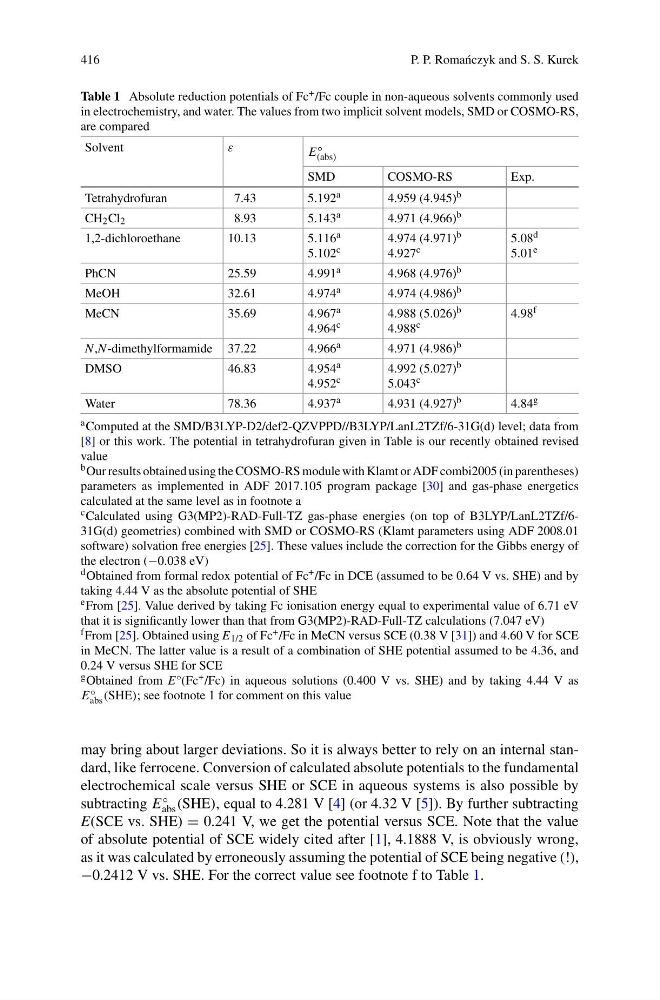
Table 1 Absolute reduction potentials of Fc + /Fc couple in non-aqueous solvents commonly used
in electrochemistry, and water. The values from two implicit solvent models, SMD or COSMO-RS,
are compared
Solvent
ε
E ◦
(abs)
SMD
COSMO-RS
Exp.
Tetrahydrofuran
7.43
5.192 a
4.959 (4.945) b
CH 2 Cl 2
8.93
5.143 a
4.971 (4.966) b
1,2-dichloroethane
10.13
5.116 a
5.102 c
4.974 (4.971) b
4.927 c
5.08 d
5.01 e
PhCN
25.59
4.991 a
4.968 (4.976) b
MeOH
32.61
4.974 a
4.974 (4.986) b
MeCN
35.69
4.967 a
4.964 c
4.988 (5.026) b
4.988 c
4.98 f
N,N-dimethylformamide 37.22
4.966 a
4.971 (4.986) b
DMSO
46.83
4.954 a
4.952 c
4.992 (5.027) b
5.043 c
Water
78.36
4.937 a
4.931 (4.927) b
4.84 g
a Computed at the SMD/B3LYP-D2/def2-QZVPPD//B3LYP/LanL2TZf/6-31G(d) level; data from
[8] or this work. The potential in tetrahydrofuran given in Table is our recently obtained revised
value
b Our results obtained using the COSMO-RS module with Klamt or ADF combi2005 (in parentheses)
parameters as implemented in ADF 2017.105 program package [30] and gas-phase energetics
calculated at the same level as in footnote a
c Calculated using G3(MP2)-RAD-Full-TZ gas-phase energies (on top of B3LYP/LanL2TZf/631G(d) geometries) combined with SMD or COSMO-RS (Klamt parameters using ADF 2008.01
software) solvation free energies [25]. These values include the correction for the Gibbs energy of
the electron (−0.038 eV)
d Obtained from formal redox potential of Fc + /Fc in DCE (assumed to be 0.64 V vs. SHE) and by
taking 4.44 V as the absolute potential of SHE
e From [25]. Value derived by taking Fc ionisation energy equal to experimental value of 6.71 eV
that it is significantly lower than that from G3(MP2)-RAD-Full-TZ calculations (7.047 eV)
f From [25]. Obtained using E 1/2 of Fc + /Fc in MeCN versus SCE (0.38 V [31]) and 4.60 V for SCE
in MeCN. The latter value is a result of a combination of SHE potential assumed to be 4.36, and
0.24 V versus SHE for SCE
g Obtained from E°(Fc + /Fc) in aqueous solutions (0.400 V vs. SHE) and by taking 4.44 V as
E ◦
abs (SHE); see footnote 1 for comment on this value
may bring about larger deviations. So it is always better to rely on an internal standard, like ferrocene. Conversion of calculated absolute potentials to the fundamental
electrochemical scale versus SHE or SCE in aqueous systems is also possible by
subtracting E
◦
abs (SHE), equal to 4.281 V [4] (or 4.32 V [5]). By further subtracting
E(SCE vs. SHE) 0.241 V, we get the potential versus SCE. Note that the value
of absolute potential of SCE widely cited after [1], 4.1888 V, is obviously wrong,
as it was calculated by erroneously assuming the potential of SCE being negative (!),
−0.2412 V vs. SHE. For the correct value see footnote f to Table 1.
P. P. Roma´ nczyk and S. S. Kurek
Table 1 Absolute reduction potentials of Fc + /Fc couple in non-aqueous solvents commonly used
in electrochemistry, and water. The values from two implicit solvent models, SMD or COSMO-RS,
are compared
Solvent
ε
E ◦
(abs)
SMD
COSMO-RS
Exp.
Tetrahydrofuran
7.43
5.192 a
4.959 (4.945) b
CH 2 Cl 2
8.93
5.143 a
4.971 (4.966) b
1,2-dichloroethane
10.13
5.116 a
5.102 c
4.974 (4.971) b
4.927 c
5.08 d
5.01 e
PhCN
25.59
4.991 a
4.968 (4.976) b
MeOH
32.61
4.974 a
4.974 (4.986) b
MeCN
35.69
4.967 a
4.964 c
4.988 (5.026) b
4.988 c
4.98 f
N,N-dimethylformamide 37.22
4.966 a
4.971 (4.986) b
DMSO
46.83
4.954 a
4.952 c
4.992 (5.027) b
5.043 c
Water
78.36
4.937 a
4.931 (4.927) b
4.84 g
a Computed at the SMD/B3LYP-D2/def2-QZVPPD//B3LYP/LanL2TZf/6-31G(d) level; data from
[8] or this work. The potential in tetrahydrofuran given in Table is our recently obtained revised
value
b Our results obtained using the COSMO-RS module with Klamt or ADF combi2005 (in parentheses)
parameters as implemented in ADF 2017.105 program package [30] and gas-phase energetics
calculated at the same level as in footnote a
c Calculated using G3(MP2)-RAD-Full-TZ gas-phase energies (on top of B3LYP/LanL2TZf/631G(d) geometries) combined with SMD or COSMO-RS (Klamt parameters using ADF 2008.01
software) solvation free energies [25]. These values include the correction for the Gibbs energy of
the electron (−0.038 eV)
d Obtained from formal redox potential of Fc + /Fc in DCE (assumed to be 0.64 V vs. SHE) and by
taking 4.44 V as the absolute potential of SHE
e From [25]. Value derived by taking Fc ionisation energy equal to experimental value of 6.71 eV
that it is significantly lower than that from G3(MP2)-RAD-Full-TZ calculations (7.047 eV)
f From [25]. Obtained using E 1/2 of Fc + /Fc in MeCN versus SCE (0.38 V [31]) and 4.60 V for SCE
in MeCN. The latter value is a result of a combination of SHE potential assumed to be 4.36, and
0.24 V versus SHE for SCE
g Obtained from E°(Fc + /Fc) in aqueous solutions (0.400 V vs. SHE) and by taking 4.44 V as
E ◦
abs (SHE); see footnote 1 for comment on this value
may bring about larger deviations. So it is always better to rely on an internal standard, like ferrocene. Conversion of calculated absolute potentials to the fundamental
electrochemical scale versus SHE or SCE in aqueous systems is also possible by
subtracting E
◦
abs (SHE), equal to 4.281 V [4] (or 4.32 V [5]). By further subtracting
E(SCE vs. SHE) 0.241 V, we get the potential versus SCE. Note that the value
of absolute potential of SCE widely cited after [1], 4.1888 V, is obviously wrong,
as it was calculated by erroneously assuming the potential of SCE being negative (!),
−0.2412 V vs. SHE. For the correct value see footnote f to Table 1.