

Molecular Electrochemistry of Coordination Compounds …
411
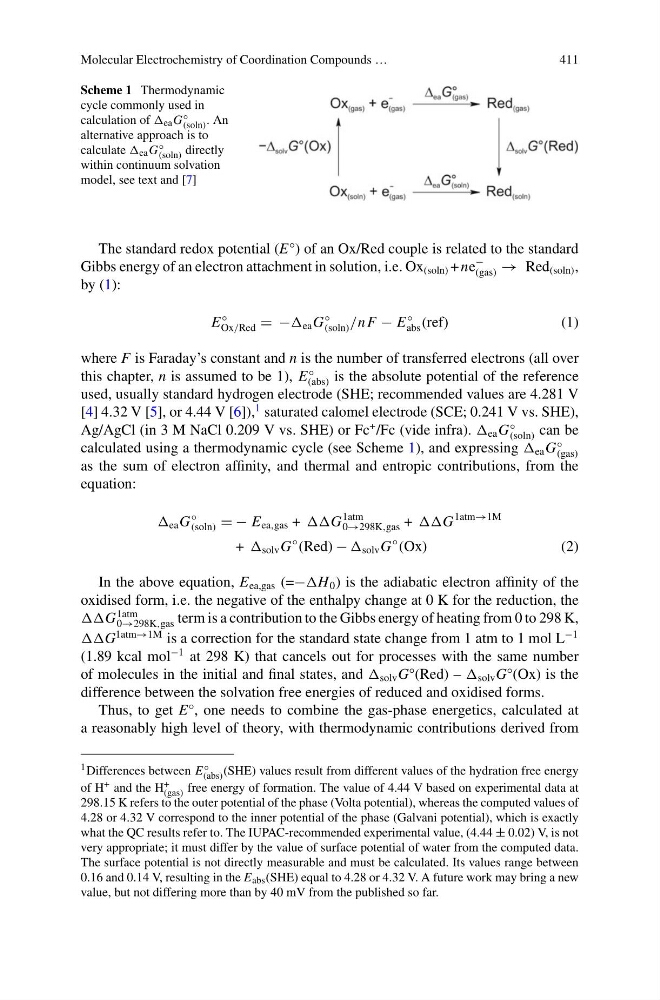
Scheme 1 Thermodynamic
cycle commonly used in
calculation of ea G ◦
(soln) . An
alternative approach is to
calculate ea G ◦
(soln) directly
within continuum solvation
model, see text and [7]
The standard redox potential (E°) of an Ox/Red couple is related to the standard
Gibbs energy of an electron attachment in solution, i.e. Ox (soln) + ne
−
(gas) → Red (soln) ,
by (1):
E
◦
Ox/Red − ea G
◦
(soln) /n F − E
◦
abs (ref)
(1)
where F is Faraday’s constant and n is the number of transferred electrons (all over
this chapter, n is assumed to be 1), E
◦
(abs) is the absolute potential of the reference
used, usually standard hydrogen electrode (SHE; recommended values are 4.281 V
[4] 4.32 V [5], or 4.44 V [6]),
1 saturated calomel electrode (SCE; 0.241 V vs. SHE),
Ag/AgCl (in 3 M NaCl 0.209 V vs. SHE) or Fc
+ /Fc (vide infra). ea G
◦
(soln) can be
calculated using a thermodynamic cycle (see Scheme 1), and expressing ea G
◦
(gas)
as the sum of electron affinity, and thermal and entropic contributions, from the
equation:
ea G
◦
(soln) − E ea,gas + G
1atm
0→298K,gas + G
1atm→1M
+ solv G
◦
(Red) − solv G
◦
(Ox)
(2)
In the above equation, E ea,gas (=−H 0 ) is the adiabatic electron affinity of the
oxidised form, i.e. the negative of the enthalpy change at 0 K for the reduction, the
G
1atm
0→298K,gas term is a contribution to the Gibbs energy of heating from 0 to 298 K,
G
1atm→1M is a correction for the standard state change from 1 atm to 1 mol L
−1
(1.89 kcal mol
−1 at 298 K) that cancels out for processes with the same number
of molecules in the initial and final states, and solv G°(Red) – solv G°(Ox) is the
difference between the solvation free energies of reduced and oxidised forms.
Thus, to get E°, one needs to combine the gas-phase energetics, calculated at
a reasonably high level of theory, with thermodynamic contributions derived from
1 Differences between E ◦
(abs) (SHE) values result from different values of the hydration free energy
of H + and the H +
(gas) free energy of formation. The value of 4.44 V based on experimental data at
298.15 K refers to the outer potential of the phase (Volta potential), whereas the computed values of
4.28 or 4.32 V correspond to the inner potential of the phase (Galvani potential), which is exactly
what the QC results refer to. The IUPAC-recommended experimental value, (4.44 ± 0.02) V, is not
very appropriate; it must differ by the value of surface potential of water from the computed data.
The surface potential is not directly measurable and must be calculated. Its values range between
0.16 and 0.14 V, resulting in the E abs (SHE) equal to 4.28 or 4.32 V. A future work may bring a new
value, but not differing more than by 40 mV from the published so far.
411
Scheme 1 Thermodynamic
cycle commonly used in
calculation of ea G ◦
(soln) . An
alternative approach is to
calculate ea G ◦
(soln) directly
within continuum solvation
model, see text and [7]
The standard redox potential (E°) of an Ox/Red couple is related to the standard
Gibbs energy of an electron attachment in solution, i.e. Ox (soln) + ne
−
(gas) → Red (soln) ,
by (1):
E
◦
Ox/Red − ea G
◦
(soln) /n F − E
◦
abs (ref)
(1)
where F is Faraday’s constant and n is the number of transferred electrons (all over
this chapter, n is assumed to be 1), E
◦
(abs) is the absolute potential of the reference
used, usually standard hydrogen electrode (SHE; recommended values are 4.281 V
[4] 4.32 V [5], or 4.44 V [6]),
1 saturated calomel electrode (SCE; 0.241 V vs. SHE),
Ag/AgCl (in 3 M NaCl 0.209 V vs. SHE) or Fc
+ /Fc (vide infra). ea G
◦
(soln) can be
calculated using a thermodynamic cycle (see Scheme 1), and expressing ea G
◦
(gas)
as the sum of electron affinity, and thermal and entropic contributions, from the
equation:
ea G
◦
(soln) − E ea,gas + G
1atm
0→298K,gas + G
1atm→1M
+ solv G
◦
(Red) − solv G
◦
(Ox)
(2)
In the above equation, E ea,gas (=−H 0 ) is the adiabatic electron affinity of the
oxidised form, i.e. the negative of the enthalpy change at 0 K for the reduction, the
G
1atm
0→298K,gas term is a contribution to the Gibbs energy of heating from 0 to 298 K,
G
1atm→1M is a correction for the standard state change from 1 atm to 1 mol L
−1
(1.89 kcal mol
−1 at 298 K) that cancels out for processes with the same number
of molecules in the initial and final states, and solv G°(Red) – solv G°(Ox) is the
difference between the solvation free energies of reduced and oxidised forms.
Thus, to get E°, one needs to combine the gas-phase energetics, calculated at
a reasonably high level of theory, with thermodynamic contributions derived from
1 Differences between E ◦
(abs) (SHE) values result from different values of the hydration free energy
of H + and the H +
(gas) free energy of formation. The value of 4.44 V based on experimental data at
298.15 K refers to the outer potential of the phase (Volta potential), whereas the computed values of
4.28 or 4.32 V correspond to the inner potential of the phase (Galvani potential), which is exactly
what the QC results refer to. The IUPAC-recommended experimental value, (4.44 ± 0.02) V, is not
very appropriate; it must differ by the value of surface potential of water from the computed data.
The surface potential is not directly measurable and must be calculated. Its values range between
0.16 and 0.14 V, resulting in the E abs (SHE) equal to 4.28 or 4.32 V. A future work may bring a new
value, but not differing more than by 40 mV from the published so far.