

Catalytic Properties of Selected Transition Metal Oxides—Computational Studies
381
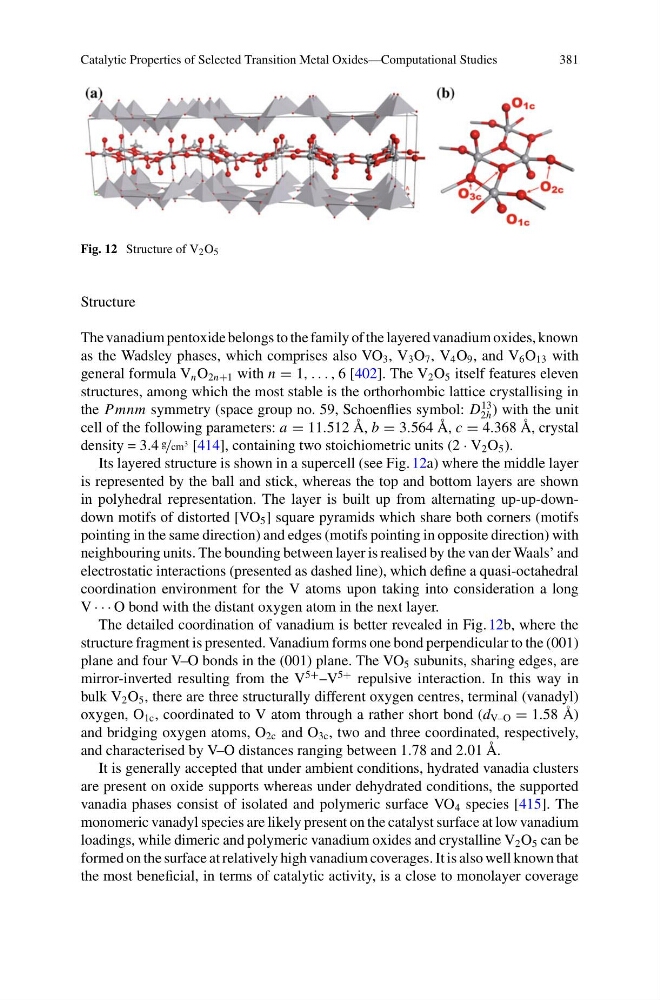
Fig. 12 Structure of V 2 O 5
Structure
The vanadium pentoxide belongs to the family of the layered vanadium oxides, known
as the Wadsley phases, which comprises also VO 3 , V 3 O 7 , V 4 O 9 , and V 6 O 13 with
general formula V n O 2n+1 with n = 1, . . . , 6 [402]. The V 2 O 5 itself features eleven
structures, among which the most stable is the orthorhombic lattice crystallising in
the Pmnm symmetry (space group no. 59, Schoenflies symbol: D
13
2h ) with the unit
cell of the following parameters: a = 11.512 Å, b = 3.564 Å, c = 4.368 Å, crystal
density = 3.4 g /cm
3 [414], containing two stoichiometric units (2 · V 2 O 5 ).
Its layered structure is shown in a supercell (see Fig. 12a) where the middle layer
is represented by the ball and stick, whereas the top and bottom layers are shown
in polyhedral representation. The layer is built up from alternating up-up-downdown motifs of distorted [VO 5 ] square pyramids which share both corners (motifs
pointing in the same direction) and edges (motifs pointing in opposite direction) with
neighbouring units. The bounding between layer is realised by the van der Waals’ and
electrostatic interactions (presented as dashed line), which define a quasi-octahedral
coordination environment for the V atoms upon taking into consideration a long
V · · · O bond with the distant oxygen atom in the next layer.
The detailed coordination of vanadium is better revealed in Fig. 12b, where the
structure fragment is presented. Vanadium forms one bond perpendicular to the (001)
plane and four V–O bonds in the (001) plane. The VO 5 subunits, sharing edges, are
mirror-inverted resulting from the V
5+ –V
5+ repulsive interaction. In this way in
bulk V 2 O 5 , there are three structurally different oxygen centres, terminal (vanadyl)
oxygen, O 1c , coordinated to V atom through a rather short bond (d V–O = 1.58 Å)
and bridging oxygen atoms, O 2c and O 3c , two and three coordinated, respectively,
and characterised by V–O distances ranging between 1.78 and 2.01 Å.
It is generally accepted that under ambient conditions, hydrated vanadia clusters
are present on oxide supports whereas under dehydrated conditions, the supported
vanadia phases consist of isolated and polymeric surface VO 4 species [415]. The
monomeric vanadyl species are likely present on the catalyst surface at low vanadium
loadings, while dimeric and polymeric vanadium oxides and crystalline V 2 O 5 can be
formed on the surface at relatively high vanadium coverages. It is also well known that
the most beneficial, in terms of catalytic activity, is a close to monolayer coverage
381
Fig. 12 Structure of V 2 O 5
Structure
The vanadium pentoxide belongs to the family of the layered vanadium oxides, known
as the Wadsley phases, which comprises also VO 3 , V 3 O 7 , V 4 O 9 , and V 6 O 13 with
general formula V n O 2n+1 with n = 1, . . . , 6 [402]. The V 2 O 5 itself features eleven
structures, among which the most stable is the orthorhombic lattice crystallising in
the Pmnm symmetry (space group no. 59, Schoenflies symbol: D
13
2h ) with the unit
cell of the following parameters: a = 11.512 Å, b = 3.564 Å, c = 4.368 Å, crystal
density = 3.4 g /cm
3 [414], containing two stoichiometric units (2 · V 2 O 5 ).
Its layered structure is shown in a supercell (see Fig. 12a) where the middle layer
is represented by the ball and stick, whereas the top and bottom layers are shown
in polyhedral representation. The layer is built up from alternating up-up-downdown motifs of distorted [VO 5 ] square pyramids which share both corners (motifs
pointing in the same direction) and edges (motifs pointing in opposite direction) with
neighbouring units. The bounding between layer is realised by the van der Waals’ and
electrostatic interactions (presented as dashed line), which define a quasi-octahedral
coordination environment for the V atoms upon taking into consideration a long
V · · · O bond with the distant oxygen atom in the next layer.
The detailed coordination of vanadium is better revealed in Fig. 12b, where the
structure fragment is presented. Vanadium forms one bond perpendicular to the (001)
plane and four V–O bonds in the (001) plane. The VO 5 subunits, sharing edges, are
mirror-inverted resulting from the V
5+ –V
5+ repulsive interaction. In this way in
bulk V 2 O 5 , there are three structurally different oxygen centres, terminal (vanadyl)
oxygen, O 1c , coordinated to V atom through a rather short bond (d V–O = 1.58 Å)
and bridging oxygen atoms, O 2c and O 3c , two and three coordinated, respectively,
and characterised by V–O distances ranging between 1.78 and 2.01 Å.
It is generally accepted that under ambient conditions, hydrated vanadia clusters
are present on oxide supports whereas under dehydrated conditions, the supported
vanadia phases consist of isolated and polymeric surface VO 4 species [415]. The
monomeric vanadyl species are likely present on the catalyst surface at low vanadium
loadings, while dimeric and polymeric vanadium oxides and crystalline V 2 O 5 can be
formed on the surface at relatively high vanadium coverages. It is also well known that
the most beneficial, in terms of catalytic activity, is a close to monolayer coverage